Monday, October 5, 2015

Pray the Rosary in October

Michael Dubruiel conceived and put together the small hardbound book, Praying the Rosary.  Click on the cover for more information.

"Michael Dubruiel"


The Gospels show that the gaze of Mary varied depending upon the circumstances of life. So it will be with us. Each time we pick up the holy beads to recite the Rosary, our gaze at the mystery of Christ will differ depending on where we find ourselves at that moment.

Thereafter Mary’s gaze, ever filled with adoration and wonder, would never leave him. At times it would be a questioning look, as in the episode of the finding in the Temple: “Son, why have you treated us so?” (Lk 2:48); it would always be a penetrating gaze, one capable of deeply understanding Jesus, even to the point of perceiving his hidden feelings and anticipating his decisions, as at Cana (cf. Jn 2:5). At other times it would be a look of sorrow, especially beneath the Cross, where her vision would still be that of mother giving birth, for Mary not only shared the passion and death of her Son, she also received the new son given to her in the beloved disciple (cf. Jn 19:26-27). On the morning of Easter hers would be a gaze radiant with the joy of the Resurrection, and finally, on the day of Pentecost, a gaze afire with the outpouring of the Spirit (cf. Acts 1:14) [Rosarium Virginis Mariae, no. 10].


As we pray the Rosary, then, we join with Mary in contemplating Christ. With her, we remember Christ, we proclaim Him, we learn from Him, and, most importantly, as we raise our voices in prayer and our hearts in contemplation of the holy mysteries, this “compendium of the Gospel” itself, we are conformed to Him.


Thursday, October 1, 2015

October is Rosary Month

Michael Dubruiel conceived and put together the small hardbound book, Praying the Rosary.  Click on the cover for more information.

"Michael Dubruiel"


The Gospels show that the gaze of Mary varied depending upon the circumstances of life. So it will be with us. Each time we pick up the holy beads to recite the Rosary, our gaze at the mystery of Christ will differ depending on where we find ourselves at that moment.

Thereafter Mary’s gaze, ever filled with adoration and wonder, would never leave him. At times it would be a questioning look, as in the episode of the finding in the Temple: “Son, why have you treated us so?” (Lk 2:48); it would always be a penetrating gaze, one capable of deeply understanding Jesus, even to the point of perceiving his hidden feelings and anticipating his decisions, as at Cana (cf. Jn 2:5). At other times it would be a look of sorrow, especially beneath the Cross, where her vision would still be that of mother giving birth, for Mary not only shared the passion and death of her Son, she also received the new son given to her in the beloved disciple (cf. Jn 19:26-27). On the morning of Easter hers would be a gaze radiant with the joy of the Resurrection, and finally, on the day of Pentecost, a gaze afire with the outpouring of the Spirit (cf. Acts 1:14) [Rosarium Virginis Mariae, no. 10].


As we pray the Rosary, then, we join with Mary in contemplating Christ. With her, we remember Christ, we proclaim Him, we learn from Him, and, most importantly, as we raise our voices in prayer and our hearts in contemplation of the holy mysteries, this “compendium of the Gospel” itself, we are conformed to Him.

October is Rosary Month

Michael Dubruiel conceived and put together the small hardbound book, Praying the Rosary.  Click on the cover for more information.

"Michael Dubruiel"


The Gospels show that the gaze of Mary varied depending upon the circumstances of life. So it will be with us. Each time we pick up the holy beads to recite the Rosary, our gaze at the mystery of Christ will differ depending on where we find ourselves at that moment.

Thereafter Mary’s gaze, ever filled with adoration and wonder, would never leave him. At times it would be a questioning look, as in the episode of the finding in the Temple: “Son, why have you treated us so?” (Lk 2:48); it would always be a penetrating gaze, one capable of deeply understanding Jesus, even to the point of perceiving his hidden feelings and anticipating his decisions, as at Cana (cf. Jn 2:5). At other times it would be a look of sorrow, especially beneath the Cross, where her vision would still be that of mother giving birth, for Mary not only shared the passion and death of her Son, she also received the new son given to her in the beloved disciple (cf. Jn 19:26-27). On the morning of Easter hers would be a gaze radiant with the joy of the Resurrection, and finally, on the day of Pentecost, a gaze afire with the outpouring of the Spirit (cf. Acts 1:14) [Rosarium Virginis Mariae, no. 10].


As we pray the Rosary, then, we join with Mary in contemplating Christ. With her, we remember Christ, we proclaim Him, we learn from Him, and, most importantly, as we raise our voices in prayer and our hearts in contemplation of the holy mysteries, this “compendium of the Gospel” itself, we are conformed to Him.


Wednesday, September 30, 2015

St. Therese on humility

This is a continuation of the 73 Steps to Spiritual Communion with God. The previous posts are below and in the archives to the right. This is the 31th step:


(31) To love one's enemies (cf Mt 5:44; Lk 6:27).


Of course, St. Benedict is merely giving us the teaching of the Gospel here, but it helps to have it isolated for our reflection and to internalize the meaning of loving the very ones who seek to harm us or those who we feel are out to get us.


I have heard this same injunction given by people advocating the practice of Eastern religions or self-help gurus to adoring listeners who would scowl if they were hearing it from a Christian pulpit. They say our "enemies" are our best teachers.


Either way whether we should just love our enemies because they are our brothers and sisters or if we should love them because they can aid us on our endless egotistic search to really "know" ourselves--there seems to be universal wisdom (as everything that Christ taught proves in the end to be) to the maxim.


When we view people as enemies we drink in their hatred, their warped vision and sometimes we merely inflate our own warped vision on people that would be shocked to find out that they were even considered enemies by us.


St. Therese of the Child Jesus has something to teach us here. There was a particular sister in her community who got on her nerves. She went out of her way to be even nicer to this sister, so that the sister after Therese death was convinced that she was one of Therese's most loved companions. In the end she really was--after all what is love if it isn't putting to death our false self that is threatened and insecure?

Feast of St. Therese of the Child Jesus


Although not formally celebrated today, because it is a Sunday.
Therese imagined that in the spiritual life we are all like infants at the foot of the stairs being summoned by our Heavenly Father to climb the heights--which try as we might we cannot do. Finally the Heavenly Father will come down the stairs and pick us up and carry us up the stairs. Which of course is a beautiful child like summary of what the Trinity has done in the incarnation of Jesus.
Are you and I trying to climb the stairs? Is our Faith in Him? Abandon yourself to the God as a child abandons oneself to their parents.
St. Therese, pray for us!

Year of Mercy

Christians are to be forgiving and merciful; we are to live out the
unity Christ died to restore. In the early church, outsiders marveled
at the followers of Christ because of their love for one another.
Sadly, the unity that was the hallmark of the early Church
has been damaged, in some cases seemingly beyond repair. We
who are called to be “merciful” stand idly by while our brothers
and sisters in other parts of the world are offered up as scapegoats.
We who are to share the Good News huddle among our own,
contented to preach to the choir. The problem is this: Jesus died
for all, so that all might be saved. We who follow Our Lord must
live to accomplish his will.

As St. Peter points out, Jesus himself is our example. The
treatment that Jesus received on the cross was worse than most
of us can even imagine but his message of forgiveness did not
change. When Jesus rose from the dead, he did not declare a holy
war against those who had put him to death. Instead he proclaimed,
“Peace,” and sent his followers to the ends of the earth
to preach the gospel, teaching all to believe and trust in him.


"michael dubruiel"

Tuesday, September 29, 2015

Novena to St. Therese continues

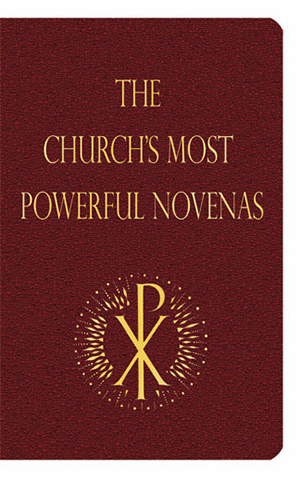
 Novena to St. Therese continues.  It's included in this pocket-sized book.


When Jesus ascended into heaven, he told his Apostles to stay where they were and to "wait for the gift" that the Father had promised: the Holy Spirit.  The Apostles did as the Lord commanded them. "They all joined together constantly in prayer, along with the women and Mary the mother of Jesus, and with his brothers" (Acts 1:14). Nine days passed; then, they received the gift of the Holy spirit, as had been promised. May we stay together with the church, awaiting in faith with Our Blessed Mother, as we trust entirely in God, who loves us more than we can ever know. 

"michael Dubruiel"