Wednesday, August 16, 2006

Cardinal Arinze on Liturgical Dance

While doing research, I came across this and found it very enjoyable...

From Adoremus:

Now, some priests and lay people think that Mass is never complete without dance. The difficulty is this: we come to Mass primarily to adore God -- what we call the vertical dimension. We do not come to Mass to entertain one another. That's not the purpose of Mass. The parish hall is for that.

So all those that want to entertain us -- after Mass, let us go to the parish hall and then you can dance. And then we clap. But when we come to Mass we don't come to clap. We don't come to watch people, to admire people. We want to adore God, to thank Him, to ask Him pardon for our sins, and to ask Him for what we need.

Don't misunderstand me, because when I said this at one place somebody said to me: "you are an African bishop. You Africans are always dancing. Why do you say we don't dance?"

A moment -- we Africans are not always dancing!

Moreover, there is a difference between those who come in procession at Offertory; they bring their gifts, with joy. There is a movement of the body right and left. They bring their gifts to God. That is good, really. And some of the choir, they sing. They have a little bit of movement. Nobody is going to condemn that. And when you are going out again, a little movement, it's all right.

But when you introduce wholesale, say, a ballerina, then I want to ask you what is it all about. What exactly are you arranging? When the people finish dancing in the Mass and then when the dance group finishes and people clap -- don't you see what it means? It means we have enjoyed it. We come for enjoyment. Repeat. So, there is something wrong. Whenever the people clap -- there is something wrong -- immediately. When they clap -- a dance is done and they clap.

It is possible that there could be a dance that is so exquisite that it raises people's minds to God, and they are praying and adoring God and when the dance is finished they are still wrapped up in prayer. But is that the type of dance you have seen? You see. It is not easy.

Most dances that are staged during Mass should have been done in the parish hall. And some of them are not even suitable for the parish hall.

I saw in one place -- I will not tell you where -- where they staged a dance during Mass, and that dance was offensive. It broke the rules of moral theology and modesty. Those who arranged it -- they should have had their heads washed with a bucket of holy water!

Why make the people of God suffer so much? Haven't we enough problems already? Only Sunday, one hour, they come to adore God. And you bring a dance! Are you so poor you have nothing else to bring us? Shame on you! That's how I feel about it.

Somebody can say, "but the pope visited this county and the people danced". A moment: Did the pope arrange it? Poor Holy Father -- he comes, the people arranged. He does not know what they arranged. And somebody introduces something funny -- is the pope responsible for that? Does that mean it is now approved? Did they put in on the table of the Congregation for Divine Worship? We would throw it out! If people want to dance, they know where to go.

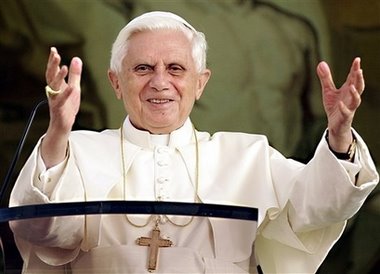
Pope's General Audience


From Asia News Italy:

“Today,” he explained, “there are those who live as if they were never to die or as if all should end with death. Some act as if humankind was master of its own destiny, as if God did not exist, going so far as to deny Him any place in our world. The great advances in science and technology, which have much improved humanity’s conditions, leave unanswered the innermost questions of the human soul. Only by opening up to the mystery of God, which is Love, can our heart’s thirst for truth and happiness be quenched. Only a point of view based on eternity can give historical events, especially the mystery of human frailty, suffering and death, real value”.

“By contemplating Mary in her celestial glory,” the Pontiff said in conclusion, “we understand that the earth is not our final homeland, that if we live constantly focused on that which is eternal, we can share one day that same glory. For this reason, despite our many daily challenges, we must not lose our serenity and peace. The luminous sign of the Assumption of our Lady in the heavens glows brighter than the sad shadows cast by sorrow and violence. We are certain that from high above Mary follows our steps with sweet trepidation. She brightens our life in its dark and stormy hours and reassures us with her maternal hand. Conscious of this, we continue confident along our path shaped by our Christian commitment wherever Providence takes us”.

Tuesday, August 15, 2006

To Mary Queen of Peace

The Pope entrusts the violent world...

From Solemnity of the Assumption of the Blessed Virgin Mary's Angelus:

“Mary encourages us not to lose faith in the face of the difficulties and
inevitable problems of daily life,” continued Benedict XVI. “She assures us of
her help and reminds us that the essential thing is to seek and to think ‘of
things that are above, not of things that are on earth’ (cfr Col 3:2).
Taken up with daily worries, we run the risk of maintaining that it is here, in
this world where we are only passing through, that the ultimate scope of human
existence lies. However Paradise is the true goal of our earthly pilgrimage. How
different our days would be if they were animated by this perspective! This is
how it was for the saints. Their existence testifies how, when one lives with
one’s heart constantly turned towards heaven, earthly realities are experienced
according to their proper value because they are illuminated by the eternal
truth of divine love.”

New Blog from an Old Blogger

Jesus Christ is Lord by Martin Farkus

Monday, August 14, 2006

The Cross in the Sand

From Pennsacola News Journal:

But the cross on Pensacola Beach by Fort Pickens Road symbolizes the birth of the United States' first European settlement.

Emerging from the white sand dunes, the universal Christian symbol commemorates Spanish Conquistador Don Tristan de Luna's first Mass when he landed on Santa Rosa Island on Aug. 15, 1559.

On the same day 447 years later, religious and community leaders plan to surround the symbol at a 6 p.m. ceremony. They encourage the public to sink their toes into this event as well.

"We're rededicating the sign that identifies the cross," said Joe Barron, member of the Knights of Columbus, De Luna Assembly, the group responsible for erecting the memorial in 1954. "We'll be there with a color guard."

While the cross survived Hurricane Ivan in 2004, the sign that identified it did not. The Roman Catholic fraternal organization has remade the sign.

Bishop John H. Ricard of the Diocese of Pensacola-Tallahassee will lead the rededication at the cross on Fort Pickens Road.

Sunday, August 13, 2006

No Greater Love Than This...

Jonathan Daniels remembered in Alabama From the Montgomery Advertiser:

Episcopalians from across the country gathered in Hayneville on Saturday to honor the memory of a seminary student who gave his life to protect a young black girl during the height of the civil rights movement.

His name was Jonathan Daniels and the fateful step he took that hot August day 46 years ago is memorialized every year in this Lowndes County town.

Named a martyr within the Episcopal Church, Daniels has become the focal point of a movement that claimed several lives in 1965 and eventually led to passage of the Voting Rights Act.


Daniels grew up in the small city where I was born. Amy and I visited Hayneville some years ago specifically to see where this had happened--the place looked frozen in history. Read Outside Agitator for the story.

Pope Gives Advice on How to Vacation

From Asia News Italy:

The pope did not fall short of giving some advice about how to utilize vacation time, an opportunity for “cultural meetings, for prolonged moments of prayer and contemplation in contact with nature or in monasteries or religious structures. Having more free time means one can dedicate oneself with greater ease to dialogue with God, to meditation of the Sacred Scripture and to reading some useful formative book. Who undergoes this experience of repose of the spirit knows how useful it is not to reduce the holidays merely to fun and enjoyment.”

Holidays are also a time to “spend more time with relatives, to rediscover family and friends” and to “nourish ourselves with the Eucharist”. The pope said: “The faithful participation in the Sunday Eucharistic celebration helps us... to feel an active part of the ecclesial community, even when one is away from one’s parish. Wherever we find ourselves, we always need to nourish ourselves with the Eucharist. We are reminded of this by the gospel pages this Sunday, which present Jesus as the Bread of Life. He himself, according to the evangelist John, proclaims that he is the ‘living bread from heaven’ (cfr Jn 6:31), the bread that nourishes our faith and feeds communion among all Christians.”