Showing posts with label Amy Welborn. Show all posts

Tuesday, March 31, 2026

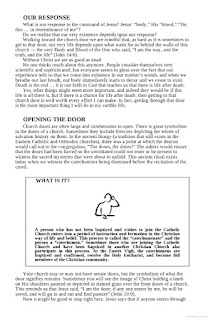
Confession during Holy Week

       For a brief, pointed and helpful guide,


Beneath the changes in discipline and celebration that this sacrament has undergone over the centuries, the same fundamental structure is to be discerned. It comprises two equally essential elements: on the one hand, the acts of the man who undergoes conversion through the action of the Holy Spirit: namely, contrition, confession, and satisfaction; on the other, God's action through the intervention of the Church. The Church, who through the bishop and his priests forgives sins in the name of Jesus Christ and determines the manner of satisfaction, also prays for the sinner and does penance with him. Thus the sinner is healed and re-established in ecclesial communion.

Monday, March 30, 2026

Tuesday of Holy Week


Taking Up Our Cross. . . In Abandonment


 Let us then cast off the works of darkness and put on the armor of light; let us conduct ourselves becomingly as in the day, not in reveling and drunkenness, not in debauchery and licentiousness, not in quarreling and jealousy. But put on the Lord Jesus Christ, and make no provision for the flesh, to gratify its desires. ROMANS 13:12–14

 “Go into the village opposite you, and immediately as you enter it you will find a colt tied, on which no one ever sat; untie it and bring it. If any one says to you ‘Why are you doing this?’ say, ‘The Lord has need of it and will send it back here immediately.’” MARK 11:2–3 

A young Israeli whose family immigrated to Brazil was studying to be a rabbi. The rabbinical school happened to be near a Benedictine monastery, where one day the young man heard the monks chanting the Hebrew psalms. Fascinated, he ventured closer. Wanting to learn more about the men who prayed the psalms so beautifully, one day the Jewish man introduced himself to one of the monks. As their conversation deepened, the monk told the young man of Jesus, the Messiah. Some months later, the student was in Rio de Janeiro when, passing by a large Catholic church, he was drawn to step inside. He walked in and made his way to the front of the sanctuary, where there hung a larger-than-life crucifix. Standing in front of the cross, he said aloud to the crucified Christ, “Tell me if it is true. Are you the Messiah?"

When he told me the story and I asked him what happened, the young Catholic priest replied, “I’m here.”

His family had disowned him, but he remained strong in his belief and trust in Jesus, who had answered him from that cross.

Most of us who were raised in Catholic households may not appreciate the price of believing. We take it for granted. When I read the stories of converts, I am moved at the distance some will travel in order to come to Christ.

The early church fathers, always seeking the fuller sense of Scripture, thought that the colt “on which no one ever sat” represented the Gentiles who had not had the Word of God preached to them. By mounting the colt that the apostles brought to him, the fathers saw Jesus as symbolically inviting the Gentiles to take on his yoke. Abandoning ourselves to Christ requires something more than throwing off our cloaks and cutting palm branches. It involves “drinking from the chalice that he will drink and undergoing the baptism that he will undergo.” This can lead to a radical redirection in our lives.

Going Wherever He Leads Us


 In the case of my friend, abandoning himself to Christ involved the rejection of his family—as Christ had prophesied would happen to those who followed him (see Mark 13:12–13). For many of us this won’t be the case. However, when we truly open our hearts to the cross of Christ and plead, “Tell me if it is true. Are you the Messiah?” we can be sure he will answer us. I recently worked with fourteen women converts to put together a book, The Catholic Mystique, in which each recounted her entrance into the Catholic Church from other  Christian traditions. Each story entailed Christ pulling them along the path he had chosen for them. What is remarkable about their stories is the abandonment to Christ they share in common. Some of the women were ordained priests or ministers in the churches they had left in order to become Catholic. Many had left behind families and friends, just as my Jewish friend had done.

The person who is truly abandoned to Christ, goes where the Lord calls him or her to go—even if it is “where they would not go.” In a recent interview, British journalist John Bishop asked Father Benedict Groeschel about his future plans for the thriving community of the Franciscan Friars of the Renewal, which Father Benedict had co-founded. Father kept insisting that he had no plans except to be led. When Bishop pressed him, the friar answered all the more insistently, “No plans, just be led.” No one knows what the future holds. Abandoning oneself to the cross of Christ, one does not try to impose “my will” against “God’s will”; rather, one prays daily, “God’s will be done.”

 Lord, Save Us!

 When the Lord entered Jerusalem on Palm Sunday, he was greeted as the Messiah. On Good Friday, the same crowd offered him up as the sacrificial lamb. We tend to interpret this as the crowd turning on Jesus, and indeed from a worldly perspective that is what seems to have taken place. We can relate to this fickle response. But if we look at what happened to Jesus, we’ll see God’s mysterious plan being enacted. “Hosanna!” the people cried as Jesus entered the city. This is one of the few words in Scripture that is not translated into English (like Alleluia; Amen; and talitha, koum). How does “Hosanna” translate into English? In most English translations of Psalm 118:25, this word is translated “Save us!” It seems that it may have been this psalm that the people of Jerusalem were proclaiming as Jesus entered the city: “Save us, we beseech thee, O LORD! O LORD, we beseech thee, give us success! Blessed be he who enters in the name of the LORD! We bless you from the house of the LORD. The LORD is God, and he has given us light. Bind the festal procession with branches, up to the horns of the altar!” (Psalm 118:25–27). They were crying out to be saved by God and his Christ. Ironically, a few days later they cried out, “Crucify him,” bringing about that very act of salvation. At times we lose sight of how this mirrors the actions of their ancestors, the patriarchs of the original twelve tribes, who sold one of their brothers into slavery—and God used that act of treachery for his own end. Thus at the end of Genesis we hear Joseph proclaim, “As for you, you meant evil against me; but God meant if for good, to bring it about that many people should be kept alive, as they are today”(Genesis 50:20). St. Paul tells us that we are to “cast off the works of darkness and put on the armor of light”—we are to conduct ourselves as people of light. Too often people try to escape or reject their cross; they flee to the darkness, escape in alcohol or sex, or immerse themselves in anger, all because things have not gone their way. Without the grace of God, this is our fate as well. Yet when we are handed a cross, if we abandon ourselves and trust in God as Christ did, what seems like defeat is in fact a victory! The evil that is done to us, God can mold into good. Then we can sing Hosanna to God in the highest, because the light of God will live in us and we will see everything in his light.


The Power of the Cross  by Michael Dubruiel is a book well-suited to daily reading during Lent. The book is available here in pdf version. Daily excerpts will be reprinted in this space during Lent.


"michael Dubruiel"

Sunday, March 29, 2026

Monday of Holy Week


Taking Up Our Cross. . . In Reverence 


Therefore let us be grateful for receiving a kingdom that cannot be shaken, and thus let us offer to God acceptable worship, with reverence and awe; for our God is a consuming fire. HEBREWS 12:28–29

 Jesus said, “Let her alone, let her keep it for the day of my burial. The poor you always have with you, but you do not always have me.” JOHN 12: 7–8 


My three-year-old son has a tendency to be unruly at Mass. He seems to enjoy the power he can exercise over us in a crowded church. On one of his recent outbursts I took him to the back of the enormous cathedral, where, moments later, I felt for the first time that the Holy Spirit might have prompted his behavior. Had he not been acting up and had I not brought him to the back of the church, I would not have encountered two powerful images.

 First I noticed the bishop, clad in red vestments, his hands extended in the orans position. It was the image of Christ on the cross. Now, I have been attending Mass all of my life and I know that the priest represents Christ, but I had never seen this as clearly as I saw it at that moment. There was something about the vestments and the outstretched arms that said to me, “This is Christ!”

 A little farther back, I noticed something else: a young woman prostrate in the aisle of the church, her forehead touching the floor in adoration. To be honest, my first reaction was one of protest. I’ve been educated in Church circles, and know all about “correct” posture and behavior during Mass. I am also well acquainted with the “Judas game” some well-educated Catholics play at Mass, in which individual acts of worship are criticized for form rather than praised for intent. Instead of worshipping Jesus like Mary of Bethany, who reverently poured out expensive nard upon the Lord’s feet and dried them with her hair; they resemble Judas, who chastised Mary for not selling the ointment and giving the proceeds to the poor.

As I continued to watch the young woman’s prayerful prostration in the cathedral that day, it struck me that what the young woman was doing—whatever her motivation—was beautiful. In a certain sense, it was even prophetic, for it drew me back to what I was doing. In my heart I thanked her for her witness. Both the bishop and the woman in prayer made it possible for me to participate as fully as possible in the Mass that day, holding my son and offering myself with Christ to the Father in my own poor way.


--an excerpt from  The Power of the Cross by Michael Dubruiel is a book well-suited to daily reading during Lent. 


"michael Dubruiel"

Saturday, March 28, 2026

Palm Sunday


The Cross of Christ Restores. . . Obedience 


-Michael Dubruiel

And by this we may be sure that we know him, if we keep his commandments. He who says, “I know him,” but disobeys his commandments is a liar, and the truth is not in him; but whoever keeps his word, in him truly love for God is perfected. By this we may be sure that we are in him: he who says he abides in him ought to walk in the same way in which he walked. 1 JOHN 2:3–6 

Truly, truly, I say to you, if any one keeps my word, he will never see death. JOHN 8:51 


“Keep His Word” 

Jesus teaches us that we have to keep his word. Of course, this is the cross for many of us. We’d rather go our own way than follow the way of Jesus, if it didn’t mean having to face the horror of death without hope. When Jesus says that those who keep his word will never “see death,” what does he mean? I studied this passage for several hours. I found that this passage was translated differently in the Vulgate to include the word “forever,” so that the intended meaning would be that the person would still die but not forever. Many commentators simply ignore it. Death is referred to in only one other place in the New Testament, in the Gospel of Luke, where Simeon had been told that he would not “see death” until he had seen the “Lord’s Christ,” or God’s Messiah. Holding the infant Jesus in his arms, Simeon prayed, “Lord, now let thy servant depart in peace, according to they word; for mine eyes have seen salvation, which thou hast prepared in the presence of all peoples, a light for revelation to the Gentiles, and for the glory of thy people Israel” (Luke 2:29–32).

 In the Scriptures, death was portrayed as an angel—and not necessarily a good angel. Remember, death entered the world because of sin, and resulted in separation from God. The angel of death passed over the Israelites to take the Egyptian firstborn when Pharaoh rejected God. So, what was Jesus saying? The most satisfying commentaries interpret the words of Jesus to mean that those who are obedient to the will of God, as revealed through Jesus’ teaching, will never see this angel of death; rather, when their earthly life ends, they will be greeted by the Lord and brought into eternal life. Obedience leads to acceptance into the kingdom; disobedience leads to expulsion from paradise. The secret to obedience is given to us in John’s Gospel, when Jesus teaches that he is the vine and we are the branches. Our life depends upon remaining part of him—which we do by being obedient to his commands and partaking in his Body and Blood offered in the Eucharist. John in his letter says that we can tell if we are “abiding” in Christ by our actions: Are they Christ-like? The power to be like Christ, of course, comes from dying to ourselves and allowing Christ to live within us. This requires more than simply listening to or parroting the words of Christ; this requires a complete abandonment to him. Every day the official prayer of the Church begins the same way, by praying Psalm 95: “Come, let us worship the Lord,” echoes the refrain, inviting us to see our Savior, our Creator, the God to whom we belong. With the invitation comes a warning: “If today you hear his voice, harden not your hearts.”

--an excerpt from  The Power of the Cross by Michael Dubruiel is a book well-suited to daily reading during Lent. 


"michael Dubruiel"

Friday, March 27, 2026

Holy Week for Children


And then the Loyola Kids Book of Bible Stories.

Remember, those stories are arranged in sections according to the liturgical season in which one would normally hear that particular Scripture narrative. So, these are in the “Lent” section. Each story is retold, and then at the end of each story, I link the Scripture to some aspect of Catholic faith or practice, and provide a thought question and a brief prayer. One of those pages can be seen in the gallery below.


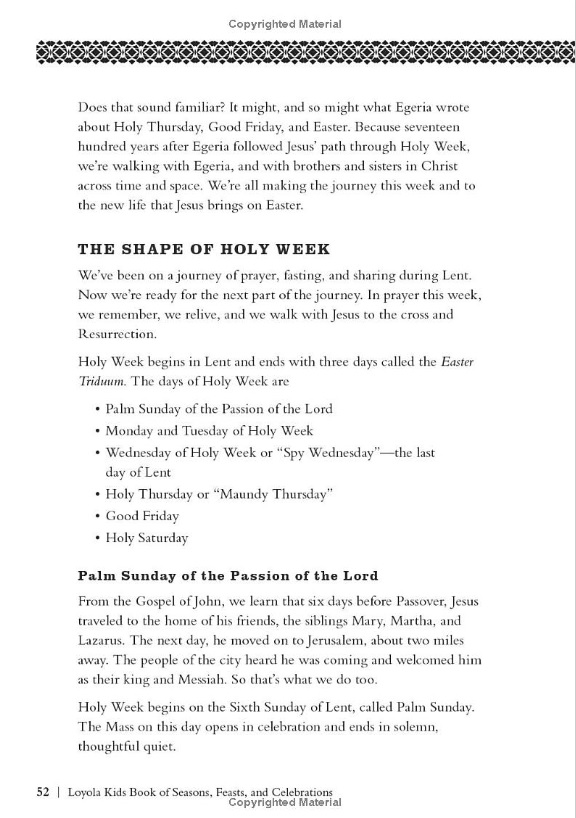
Finally, the Loyola Kids Book of Seasons, Feasts and CelebrationsOrganized in an obvious way! Here’s just one page from the Holy Week section.

v

Friday Stations of the Cross

      You can get John Paul II's Biblical Way of the Cross by Michael Dubruiel and Amy Welborn here.  


In 1991, Pope John Paul II introduced a new Bible-based interpretation of the Stations of the Cross. This devotional guide invites readers to prayerfully walk in solidarity with Jesus on his agonizing way of the cross—from his last torturous moments in the Garden of Gethsemane to his death and burial.

Now with full-color station images from previously unpublished paintings by Michael O'Brien, this booklet creates an ideal resource for individual or group devotional use, particularly during the Lenten season.


-Michael Dubruiel


"michael Dubruiel"

Tuesday, March 24, 2026

Michael Dubruiel Daily Lenten Meditation


The Cross of Christ Illumines. . . The Way to True Unity 


Therefore be imitators of God, as beloved children. And walk in love, as Christ loved us and gave himself up for us, a fragrant offering and sacrifice to God. EPHESIANS 5:1–2 

So there was a division among the people over him. Some of them wanted to arrest him, but no one laid hands on him. JOHN 7:43–44 

One of the most remarkable American Catholics of the last century was a humble Capuchin friar whose name in religion was Father Solanus Casey. Solanus served as a friar in Detroit, in New York, and in his final years in the town of Huntington, Indiana. Born of Irish parents, Solanus did not fare well in the seminary, where he was taught by German-speaking priests in Latin, so while he was ordained a priest, he was never allowed to preach a doctrinal homily or to hear confessions. Yet God gave Solanus the gift of healing, and people sought him out from all over. When he died in 1957, those who knew him regarded him as a saint. He now is recognized as a Venerable, the last step before being beatified by the Church.

Solanus was the community’s porter, the doorkeeper. Today we would call him a receptionist, someone who would greet visitors who came to the friary seeking prayers or material comfort.  Solanus did his job so well that people lined up to have a few moments of his counsel. People of all faiths would come to him requesting prayers and healings. What Solanus would ask of these seekers was rather unique. He told them to “thank God ahead of time”—in other words, to step out in faith, before any miracle had happened; to act before God as though it already had happened. The way that he normally asked people to express this thanks to God was for them to sign up to have Masses said by the Capuchin mission society, whether they were Catholic or not. Mass is the perfect “thanksgiving,” so it made sense to Solanus that if one were to thank God ahead of time, having Mass said was the perfect way to do this. People continue to seek Solanus’s intercession to this day, and they continue to “thank God ahead of time,” with remarkable results.


--an excerpt from  The Power of the Cross by Michael Dubruiel is a book well-suited to daily reading during Lent. 


"michael Dubruiel"

Monday, March 23, 2026

Michael Dubruiel Daily Lenten Meditation


The Cross of Christ Transforms. . . Our Priorities


 In this is love, not that we loved God but that he loved us and sent his Son to be the expiation for our sins. Beloved, if God so loved us, we also ought to love one another. No man has ever seen God; if we love one another, God abides in us and his love is perfected in us. 1 JOHN 4:10–12 

And the scribe said to him, “You are right, Teacher; you have truly said that he is one, and there is no other but he; and to love him with all the heart, and with all the understanding, and with all the strength, and to love one’s neighbor as oneself, is much more than all the burnt offerings and sacrifices.” And when Jesus saw that he answered wisely, he said to him, “You are not far from the kingdom of God.” MARK 12:32–34 

A young girl dying of cancer befriended a famous archbishop. The bishop had a soft spot in his heart for children like her; his own niece had been diagnosed and he knew firsthand the agony both the patient and her parents faced. The archbishop had extended a standing invitation to the Protestant chaplain of the children’s hospital: If any Catholic child in the cancer ward wanted to see a priest, he should be summoned. So it happened that the archbishop was called to accompany this young cancer patient, Lorraine, in her last months of life. In time Lorraine came to trust the archbishop, and she shared with him her greatest trial. Her parents were angry with God because of her illness. She had been diagnosed when she was five years old, and had not yet made her First Communion. Would it be possible, she asked her friend, to receive the Eucharist before she died? After consulting with the parents, the archbishop prepared her personally for her first reconciliation, then celebrated Mass in her hospital room, confirming her and giving her First Communion. She lived only a short while longer. The archbishop said she had great faith but her constant worry was her parents. No doubt she was now interceding for them, that they might come to know the love that she had experienced in her suffering, that same suffering that had become an obstacle of faith to them.

This is the obstacle of the cross—when Our Lord died on the cross, some left believing that he was the Son of God, others left in utter disbelief. Yet the Scriptures tell us that Jesus’ death on the cross was a sign of God’s love.

--an excerpt from  The Power of the Cross by Michael Dubruiel is a book well-suited to daily reading during Lent. 


"michael Dubruiel"

Sunday, May 25, 2025

What is the Catholic Mass?


From How to Get the Most Out of the Eucharist by Michael Dubruiel

About Michael Dubruiel


"michael dubruiel"


From Chapter 3 - Adore. Part 5

LE S S O N S LE A R N ED F RO M A H REE -Y E A R -O L D

My son Joseph walked into the room while I was putting together the material for this chapter. When he walked in I was having a difficult time coming up with a good illustration for what “living in thanksgiving” means in the concrete and I wasn’t thankful that he was bothering me. Then it struck me that the point of living in thanksgiving is simply that what I might otherwise perceive as an interruption becomes an intervention, once I adore God above all things.


God had sent Joseph into my room. This hit me when I sent him away and he said “Thank you,” as he went off. For a period of his young life he had the habit of saying “thank you,” not after he had been given something that he was appreciative of but rather 
when he had been told to do something, I think he thought that “thank you”meant “okay.”Yet this is exactly what living in thanksgiving is, saying “thank you” to whatever God presents to us in the daily events of our lives.


“ L I V I N G I N H A N K S G I V I N G 


Living in thanksgiving literally means always having gratitude on your lips.


The late great Orthodox liturgist Alexander Schmemann felt that the meaning of “thanksgiving”— the literal translation of the Greek word Eucharist — had been lost on modern people. We tend to limit giving thanks to only those things that we receive that we perceive as good.Yet Schmemann argues that for the early church “giving thanks” was something the Christian did because the Kingdom of God had been restored in Jesus Christ.


Our very inclusion in Christ is reason enough to give thanks; the fact that God has spoken to us in the Word is another reason to give thanks; the fact that Christ has saved us and shares his Body and Blood with us is another reason to give thanks; and the fact that Christ has given us a mission is yet another reason to give him thanks! In fact,you will recognize that at the point in the celebration of the Eucharist that each of these things is mentioned, we express our thanks, either as a congregation, when we say, “Thanks be to God,” or through the presider, when he says to God, “We give you thanks.”


Because of what Christ has done for us we now have a vantage point in life that those who do not know Christ do not have.The liturgy is a mystery of light, and we are on the mountaintop of the Transfiguration and know that Jesus rises from the dead — that he is victorious over our enemies. Therefore, as St. Paul tells the Thessalonians, we can “Give thanks in all circumstances; for this is the will of God in Christ Jesus for you” (1 Thessalonians 5:18).


LIVING THE EUCHARIST
Practice giving thanks to God at all times. Make it a habit to step back when you judge something negatively and to ask God to help you to see it in his will.

Saturday, May 24, 2025

Understanding the Catholic Mass

   Maybe you are a recent convert, or perhaps you've attended Mass your whole life, but there are still things that puzzle you, like: when you should genuflect and when you should bow; what the different books used at Mass are and what they contain; the meaning of words like "Amen," "Alleluia," or "Hosanna"; what to do during the sign of peace.

You aren't alone.

The How-to Book of the Mass by Michael Dubruiel  not only provides the who, what, where, when, and why of the most time-honored traditions of the Catholic Church, but also the how. All in an easy-to-read, easy-to-understand format.

In this complete guide to the celebration of the Eucharist you get: Step-by-step guidelines to walk you through the Mass

Biblical background of the prayers of the Mass. 

Insights from the Tradition and teaching of the Church

Practical aid to overcoming distractions

Concrete ways to grow in your relationship with Jesus Christ at every Mass

A handy study guide for individual or group use


"michael Dubruiel"


A sample:


WHERE DOES THE TERM "MASS" COME FROM?

It is very possible that you may not know what "Mass" means. After all, you probably have always heard the Mass said in your own language. But "Mass" is derived from the way the Mass was ended in Latin.

WHAT DOES IT MEAN?

"Mass" is an English rendering of the Latin term "missa.” In Latin the Mass ends with "Ite missa est,” which translated into English means "Go, it is sent" the "it" being the Church.
From the Latin word "missa" comes the English word "dismiss." So "Mass" means "dismissal." The celebration takes its name from the sending forth that occurs at the end of every Mass.

-


Friday, May 23, 2025

Michael Dubruiel: How-To Book of the Mass (3)

    The How-to Book of the Mass by Michael Dubruiel not only provides the who, what, where, when, and why of the most time-honored traditions of the Catholic Church, but also the how. All in an easy-to-read, easy-to-understand format.


"michael Dubruiel"


From the introduction:


 The Road to Emmaus:


As we look at the various parts of the Mass, we will pause to meditate on this story from Luke's Gospel. I expect that you will come to finnd in this Gospel story an excellent tool to help you refocus yourself on Christ at the various moments of every Mass you attend. I have written this book with all Catholics in mind. Whether young or old, male or female, liberal or conservative — In Christ we are one, at Mass we are one, one Body: Jesus'. 


I hope to help you rediscover the Mass as a vehicle for letting go of all that can seem to separate you in life, and to replace what seem like distractions with the deep, meaning-filled events of your daily life. Rediscover the Mass as a way to open the wounds, the scars, the needs that Jesus can heal, and to encounter the very Lord Himself, so you might leave every Mass with His peace and a deep sense of unity with God and your fellow man. 


A sample page:

"michael Dubruiel"


Thursday, May 22, 2025

Michael Dubruiel: How-to Book of the Mass (2)


 The How-to Book of the Mass by Michael Dubruiel not only provides the who, what, where, when, and why of the most time-honored traditions of the Catholic Church, but also the how. All in an easy-to-read, easy-to-understand format.


"michael Dubruiel"


From the introduction:


When the apostles spied Jesus walking on the water, they were overcome with fear. 


Peter asked our Lord if it were really Him or a ghost. Our Lord told the apostles not to fear. Peter, now having regained his composure, asked if he might join Jesus for His evening walk on the water. Jesus told him to come out of the boat. And Peter did. And Peter walked on the water, too. For a few moments. Then he took account of how strong the winds were, and he sank like a rock. 


This morning when I went to Mass It was thundering outside. I wondered whether I had remembered to shut the windows at home and in my car. I thought about all the electrical appliances, the trees in our yard, and I wondered whether lightening had struck anywhere near our home. All the while, the priest was preaching his homily. Do you think I encountered the living Jesus at that moment?

 Other times It is my one-year-old son, Michael Jacob. or five-year-old son, Joseph. who are vying for my attention. They can make listening and praying difficult. But on the other hand, they often help me to notice everything in a new light. Their pointing out everything they see and asking "What is it?" has been a great aid in the formation of this book. Whatever the distractions of the day, I know that too often I am caught up with the winds and not with Jesus. If you are like me, then this book will help you. The Mass is our opportunity to meet Jesus, to listen to Him and to receive Him. There is a story in the Gospel of Luke that provides a summary of the Mass. It is the account of how the Risen Lord Jesus made Himself known to several of His disciples as they were making their way to a town called Emmaus.


A sample page:

"michael Dubruiel"


Wednesday, May 21, 2025

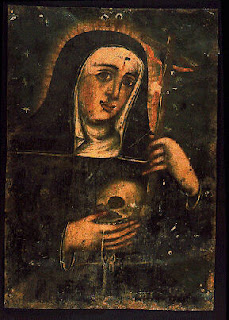
St. Rita of Cascia - May 22


"michael Dubruiel"From The Church's Most Powerful Novenas by Michael Dubruiel:


Rita Lotti was born near Cascia in Italy in the fourteenth century, the only child of her parents, Antonio and Amata. Her parents were official peacemakers in a turbulent environment of feuding families.
At an early age Rita felt called to religious life; however, her parents arranged for her to be married to Paolo Mancini. Rita accepted this as God’s will for her, and the newlyweds were soon blessed with two sons.
One day while on his way home, Paolo was killed. Rita’s grief was compounded with the fear that her two sons would seek to avenge their father’s death, as was the custom of the time. She began praying and fasting that God would not allow this to happen. Both sons soon fell ill and died, which Rita saw as an answer to her prayers.
Now alone in the world, Rita sought to enter religious life, feeling that God had cleared the path for her to fulfill the vocation that she had felt was hers from childhood. Yet she found that the convent she so desired to enter was reluctant to accept her due to fears that the political rivals that had killed her husband would bring violence on them.
She finally brought peace between the rivals and was able to enter the Convent of St. Mary Magdalene of the Augustinian Nuns. In religious life, Rita was noted for her holiness. She spent her days not only in prayer and contemplation but also in service to the sick and the poor.
One day while kneeling in prayer and contemplating the passion of Jesus, she received the wound of one thorn from the crown of thorns that she bore until her death some fifteen years later.
Devotion to St. Rita was almost nonexistent for five hundred years, but with her canonization in 1900, all of that has changed. She is truly a saint for every state in life, having spent her life as a married woman, a mother, a widow, and a religious.

Tuesday, May 20, 2025

Michael Dubruiel: How-to Book of the Mass (1)

   The How-to Book of the Mass by Michael Dubruiel not only provides the who, what, where, when, and why of the most time-honored traditions of the Catholic Church, but also the how. All in an easy-to-read, easy-to-understand format.


"michael Dubruiel"


From the introduction:

There is more contained within these pages than just the mechanics of the celebration of the Mass; also described is how to attend Mass in a way that makes it truly an encounter with the Lord Jesus Christ every time. 

Lifelong Catholics may have grown so used to the ritual that they aimlessly go through the motions and find that their minds often wander. Novices, on the other hand. may feel so overwhelmed by all that is unknown to them that they fail to recognize Christ in the process.

 Every encounter with Jesus is unique.


A sample page:

Michael Dubruiel


Monday, May 19, 2025

Free Catholic Book

   The Fourth Rule: St. Benedict's Guide to Life by Michael Dubruiel, is free today.  

How can I be at peace? What's the meaning of my life? You're not the first to ask these questions. They're the fundamental questions of human life. Over a thousand years ago, an Italian monk offered answers and put them into practice. Come discover their lasting truth of St. Benedict of Nursia's Rule.


"michael Dubruiel"


(14) To relieve the poor.


A few of these poor souls, I recognized from my visits to the local pub in town. I did not judge them or deny them the tickets even though I knew that they had some money (at least some to buy drinks). One reason for my lack of judgment, was due to the fact that giving the monks food away, did not cost me anything. I wonder though, if the money had been coming out of my pocket, if I would have been as understanding.


Others came to the door looking for food of a different sort.


Thomas Merton in Bread in the Wilderness speaks of the psalms as God’s manna, given to feed the soul in the desert of life. The monk’s prayer, made up almost entirely of praying the psalms, provided that nourishment for many who had suffered loss or hurt from great struggles of faith.


All of us are poor. It is arrogant to think that I am somehow better than anyone else. If there is anything that I have hated throughout my life, it is those who look down on others. Sadly, it is also the part of myself that I hate the most—and the part that I know could ultimately condemn me if I do not let go of it.


Saint Benedict did not leave counsel to “help” the poor, even though we could interpret this counsel as concretely doing this. He told them to breathe life into them.


I could feed the poor with food, but if I made them feel like I was doing them a great service, I could leave them with their bellies full but still feeling very poor. If on the other hand, I fed them in the way I might some friend who I hoped to impress and win favor from, how might that leave them?


The famous, the wealthy and those in power often find that doors are opened for them and everything provided for them, although they usually have done nothing to deserve it. We may not have a “royal” family in this land of ours, but some are treated that way nonetheless. Why should some be treated that way and while others are neglected?

Free Christian Inspirational Book

   The Fourth Rule: St. Benedict's Guide to Life by Michael Dubruiel, is free today. 

How can I be at peace? What's the meaning of my life? You're not the first to ask these questions. They're the fundamental questions of human life. Over a thousand years ago, an Italian monk offered answers and put them into practice. Come discover their lasting truth of St. Benedict of Nursia's Rule.


"michael Dubruiel"


(13) To love fasting.


Most of us are not familiar with fasting, but we are with dieting. They are not the same thing. Dieting has to do with vanity, fasting has to do with a higher good. We all feel so many needs that are not real but remain unaware. Fasting is a traditional means of gaining the wisdom of what we truly need.


Notice that St. Benedict’s counsel is not simply to “fast” but rather to “love” fasting. He wishes that the monk’s desire be-- to do without.


I am reminded of an old distinction made by Archbishop Fulton Sheen on his Life is Worth Living series. We have little choice over what we like, but love is an act of the will. We can choose to love something and we usually do learn to love both things and people that initially we may not have liked. We can also learn and choose to hate.


In a society such as ours fasting happens often enough but not for it’s own sake. People traveling or involved in work regularly skip meals for the sake of whatever has their focus. The problem is that in the long run we tend to be like camels and when we do sit down to eat, we gorge ourselves in case it might be awhile before we set down again.