Thursday, November 6, 2025

Michael Dubruiel: 73 Steps to Communion with God 61

     This is a continuation of the 73 Steps to Communion with God by Michael Dubruiel. The previous steps appear throughout the Archives, available to the left. This is the 61st step:


(61) To obey the commands of the Abbot in all things, even though he himself (which Heaven forbid) act otherwise, mindful of that precept of the Lord: "What they say, do ye; what they do, do ye not" (Mt 23:3).


The Abbot is the head of the monastery, and even though you and I may not be in a monastery we all have human authorities that we should respect and obey. Like the previous counsel where St. Benedict taught us to hate our own will, here we are taught to obey those whom God has placed over us even if the person in authority isn't the most God-like person.


Benedict quotes Our Lord injunction to obey the Pharisees who He says sat in the seat of Moses. A quick survey of the Gospels will find that Jesus often condemned the behavior of the Pharisees but in this passage says that they should be obeyed anyway because God had put them in their positions of authority.


We also have the example of Our Lord's journey to the cross where He is handed over by the High Priests and then made subject to Pilate. He tells Pilate that Pilate has no authority over Him unless it were given from above from God. So Our Lord accepts Pilate's authority to put Him to death.


This way of looking at authority should lead us to pray for those who God has placed over us that they too will seek to do God's will. The person who truly believes in God will trust that even a corrupt authority will unwittingly do the will of God. The Scriptures are filled with examples of evil kings doing the will of God even though they were unaware of it and might have had evil motives at the time.


The example of Joseph in Genesis, sold into slavery by his brothers who later bow before him imploring his mercy stands as the premier example of this trust that we all should have that God works through whoever He wills. Joseph faced with his brothers says, "what you did to me you meant for evil but God meant it for good to bring about the salvation of many."

Michael Dubruiel


Being obedient but without following the example of bad authority allows us to worship God alone.

Wednesday, November 5, 2025

Michael Dubruiel: 73 Steps to Communion with God 60b

        This is a continuation of the 73 Steps to Communion with God by Michael DubruielThe previous steps appear throughout the Archives, available to the left. This is the 60th step, part 2:


Michael Dubruiel


(60) To hate one's own will:


To fight "our will" does not mean going off into another direction but rather facing reality. Our "will" often pulls us away from what most needs our attention. We often will to be somewhere other than where we are, to be doing something other than what needs to be done and to be with someone other than the one we are with at the present moment. These are exactly the moments when we are to "hate" our own will and seek to do the will of God.


God had placed us where we are right at this very moment. He has also placed us in a situation that demands our attention at this moment. The person who is before us has been placed there by God. Being attentive to all that God has placed in our midst will bring a contentment that we will never find if we are constantly seeking to flee from the cross.


Tuesday, November 4, 2025

Michael Dubruiel: 73 Steps to Communion with God 60a

       This is a continuation of the 73 Steps to Communion with God by Michael DubruielThe previous steps appear throughout the Archives, available to the left. This is the 60th step, part 1: 


Michael Dubruiel


(60) To hate one's own will:


Someone who seeks to be in communion with God has to learn to subject themselves entirely to God's will. Jesus who was the Son of God still prayed in His humanity that "not his will be done but the Father's." We all have "our way" of looking at life and "our way" of doing things and the Scriptures are quite clear that "our way is not God's way."


We all suffer because we believe that happiness lies in fulfilling our will. But if we have the gift to reflect on our past, we quickly come to the realization that much of what we "will" does not bring us happiness and in fact is quite fleeting and arbitrary--changing with the wind.


Monday, November 3, 2025

Michael Dubruiel: 73 Steps to Communion with God 59b

        This is a continuation of the 73 Steps to Communion with God by Michael Dubruiel. The previous steps appear throughout the Archives, available to the left. This is the 59th step part 2:


Michael Dubruiel


(59) Not to fulfil the desires of the flesh (cf Gal 5:16).


Contrast the works of the flesh with the desires of the Spirit: "But the fruit of the Spirit is love, joy, peace, patience, kindness, goodness, faithfulness, gentleness, self-control," (Galatians 5:22). Notice the first three are all what the "desires'" of the flesh are motivated by, the desire to experience love, joy and peace, but of course they never lead to that, so we should strive to live by the Spirit.


How can w do it? St. Paul tells us, "those who belong to Christ Jesus have crucified the flesh with its passions and desires. If we live by the Spirit, let us also walk by the Spirit," (Galatians 5: 24-25). We need to subjugate ourselves to Jesus and to trust in the Holy Spirit at every moment of everyday, so that we seek to fulfill the will of God and not of our flesh.


Sunday, November 2, 2025

Michael Dubruiel: 73 Steps to Communion with God 59a

       This is a continuation of the 73 Steps to Communion with God by Michael DubruielThe previous steps appear throughout the Archives, available to the left. This is the 59th step part 1: 


Michael Dubruiel


(59) Not to fulfil the desires of the flesh (cf Gal 5:16).


This counsel of St. Benedict's is a quote from St. Paul's letter to the Galatians, "But I say, walk by the Spirit, and do not gratify the desires of the flesh," (Galatians 5:16). St. Paul saw the flesh and the Spirit at war with one another and one would suspect that so would St. Benedict. The flesh for Paul was an obstacle to being the person God had created us to be.


But less we project all of our own ideas about what the "flesh" means, let us look at what St. Paul means when he speaks about the "flesh": "Now the works of the flesh are plain: fornication, impurity, licentiousness, idolatry, sorcery, enmity, strife, jealousy, anger, selfishness, dissension, party spirit, envy, drunkenness, carousing, and the like. I warn you, as I warned you before, that those who do such things shall not inherit the kingdom of God," (Galatians 5:19-21). If one peruses the list one will find that the "desires" of the flesh are all the ways that our desires can go mad and lead to our own destruction.

Saturday, November 1, 2025

All Souls Day - November 2


"michael Dubruiel"
One time in the late 80's I was traveling with another friend of mine, Brian, on our way to Chicago. The first night we stopped at the Monastery of the Holy Spirit in Conyers, GA about twenty miles east of Atlanta.

Fr. Francis (originally a monk at Gethsemani and one of the founding monks of Holy Spirit, then in his 80's) met us at the Guest House door, "Will you stay?"

Anyone who has read Thomas Merton's Seven Storey Mountain knows this is what you expect to hear when you arrive at a Trappist monastery. There is a double meaning to the question..."Will you stay?" and join our community, "Will you stay?" in the guest house and finally since in the Rule of St. Benedict the stranger is to be welcomed as Christ...Will you stay? Lord as in "Stay with us Lord for the day is far spent."

We answered "yes" as in yes we'll stay in the guest house tonight, which we did and attended prayers and Mass--then left the next morning on our way to Gethsemani. We arrived in Gethsemani that afternoon (about seven hours later). No one greeted us or asked us if we would stay. There were a few other pilgrims wandering around but no monks visible. We were settled in the chapel for Vespers when the first monks began to emerge from the cloister and enter into the chapel. Brian leaned over to me and whispered, "Its the same guys."

Well not exactly. Driving toward Birmingham and away from Gethsemani I thought of my friend Peter who has been a big fan of the Trappists from way back. I knew that he had thought about entering the Monastery of Our Lady of the Holy Spirit at one timea and still made visits there frequently--I also knew that he had visited Gethsemani several times. His experience and mine of both monasteries knew that one welcomed strangers and the other saw them as an intrusion and to be fair because of Thomas Merton Gethsemani got a glut of strangers.

When I first stayed at Gethsemani the beds were very Trappist--really nothing more than a pallet with a two inch mattress on it. Years laters a beautiful, state of the art guest house was built that was more along the lines of mid range hotel. Now the Welcome Center--the times they are a changing.

I called Pete to share my views about the Welcome Center and I share them here because for the most part they were inaccurate as my return trip proved but they say a lot about how our minds process religious experiences. I told Pete:

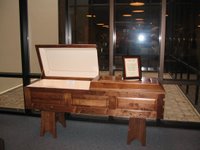
"The first thing you notice when you walk in through the cloister wall and into the building is a coffin...it is open but empty. In some ways it is symbolic of immediately reminding you of your final end and asking you the question what am I here for? Several monks were available to answer the question.""michael Dubruiel"

"Over the PA system there was an incessant crackling of flames--they made me think of the flames of Hell (another of the Last Things), when in fact a peak into the room to the left of the entrance showed that it was the Easter Fire being prepared and the flames providing the fire to illuminate the Easter Candle--symbolic of the light of Christ illuminating the darkness. The video featured the changing seasons...the crackling flames were replaced with crackling dead leaves falling from the trees surrounding the monastery, the barren trees introduced the funeral of a monk with living monks keeping vigil reading the psalms all night before the burial of their brother."

I told Pete that all of this left me with the impression that the Welcome Center was designed as a sort of funeral parlor and that unconsciously the monks were providing the guest with a modern morality play that the visitor was the staring player. Walking out of the Welcome Center I made my way toward the Chapel for Vespers--passing by another gate where the words "God Alone" were engraved. Long time readers of this blog will remember that this gate once graced the right hand column of this blog...the Gospel in two words, a reminder that after death all that matters will be God Alone...a reminder that in this life ultimately what matters is God Alone.

Then the Chapel and monks bending in unison at the waist singing "Praise to the Father, the Son and Holy Spirit both now and forever, until the end of the ages." punctuating the Psalms of praise and thanksgiving.

Death, Hell, Purgatory and Heaven all in a few minutes of each other. "Will you stay?"

No, not here anyway.

(Later my return to Getsemani later in the week and a more accurate description of the Welcome Center).

-Michael Dubruiel


Friday, October 31, 2025

Michael Dubruiel: All Saints Day - November 1

   We spent part of last week attending the National Catholic Youth Conference in Atlanta. One moment from all that I experienced continues to stay with me, perhaps I might say even to haunt me. While Joseph, Katie and I were walking back toward the exhibit area where Amy and Michael were, we suddenly notice a quiet and people stopping (in an environment that was much like walking through midtown Manhattan on a weekday). Then enmasse young and old dropped to their knees.


Advancing were youth holding signs "Silence and Kneel"…everyone obediently did so as cassocked men holding candles, one swinging incense advanced in front of a coped priest with humeral veil wrapped around the base of a monstrance held the Eucharistic Body of Our Lord aloft.

Those who have seen the movie "The Mission" with one of the best scenes ever filmed about the spiritual life will remember Jeremy Irons playing a priest holding the monstrance in the midst of battle all around him, himself falling and an indigenous man picking up the monstrance and continuing the procession. That is what popped into my mind as I instructed young Joseph to make the sign of the cross as Jesus passed in our midst.

I'll bet that when all is said and done, I'm not alone in this being a moment that will be remembered by all. What is more I have realized that these Catholic prayer moments are the solid foundation that most Catholics never forget--long after they have forgotten most of what they were taught.

There is a lesson here for those of us who try to pass on the faith to our children--introduce them to Christ, like disciples on the road to Emmaus let Christ the stranger teach them, open the Scriptures to them so that they might recognize him in the breaking of the Bread--that they may pick up his Presence and carry it through the streets of life where a battle wages.

Such catechesis is the lesson plan of saints--may all the saints pray that we might take up that charge!