Sunday, October 5, 2025

Michael Dubruiel: 73 Steps to Deeper Spirituality - 48a

      This is a continuation of the 73 Steps to Spritual Communion with God by Michael Dubruiel. The previous posts are in the archives to the right. This is step 48 part 1:


(48) To keep a constant watch over the actions of our life.


We read in the Book of Wisdom "To fix one's thought on her is perfect understanding, and he who is vigilant on her account will soon be free from care", (Wisdom 6:15). Vigilance is a hallmark of monastic life, it is why silence has always been valued in that setting.


Vigilance requires attentiveness. Everyone has had the experience where they arrive home after driving the daily route only to discover that they remember nothing about the trip they have just made presumably awake. Much of life can become so routine that we are oblivious to those around us.


Monks have a practice of keeping "vigil." I once tried something similar when I attended school at a monastery. I decided that I would simply spend the night with Jesus in the Blessed Sacrament. I took along a Bible, a rosary and sat in a small oratory. Just the Lord and me. The time passed rather quickly. There were no great revelations during that period of prayer, but what I did notice was that during the next few days everything seemed more intense. It was almost as though the world was suddenly in "high definition" vs. the black and white that it usually seems to be.


Michael Dubruiel

Friday, October 3, 2025

St. Francis of Assisi - October 4


St. Francis of Assisi taught his followers to reverence Christ and
his cross wherever they might find themselves. The prayer attributed
to St. Francis that begins, “Lord, make me a channel of your
peace,” was in fact not composed by St. Francis; it was misapplied
to him in a prayer book. The true prayer of St. Francis was one
he taught his friars to pray whenever they would pass a Church
or the sign of the cross made by two branches in a tree. They were
to prostrate themselves toward the church or the cross and pray,
“We adore you Christ and we praise you present here and in all
the Churches throughout the world, because by your holy cross
you have redeemed the world.”
The cross reminds us of the true Christ, the one in the
Gospels who was constantly misjudged by the religious figures
of his day. If we are not careful, he will be misjudged by us as well.
We need to worship him alone.

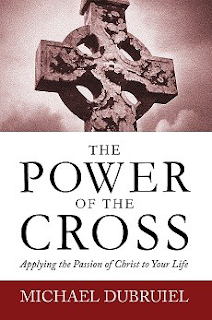
From The Power of the Cross , by Michael Dubruiel available as a free download by clicking the cover below:


"michael Dubruiel"


Thursday, October 2, 2025

Michael Dubruiel: October is Rosary Month

     Michael Dubruiel conceived and put together the small hardbound book, Praying the Rosary.  Click on the cover for more information.


"Michael Dubruiel"


The Gospels show that the gaze of Mary varied depending upon the circumstances of life. So it will be with us. Each time we pick up the holy beads to recite the Rosary, our gaze at the mystery of Christ will differ depending on where we find ourselves at that moment.

Thereafter Mary’s gaze, ever filled with adoration and wonder, would never leave him. At times it would be a questioning look, as in the episode of the finding in the Temple: “Son, why have you treated us so?” (Lk 2:48); it would always be a penetrating gaze, one capable of deeply understanding Jesus, even to the point of perceiving his hidden feelings and anticipating his decisions, as at Cana (cf. Jn 2:5). At other times it would be a look of sorrow, especially beneath the Cross, where her vision would still be that of mother giving birth, for Mary not only shared the passion and death of her Son, she also received the new son given to her in the beloved disciple (cf. Jn 19:26-27). On the morning of Easter hers would be a gaze radiant with the joy of the Resurrection, and finally, on the day of Pentecost, a gaze afire with the outpouring of the Spirit (cf. Acts 1:14) [Rosarium Virginis Mariae, no. 10].


As we pray the Rosary, then, we join with Mary in contemplating Christ. With her, we remember Christ, we proclaim Him, we learn from Him, and, most importantly, as we raise our voices in prayer and our hearts in contemplation of the holy mysteries, this “compendium of the Gospel” itself, we are conformed to Him.


Wednesday, October 1, 2025

Feast of the Guardian Angels - October 2


"michael Dubruiel"
Yours and mine...

From the Catholic Encyclopedia:

That every individual soul has a guardian angel has never been defined by the Church, and is,
consequently, not an article of faith; but it
is the "mind of the Church", as St. Jerome expressed it:
"how great the dignity of the soul, since each one has
from his birth an angel
commissioned to guard it." (Comm. in Matt., xviii, lib. II).


Michael Dubruiel 

Tuesday, September 30, 2025

October 1- St. Therese


"Michael Dubruiel"

Therese imagined that in the spiritual life we are all like infants at the foot of the stairs being summoned by our Heavenly Father to climb the heights--which try as we might we cannot do. Finally the Heavenly Father will come down the stairs and pick us up and carry us up the stairs. Which of course is a beautiful child like summary of what the Trinity has done in the incarnation of Jesus.
Are you and I trying to climb the stairs? Is our Faith in Him? Abandon yourself to the God as a child abandons oneself to their parents.
St. Therese, pray for us!


Michael Dubruiel

Monday, September 29, 2025

St. Jerome: September 30

 September 30 is the memorial of St. Jerome.  More from Pope Benedict XVI:


What can we learn from St Jerome? It seems to me, this above all; to love the Word of God in Sacred Scripture. St Jerome said: “Ignorance of the Scriptures is ignorance of Christ”. It is therefore important that every Christian live in contact and in personal dialogue with the Word of God given to us in Sacred Scripture.

This dialogue with Scripture must always have two dimensions: on the one hand, it must be a truly personal dialogue because God speaks with each one of us through Sacred Scripture and it has a message for each one. We must not read Sacred Scripture as a word of the past but as the Word of God that is also addressed to us, and we must try to understand what it is that the Lord wants to tell us.

However, to avoid falling into individualism, we must bear in mind that the Word of God has been given to us precisely in order to build communion and to join forces in the truth on our journey towards God. Thus, although it is always a personal Word, it is also a Word that builds community, that builds the Church. We must therefore read it in communion with the living Church.

The privileged place for reading and listening to the Word of God is the liturgy, in which, celebrating the Word and making Christ’s Body present in the Sacrament, we actualize the Word in our lives and make it present among us. We must never forget that the Word of God transcends time. Human opinions come and go. What is very modern today will be very antiquated tomorrow. On the other hand, the Word of God is the Word of eternal life, it bears within it eternity and is valid for ever. By carrying the Word of God within us, we therefore carry within us eternity, eternal life.


The Power of the Cross  by Michael Dubruiel. 


"michael Dubruiel"


Michael Dubruiel: 73 Steps to Spritual Communion with God - 47a

    This is a continuation of the 73 Steps to Spritual Communion with God by Michael Dubruiel. The previous posts are in the archives to the right. This is step 47:


(47) To keep death before one's eyes daily.


Momento Mori, "remember death" is an ancient spiritual maxim presented to us here by St. Benedict. Keeping one's end in mind helps us to focus on what really matters. Many self-motivators have picked up on this and while avoiding "death" have sought to get people to meditate on what is really important in life.


Of course what happens after death matters a great deal if we are to focus on death. If one believes that nothing happens after death that focusing on it could be a morose practice that would only depress the person. If on the other hand one believes in the after life and a judgment then every decision I make in the present is moving me along a road in one of two directions--either toward heaven or hell.


Many people believe in a after life for absolutely no good reason. Many of them do not believe in God, but reaping the harvest of Christendom continue to carry around with them a vague sense that death is not the end. But this belief does not come from science.

Others, nihilists, belief in nothing but the present but in a rather dark manner, since death is the end that the whole of life is rather meaningless and existence is a bore.

Michael Dubruiel