Several years ago, Michael Dubruiel edited a prayer book centered on Fulton Sheen's writings. It is out of print, but there are a few used copies available at reasonable prices here:
The first reading at Mass, from the Acts of the Apostles:
To help emphasize the role of the Works of Mercy in the Life of the Christian!
While the Bishop and Father Benedict were working on the written text of the book I came across a stunning work of iconography one day while visiting an Eastern Catholic church. On the back wall of the church was an icon of the Last Judgment taken from Matthew 25. I found that the great iconographer Mila Mina had written the icon. I immediately contacted Mila and asked if the icon might be used as an illustration for this book, her response was "anything to make the Gospel known!" Thanks to Mila and her son Father John Mina for allowing Joyce Duriga and David Renz to photograph the icon at Ascension of Our Lord Byzantine Catholic Church, Clairton, PA.
Fr. Groeschel has written the introductory text that begins each section as well as the final "What Should I Do?" at the end of the book, and Bishop Baker has written the individual meditations and prayers contained in each of the six sections.
My son Joseph walked into the room while I was putting together the material for this chapter. When he walked in I was having a difficult time coming up with a good illustration for what “living in thanksgiving” means in the concrete and I wasn’t thankful that he was bothering me. Then it struck me that the point of living in thanksgiving is simply that what I might otherwise perceive as an interruption becomes an intervention, once I adore God above all things.
God had sent Joseph into my room. This hit me when I sent him away and he said “Thank you,” as he went off. For a period of his young life he had the habit of saying “thank you,” not after he had been given something that he was appreciative of but rather when he had been told to do something, I think he thought that “thank you”meant “okay.”Yet this is exactly what living in thanksgiving is, saying “thank you” to whatever God presents to us in the daily events of our lives.
“ L I V I N G I N T H A N K S G I V I N G ”
Living in thanksgiving literally means always having gratitude on your lips.
The late great Orthodox liturgist Alexander Schmemann felt that the meaning of “thanksgiving”— the literal translation of the Greek word Eucharist — had been lost on modern people. We tend to limit giving thanks to only those things that we receive that we perceive as good.Yet Schmemann argues that for the early church “giving thanks” was something the Christian did because the Kingdom of God had been restored in Jesus Christ.
Our very inclusion in Christ is reason enough to give thanks; the fact that God has spoken to us in the Word is another reason to give thanks; the fact that Christ has saved us and shares his Body and Blood with us is another reason to give thanks; and the fact that Christ has given us a mission is yet another reason to give him thanks! In fact,you will recognize that at the point in the celebration of the Eucharist that each of these things is mentioned, we express our thanks, either as a congregation, when we say, “Thanks be to God,” or through the presider, when he says to God, “We give you thanks.”
Because of what Christ has done for us we now have a vantage point in life that those who do not know Christ do not have.The liturgy is a mystery of light, and we are on the mountaintop of the Transfiguration and know that Jesus rises from the dead — that he is victorious over our enemies. Therefore, as St. Paul tells the Thessalonians, we can “Give thanks in all circumstances; for this is the will of God in Christ Jesus for you” (1 Thessalonians 5:18).
Maybe you are a recent convert, or perhaps you've attended Mass your whole life, but there are still things that puzzle you, like: when you should genuflect and when you should bow; what the different books used at Mass are and what they contain; the meaning of words like "Amen," "Alleluia," or "Hosanna"; what to do during the sign of peace.
You aren't alone.
The How-to Book of the Mass by Michael Dubruiel not only provides the who, what, where, when, and why of the most time-honored traditions of the Catholic Church, but also the how. All in an easy-to-read, easy-to-understand format.
In this complete guide to the celebration of the Eucharist you get: Step-by-step guidelines to walk you through the Mass
Biblical background of the prayers of the Mass.
Insights from the Tradition and teaching of the Church
Practical aid to overcoming distractions
Concrete ways to grow in your relationship with Jesus Christ at every Mass
A handy study guide for individual or group use
The How-to Book of the Mass by Michael Dubruiel not only provides the who, what, where, when, and why of the most time-honored traditions of the Catholic Church, but also the how. All in an easy-to-read, easy-to-understand format.
The Road to Emmaus:
As we look at the various parts of the Mass, we will pause to meditate on this story from Luke's Gospel. I expect that you will come to finnd in this Gospel story an excellent tool to help you refocus yourself on Christ at the various moments of every Mass you attend. I have written this book with all Catholics in mind. Whether young or old, male or female, liberal or conservative — In Christ we are one, at Mass we are one, one Body: Jesus'.
I hope to help you rediscover the Mass as a vehicle for letting go of all that can seem to separate you in life, and to replace what seem like distractions with the deep, meaning-filled events of your daily life. Rediscover the Mass as a way to open the wounds, the scars, the needs that Jesus can heal, and to encounter the very Lord Himself, so you might leave every Mass with His peace and a deep sense of unity with God and your fellow man.
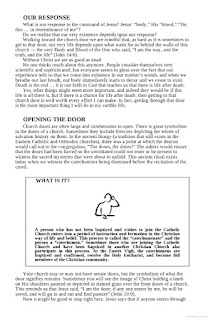
A sample page: