Tuesday, May 20, 2025

Michael Dubruiel: How-to Book of the Mass (1)

   The How-to Book of the Mass by Michael Dubruiel not only provides the who, what, where, when, and why of the most time-honored traditions of the Catholic Church, but also the how. All in an easy-to-read, easy-to-understand format.


"michael Dubruiel"


From the introduction:

There is more contained within these pages than just the mechanics of the celebration of the Mass; also described is how to attend Mass in a way that makes it truly an encounter with the Lord Jesus Christ every time. 

Lifelong Catholics may have grown so used to the ritual that they aimlessly go through the motions and find that their minds often wander. Novices, on the other hand. may feel so overwhelmed by all that is unknown to them that they fail to recognize Christ in the process.

 Every encounter with Jesus is unique.


A sample page:

Michael Dubruiel


Monday, May 19, 2025

Free Catholic Book

   The Fourth Rule: St. Benedict's Guide to Life by Michael Dubruiel, is free today.  

How can I be at peace? What's the meaning of my life? You're not the first to ask these questions. They're the fundamental questions of human life. Over a thousand years ago, an Italian monk offered answers and put them into practice. Come discover their lasting truth of St. Benedict of Nursia's Rule.


"michael Dubruiel"


(14) To relieve the poor.


A few of these poor souls, I recognized from my visits to the local pub in town. I did not judge them or deny them the tickets even though I knew that they had some money (at least some to buy drinks). One reason for my lack of judgment, was due to the fact that giving the monks food away, did not cost me anything. I wonder though, if the money had been coming out of my pocket, if I would have been as understanding.


Others came to the door looking for food of a different sort.


Thomas Merton in Bread in the Wilderness speaks of the psalms as God’s manna, given to feed the soul in the desert of life. The monk’s prayer, made up almost entirely of praying the psalms, provided that nourishment for many who had suffered loss or hurt from great struggles of faith.


All of us are poor. It is arrogant to think that I am somehow better than anyone else. If there is anything that I have hated throughout my life, it is those who look down on others. Sadly, it is also the part of myself that I hate the most—and the part that I know could ultimately condemn me if I do not let go of it.


Saint Benedict did not leave counsel to “help” the poor, even though we could interpret this counsel as concretely doing this. He told them to breathe life into them.


I could feed the poor with food, but if I made them feel like I was doing them a great service, I could leave them with their bellies full but still feeling very poor. If on the other hand, I fed them in the way I might some friend who I hoped to impress and win favor from, how might that leave them?


The famous, the wealthy and those in power often find that doors are opened for them and everything provided for them, although they usually have done nothing to deserve it. We may not have a “royal” family in this land of ours, but some are treated that way nonetheless. Why should some be treated that way and while others are neglected?

Free Christian Inspirational Book

   The Fourth Rule: St. Benedict's Guide to Life by Michael Dubruiel, is free today. 

How can I be at peace? What's the meaning of my life? You're not the first to ask these questions. They're the fundamental questions of human life. Over a thousand years ago, an Italian monk offered answers and put them into practice. Come discover their lasting truth of St. Benedict of Nursia's Rule.


"michael Dubruiel"


(13) To love fasting.


Most of us are not familiar with fasting, but we are with dieting. They are not the same thing. Dieting has to do with vanity, fasting has to do with a higher good. We all feel so many needs that are not real but remain unaware. Fasting is a traditional means of gaining the wisdom of what we truly need.


Notice that St. Benedict’s counsel is not simply to “fast” but rather to “love” fasting. He wishes that the monk’s desire be-- to do without.


I am reminded of an old distinction made by Archbishop Fulton Sheen on his Life is Worth Living series. We have little choice over what we like, but love is an act of the will. We can choose to love something and we usually do learn to love both things and people that initially we may not have liked. We can also learn and choose to hate.


In a society such as ours fasting happens often enough but not for it’s own sake. People traveling or involved in work regularly skip meals for the sake of whatever has their focus. The problem is that in the long run we tend to be like camels and when we do sit down to eat, we gorge ourselves in case it might be awhile before we set down again.

Friday, May 16, 2025

Michael Dubruiel: The Pocket Guide to the Mass

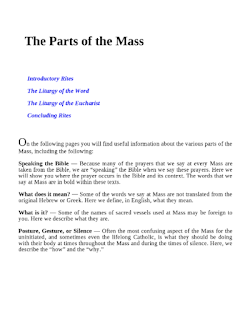
   Michael Dubruiel's Pocket Guide to the Mass - a sample page. 


Walks you through the Mass, explaining the biblical basis of prayers, the meaning behind gestures, and a brief overview of the spirituality that brings Catholics together for Eucharist each week.

Published in 2007, still in print. 

An excellent resource for your parish for the Eucharistic Revival year. 


More books by Michael Dubruiel

Michael Dubruiel

Wednesday, May 14, 2025

Michael Dubruiel: The Pocket Guide to the Mass

   A Pocket Guide to the Mass by Michael Dubruiel: introduction


Get the most out of the Mass...

A Pocket Guide to the Mass walks you through the biblical basis of prayers, the meaning behind gestures, and a brief overview of the spirituality that brings Catholics together for Eucharist each week.

Reenergize your time at Mass or help those who are new or returning to the Church with this quick and insightful overview. Rediscover the fullness of the Mass today!


Michael Dubruiel


Tuesday, May 13, 2025

Michael Dubruiel's Pocket Guide to the Mass


"michael dubruiel"The Gospel readings at Mass during this time are focusing on the Eucharist via John, chapter 6.  Why not follow the Church's lead and learn more about the Mass during this time?

From Michael Dubruiel, in 2007:

I have written a lot about the Mass--without ever really intending to do so. First, I wrote about the Mass in The How-To Book of the Mass: Everything You Need to Know but No One Ever Taught You--this book has done so well that I was asked to write a follow-up to it. That book How To Get The Most Out Of The Eucharist, probably should have been titled "How to Offer Your Sacrifice at Every Mass." Then this year, A Pocket Guide to the Mass, which is part of the "A Pocket Guide" series. Each book is different and offers a slightly different way to open oneself up to the riches that are being bestowed upon us by fulfilling the Lord's command to "Do this." Thanks to everyone who has read any of the three and offered very positive reviews of them.

Monday, May 12, 2025

Free Catholic Book

    Free today:

From How to Get the Most Out of the Eucharist by Michael Dubruiel

About Michael Dubruiel


"michael dubruiel"


From Chapter 3 - Adore. Part 8


ADORING GOD WITH PRAISE AND THANKSGIVING

One of my favorite quotes is from the journals of Father Alexander Schmemann: “God, when creating the world, did not solve problems or pose them.He created what He could call ‘very good.’ God created the world, but the devil transformed the world and man and life into a ‘problem.’ ”

If we want to adore God with praise and thanksgiving we are going to have to learn to stop seeing everything as a “problem” or “interruption” and begin to be open to seeing God’s goodness and interventions even in the most unlikely of places.

Many of the most horrific sins ever committed by human beings happen because people see problems where they should see blessings. If we do not adore God above all, we risk doing horrible things as we serve whatever else we have put in God’s place.

ELP FROM THE FATHERS OF THE HURCH
Human beings are created for the purpose of praising God.The Lord demands nothing else in the same manner that he requires praise and thanksgiving of us.For that reason he made rational beings and distinguished us from animals by our power of speech so that we might praise and glorify him continually.
— S T. J OHN HRYSOSTOM