Monday, February 12, 2024

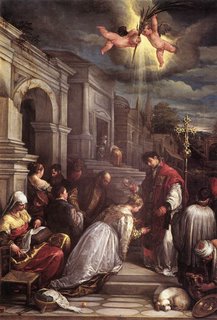
St. Valentine's Day - February 14


"Michael Dubruiel"From the CATHOLIC ENCYCLOPEDIA:

At least three different Saint Valentines, all of them martyrs, are mentioned in the early martyrologies under date of 14 February. One is described as a priest at Rome, another as bishop of Interamna (modern Terni), and these two seem both to have suffered in the second half of the third century and to have been buried on the Flaminian Way, but at different distances from the city. In William of Malmesbury's time what was known to the ancients as the Flaminian Gate of Rome and is now the Porta del Popolo, was called the Gate of St. Valentine. The name seems to have been taken from a small church dedicated to the saint which was in the immediate neighborhood. Of both these St. Valentines some sort of Acta are preserved but they are of relatively late date and of no historical value. Of the third Saint Valentine, who suffered in Africa with a number of companions, nothing further is known.


Michael Dubruiel 

Sunday, February 11, 2024

Lent Devotional by Michael Dubruiel


 Lent begins in just a couple of days. Ash Wednesday is February 14. The Power of the Cross is a Lent devotional. It's available as an ebook here. 


When our earthly life ceases, we will be welcomed into God’s
kingdom to the degree that we made him the Lord of our lives.
For many of us, that will mean some time along the purgative
way, learning to release all of our demands upon God. God has
found his rightful place in our hearts when we realize that whatever
he wills is best for us.


-The Power of the Cross 
"michael dubruiel"

Saturday, February 10, 2024

Our Lady of Lourdes - February 11

    Michael Dubruiel conceived and put together the small hardbound book, Praying the Rosary.  Click on the cover for more information.


"Michael Dubruiel"


The Gospels show that the gaze of Mary varied depending upon the circumstances of life. So it will be with us. Each time we pick up the holy beads to recite the Rosary, our gaze at the mystery of Christ will differ depending on where we find ourselves at that moment.

Friday, February 9, 2024

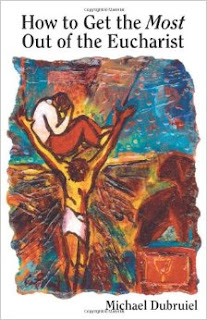
Michael Dubruiel: How to Get the Most Out of the Eucharist - part 19


From How to Get the Most Out of the Eucharist by Michael Dubruiel

About Michael Dubruiel


"michael Dubruiel"


From Chapter 3 - Adore. Part 6

“ T R U S T I N G  I N O D    I N LL I R C U M S TA N C E S 

When Our Lord spoke about his Second Coming, an event that every celebration of the Eucharist looks forward to and prays for in a joyful manner,he laid out the signs that will precede that coming, and indeed they are all rather horrible — that is, if all your hope is invested in your 401K.Yet notice the contrast between the unbeliever and the believer:


And there will be signs in sun and moon and stars, and upon the earth distress of nations in perplexity at the roaring of the sea and the waves, men fainting with fear and with foreboding of what is coming on the world; for the powers of the heavens will be shaken. And then they will see the Son of man coming in a cloud with power and great glory. Now when these things begin to take place, look up and raise your heads, because your redemption is drawing near.
— LUKE 2 1 : 2 5 – 2 8 ( EMPHASIS ADDED )


While one crowd is dying of fear because everything seems to be crumbling around them the other crowd, the believers, stand up and look to the heavens. Why?
If we truly place our faith in God,we will trust in him no matter what happens. In fact, the way that we see will be completely different. Jesus referred to unbelievers as blind and believers as those who truly see. Seeing that God is the “one thing needful” keeps us from putting our trust in anything else.

St. Benedict, in his Rule, counsels those who want to follow Christ “to prefer nothing to the love of Christ.” This means that we must love Christ above everything else, and that being loved by Christ must be our first priority in life.

Thursday, February 8, 2024

Michael Dubruiel: How to Get the Most Out of the Eucharist - part 18


From How to Get the Most Out of the Eucharist by Michael Dubruiel

About Michael Dubruiel


"michael dubruiel"


From Chapter 3 - Adore. Part 5

LE S S O N S LE A R N ED F RO M A H REE -Y E A R -O L D

My son Joseph walked into the room while I was putting together the material for this chapter. When he walked in I was having a difficult time coming up with a good illustration for what “living in thanksgiving” means in the concrete and I wasn’t thankful that he was bothering me. Then it struck me that the point of living in thanksgiving is simply that what I might otherwise perceive as an interruption becomes an intervention, once I adore God above all things.


God had sent Joseph into my room. This hit me when I sent him away and he said “Thank you,” as he went off. For a period of his young life he had the habit of saying “thank you,” not after he had been given something that he was appreciative of but rather 
when he had been told to do something, I think he thought that “thank you”meant “okay.”Yet this is exactly what living in thanksgiving is, saying “thank you” to whatever God presents to us in the daily events of our lives.


“ L I V I N G I N H A N K S G I V I N G 


Living in thanksgiving literally means always having gratitude on your lips.


The late great Orthodox liturgist Alexander Schmemann felt that the meaning of “thanksgiving”— the literal translation of the Greek word Eucharist — had been lost on modern people. We tend to limit giving thanks to only those things that we receive that we perceive as good.Yet Schmemann argues that for the early church “giving thanks” was something the Christian did because the Kingdom of God had been restored in Jesus Christ.


Our very inclusion in Christ is reason enough to give thanks; the fact that God has spoken to us in the Word is another reason to give thanks; the fact that Christ has saved us and shares his Body and Blood with us is another reason to give thanks; and the fact that Christ has given us a mission is yet another reason to give him thanks! In fact,you will recognize that at the point in the celebration of the Eucharist that each of these things is mentioned, we express our thanks, either as a congregation, when we say, “Thanks be to God,” or through the presider, when he says to God, “We give you thanks.”


Because of what Christ has done for us we now have a vantage point in life that those who do not know Christ do not have.The liturgy is a mystery of light, and we are on the mountaintop of the Transfiguration and know that Jesus rises from the dead — that he is victorious over our enemies. Therefore, as St. Paul tells the Thessalonians, we can “Give thanks in all circumstances; for this is the will of God in Christ Jesus for you” (1 Thessalonians 5:18).


LIVING THE EUCHARIST
Practice giving thanks to God at all times. Make it a habit to step back when you judge something negatively and to ask God to help you to see it in his will.

Wednesday, February 7, 2024

Michael Dubruiel: How to Get the Most Out of the Eucharist - part 17


From How to Get the Most Out of the Eucharist by Michael Dubruiel

About Michael Dubruiel


"michael dubruiel"


From Chapter 3 - Adore. Part 4


From a positive standpoint, then, what can we do to adore God in the Eucharist?

First we must foster a sense of reverence for God.The actions in the Mass of kneeling, bowing, and beating our breasts all have meaning. They cause us to consciously call to mind that God is present and to focus all of our attention on what God wants of us at the present moment.

Second, we need to worship the Eucharist outside of Mass in order to foster a deeper communion with our Eucharistic Lord when we receive his awesome gift at Mass. When we actively worship Our Lord Jesus Christ in the Blessed Sacrament we grow in awareness of what it means to receive him at Communion. Pope John Paul II has written about this as a necessary element to restoring an awe of the precious gift of the Eucharist. A Franciscan friend recently told me that when preaching about the Eucharist to young people, he begins by telling them to “Be amazed,” paraphrasing the Holy Father’s injunction.

Coming aside to reverence Christ in the Eucharist, realizing that he is before us, has the same power to change us as he did to those who came into his earthly presence.
LIVING THE UCHARIST
Try to find time to make a visit to a chapel or church to adore the Lord in the Blessed Sacrament. Give Christ whatever time you have, whether a little or a lot. Make acts of worship in his presence.
Consciously call to mind God’s presence throughout the day, no matter where you are.

Third,we need to understand what the Catechism of the Catholic Church calls “the implications of faith in one God.” It means:
    “Living in thanksgiving” (CCC 224).
    “Trusting God in every circumstance” (CCC 227).v

Tuesday, February 6, 2024

Ash Wednesday is February 14

   The Power of the Cross by Michael Dubruiel - a Lenten devotional book - is available as an ebook, after being out of print for many years. 

"michael Dubruiel"


There is power in the Cross of Christ that, sad to say, many Christians don't experience. Now you can learn to see Jesus' suffering and death not as a spectacle or theatrical production, but as a blueprint for how to live your life.

Here is the radical teaching of Our Lord presented in a series of concrete steps that you can take at your own pace, whether you use this book alone or with a group. Learn:

*How to follow Christ more closely.
*God's unique purpose and mission for you.
*How to overcome the evil that you have suffered at the hands of others.
*To find God's presence in difficult times.
*The keys to unleashing the power of the Cross in your life.


Day by day for five weeks, here are the prayers, the reflections, the stories, and the teaching that will help you not only better comprehend the power of Christ's great sacrifice for you, but come to a better understanding of why and how to accept that power now.