Thursday, May 18, 2023

Daily Reflection by Michael Dubruiel (4)


The Cross of Christ Transforms. . . Our Lives 


 Who You Gonna Call? 

I think it is understandable. We live in a consumer society that constantly tries to sell us a slice of heaven: “enough” life insurance, in case you should die suddenly; a “big enough” plot, so that your loved ones will be able to find you; the “right” drug to help you get more out of sex, enhance your mood, keep your kids in line; the list goes on and on. But in the end, will any of these enticing offers truly save us? Of course not. The cross of Christ forces us to choose sides, to reorder our priorities. It also transforms our personal crosses and gives us hope: We have on our side someone who is victorious over all enemies, all powers and principalities. St. Leonard said, “Impress on yourself this great truth: Even if all hell’s devils come after you to tempt you, you won’t sin unless you want to—provided that you don’t trust in your own powers, but in the assistance of God. He doesn’t refuse help to those who ask it with a lively faith.” God offers us all the help we need in this life, if we avail ourselves of it. As the catchy title tune of the movie Ghostbusters asks us: “Who ya gonna call?”


"michael Dubruiel"

Wednesday, May 17, 2023

Daily Reflection by Michael Dubruiel (3)


The Cross of Christ Transforms. . . Our Lives 


 Lukewarm Faith

I visited the ruins of Laodicea in 1979 while I was serving in Turkey as a member of the United States Army. Of all the seven churches mentioned in Revelation, the ruins of this city were the most desolate. It was destroyed late in the fifth century AD by a terrible earthquake. My memory is of a wide-open field, with an amphitheater and some graves nearby. In the Book of Revelation, Jesus warns the apathetic Church of Laodicea: “I know your works: . . . because you are lukewarm, and neither cold nor hot, I will spew you out of my mouth. For you say, I am rich, I have prospered, and I need nothing; not knowing that you are wretched, pitiable, poor, blind, and naked. Therefore I counsel you to buy from me gold refined by fire, that you may be rich, and white garments to clothe you and to keep the shame of your nakedness from being seen, and salve to anoint your eyes, that you may see. Those whom I love, I reprove and chasten; so be zealous and repent” (Revelation 3:15–19).

Archbishop Fulton J. Sheen, perhaps the greatest American Catholic preacher of the last century, used to say that these words were addressed especially to those of us who live in the northern hemisphere. When I look at the cross of Christ, I realize he’s right: The cross speaks of radical commitment; mine is only lukewarm by comparison.  I often harbor thoughts about grasping at things of the world that might offer some guarantee against whatever impending doom lies in the future.


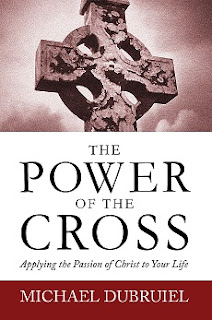
The Power of the Cross by Michael Dubruiel is a book well-suited to daily reading during Lent. The book is available here in pdf version. Daily excerpts will be reprinted in this space during Lent.


"michael Dubruiel"

Tuesday, May 16, 2023

Michael Dubruiel's Pocket Guide to the Mass


The Gospel readings at Mass during this time are focusing on the Eucharist via John, chapter 6.  Why not follow the Church's lead and learn more about the Mass during this time?

From Michael Dubruiel, in 2007:

I have written a lot about the Mass--without ever really intending to do so. First, I wrote about the Mass in The How-To Book of the Mass: Everything You Need to Know but No One Ever Taught You--this book has done so well that I was asked to write a follow-up to it. That book How To Get The Most Out Of The Eucharist, probably should have been titled "How to Offer Your Sacrifice at Every Mass." Then this year, A Pocket Guide to the Mass, which is part of the "A Pocket Guide" series. Each book is different and offers a slightly different way to open oneself up to the riches that are being bestowed upon us by fulfilling the Lord's command to "Do this." Thanks to everyone who has read any of the three and offered very positive reviews of them.
Monday, May 15, 2023

Pentecost Novena


 Pentecost 2023 is May 28


When Jesus ascended into heaven, he told his Apostles to stay where they were and to "wait for the gift" that the Father had promised: the Holy Spirit.  The Apostles did as the Lord commanded them. "They all joined together constantly in prayer, along with the women and Mary the mother of Jesus, and with his brothers" (Acts 1:14). Nine days passed; then, they received the gift of the Holy spirit, as had been promised. May we stay together with the church, awaiting in faith with Our Blessed Mother, as we trust entirely in God, who loves us more than we can ever know. 

"michael Dubruiel"

Saturday, May 13, 2023

Michael Dubruiel: Feast of the Ascension


The first reading at Mass, from the Acts of the Apostles: 

In the first book, Theophilus,
I dealt with all that Jesus did and taught
until the day he was taken up,
after giving instructions through the Holy Spirit
to the apostles whom he had chosen.
He presented himself alive to them
by many proofs after he had suffered,
appearing to them during forty days
and speaking about the kingdom of God.
While meeting with the them,
he enjoined them not to depart from Jerusalem,
but to wait for “the promise of the Father
about which you have heard me speak;
for John baptized with water,
but in a few days you will be baptized with the Holy Spirit.”
When they had gathered together they asked him,
“Lord, are you at this time going to restore the kingdom to Israel?”
He answered them, “It is not for you to know the times or seasons
that the Father has established by his own authority.
But you will receive power when the Holy Spirit comes upon you,
and you will be my witnesses in Jerusalem,
throughout Judea and Samaria,
and to the ends of the earth.”
When he had said this, as they were looking on,
he was lifted up, and a cloud took him from their sight.
While they were looking intently at the sky as he was going,
suddenly two men dressed in white garments stood beside them.
They said, “Men of Galilee,
why are you standing there looking at the sky?
This Jesus who has been taken up from you into heaven
will return in the same way as you have seen him going into heaven.”


michael dubruiel


Our Lady of Fatima - May 13


 Michael Dubruiel conceived and put together the small hardbound book, Praying the Rosary.  Click on the cover for more information.


"Michael Dubruiel"


The Gospels show that the gaze of Mary varied depending upon the circumstances of life. So it will be with us. Each time we pick up the holy beads to recite the Rosary, our gaze at the mystery of Christ will differ depending on where we find ourselves at that moment.

Thereafter Mary’s gaze, ever filled with adoration and wonder, would never leave him. At times it would be a questioning look, as in the episode of the finding in the Temple: “Son, why have you treated us so?” (Lk 2:48); it would always be a penetrating gaze, one capable of deeply understanding Jesus, even to the point of perceiving his hidden feelings and anticipating his decisions, as at Cana (cf. Jn 2:5). At other times it would be a look of sorrow, especially beneath the Cross, where her vision would still be that of mother giving birth, for Mary not only shared the passion and death of her Son, she also received the new son given to her in the beloved disciple (cf. Jn 19:26-27). On the morning of Easter hers would be a gaze radiant with the joy of the Resurrection, and finally, on the day of Pentecost, a gaze afire with the outpouring of the Spirit (cf. Acts 1:14) [Rosarium Virginis Mariae, no. 10].


As we pray the Rosary, then, we join with Mary in contemplating Christ. With her, we remember Christ, we proclaim Him, we learn from Him, and, most importantly, as we raise our voices in prayer and our hearts in contemplation of the holy mysteries, this “compendium of the Gospel” itself, we are conformed to Him.


Friday, May 12, 2023

Mary and the Muslims - Fatima


From the National Rosary Crusade, written many years ago by the Servant of God Bishop Fulton Sheen:

MARY
The Qu'ran, which is the Bible for the Muslims, has many passages concerning the Blessed Virgin. First of all, the Qu'ran believes in her Immaculate Conception, and also in her Virgin Birth. The third chapter of the Qu'ran places the history of Mary's family in a genealogy which goes back through Abraham, Noah, and Adam. When one compares the Qu'ran's description of the birth of Mary with the apocryphal Gospel of the birth of Mary, one is tempted to believe that Mohammed very much depended upon the latter. Both books describe the old age and the definite sterility of the mother of Mary. When, however, she conceives, the mother of Mary is made to say in the Qu'ran: "O Lord, I vow and I consecrate to you what is already within me. Accept it from me."

When Mary is born, the mother says: And I consecrate her with all of her posterity under thy protection, O Lord, against Satan!"

The Qu'ran passes over Joseph in the life of Mary, but the Muslim tradition knows his name and has some familiarity with him. In this tradition, Joseph is made to speak to Mary, who is a virgin. As he inquired how she conceived Jesus without a father, Mary answered:

Do you not know that God, when he created the wheat had no need of seed, and that God by his power made the trees grow without the help of rain? All that God had to do was to say, 'So be it, and it was done.'

The Qu'ran was also verses on the Annunciation, Visitation, and Nativity. Angels are pictured as accompanying the Blessed Mother and saying: "Oh, Mary, God has chosen you and purified you, and elected you above all the women of the earth." In the nineteenth chapter of the Qu'ran there are 41 verses on Jesus and Mary. There is such a strong defense of the virginity of Mary here that the Qu'ran, in the fourth book, attributed the condemnation of the Jews to their monstrous calumny against the Virgin Mary.

FATIMA 
Mary, then, is for the Muslims the true Sayyida, or Lady. The only possible serious rival to her in their creed would be Fatima, the daughter of Mohammed himself. But after the death of Fatima, Mohammed wrote: "Thou shalt be the most blessed of all women in Paradise, after Mary." In a variation of the text, Fatima is made to say, "I surpass all the women, except Mary."

This brings us to our second point: namely, why the Blessed Mother, in the 20th century, should have revealed herself in the insignificant little village of Fatima, so that to all future generations she would be known as "Our Lady of Fatima." Since nothing ever happens out of Heaven except with a finesse of all details, I believe that the blessed Virgin chose to be known as "Our Lady of Fatima" as a pledge and a sign of hope to the Muslim people, and as an assurance that they, who show her so much respect, will one day accept her divine Son too.

Evidence to support these views is found in the historical fact that the Muslims occupied Portugal for centuries. At the time when they were finally driven out, the last Muslim chief had a beautiful daughter by the name of Fatima. A Catholic boy fell in love with her, and for him she not only stayed behind when the Muslims left, but even embraced the faith. The young husband was so much in love with her that he changed the name of the town where he lived to Fatima. Thus, the very place where our lady appeared in 1917 bears a historical connection to Fatima, the daughter of Mohammed.

The final evidence of the relationship of Fatima to the Muslims is the enthusiastic reception which the Muslims in Africa, India, and elsewhere gave to the pilgrim statue of Our Lady of Fatima. Muslims attended the church services in honor of our Lady, they allowed religious processions and even prayers before their mosques; and in Mozambique, the Muslims who were unconverted, began to be Christian as soon as the statue of Our Lady of Fatima was erected.