Tuesday, March 21, 2023

Michael Dubruiel Daily Lenten Meditation


The Cross of Christ Transforms. . . Our Lives 


 Lukewarm Faith

I visited the ruins of Laodicea in 1979 while I was serving in Turkey as a member of the United States Army. Of all the seven churches mentioned in Revelation, the ruins of this city were the most desolate. It was destroyed late in the fifth century AD by a terrible earthquake. My memory is of a wide-open field, with an amphitheater and some graves nearby. In the Book of Revelation, Jesus warns the apathetic Church of Laodicea: “I know your works: . . . because you are lukewarm, and neither cold nor hot, I will spew you out of my mouth. For you say, I am rich, I have prospered, and I need nothing; not knowing that you are wretched, pitiable, poor, blind, and naked. Therefore I counsel you to buy from me gold refined by fire, that you may be rich, and white garments to clothe you and to keep the shame of your nakedness from being seen, and salve to anoint your eyes, that you may see. Those whom I love, I reprove and chasten; so be zealous and repent” (Revelation 3:15–19).

Archbishop Fulton J. Sheen, perhaps the greatest American Catholic preacher of the last century, used to say that these words were addressed especially to those of us who live in the northern hemisphere. When I look at the cross of Christ, I realize he’s right: The cross speaks of radical commitment; mine is only lukewarm by comparison.  I often harbor thoughts about grasping at things of the world that might offer some guarantee against whatever impending doom lies in the future.

 Who You Gonna Call? 

I think it is understandable. We live in a consumer society that constantly tries to sell us a slice of heaven: “enough” life insurance, in case you should die suddenly; a “big enough” plot, so that your loved ones will be able to find you; the “right” drug to help you get more out of sex, enhance your mood, keep your kids in line; the list goes on and on. But in the end, will any of these enticing offers truly save us? Of course not. The cross of Christ forces us to choose sides, to reorder our priorities. It also transforms our personal crosses and gives us hope: We have on our side someone who is victorious over all enemies, all powers and principalities. St. Leonard said, “Impress on yourself this great truth: Even if all hell’s devils come after you to tempt you, you won’t sin unless you want to—provided that you don’t trust in your own powers, but in the assistance of God. He doesn’t refuse help to those who ask it with a lively faith.” God offers us all the help we need in this life, if we avail ourselves of it. As the catchy title tune of the movie Ghostbusters asks us: “Who ya gonna call?”


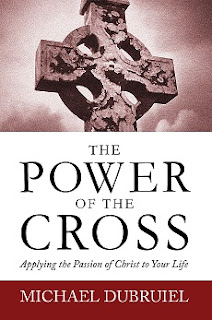
The Power of the Cross by Michael Dubruiel is a book well-suited to daily reading during Lent. The book is available here in pdf version. Daily excerpts will be reprinted in this space during Lent.

"michael Dubruiel"

Michael Dubruiel Daily Lenten Meditation


The Cross of Christ Transforms. . . Our Lives 


 Whom Do I Trust? 

The bishop who was responsible for the conversion of St. Augustine said, “Faith means battles. If there are no contests, it is because there are none who desire to contend.” What Ambrose meant is that if we find our faith relatively easy, we should look again to see how much faith we really have. St. Peter Chrysologus said, “If you want to party with the Devil, you can’t celebrate with Christ.” In other words, you and I have to choose. Jesus told his disciples, “He who is not with me is against me, and he who does not gather with me scatters” (Matthew 12:30).

Stories of warrior saints abound. St. Padre Pio wrestled with the devil throughout the night. Similar tales are told of St. John Vianney. St. Francis and St. Benedict are both said to have waged great battles with the flesh. Whether the enemy was physical or spiritual, these holy men and women continued to fight—not by their own resources, but by acknowledging, like Paul, that “when I am weak, then I am strong” (2 Corinthians 12:10). Not one  person who trusts in Jesus, says St. Paul, “will be put to shame”; what the Lord promises, he delivers.


The Power of the Cross by Michael Dubruiel is a book well-suited to daily reading during Lent. The book is available here in pdf version. Daily excerpts will be reprinted in this space during Lent.


"michael Dubruiel"

Monday, March 20, 2023

St. Joseph Feast Celebrated March 20, 2023

   O sacred Lord of ancient Israel, who showed yourself to Moses in the burning bush, who gave him the holy law on Sinai mountain: come, stretch out your mighty hand to set us free.


"Joseph her husband, since he was a righteous man, yet unwilling to expose her to shame,decided to divorce her quietly." I suspect that most people gloss right over this passage at the beginning of Matthew's Gospel and today's reading. We know that Joseph is not going to divorce Mary, in the same way that we know that Abraham ultimately isn't going to sacrifice Isaac--so we gloss over the fact that Joseph, a righteous man who is unwilling to expose Mary to the possibility of being executed for adultery (since that would be the only plausible explanation for her pregnancy) decides to divorce her.
We could surmise from this that the Holy Family almost was a single parent family. We could also conclude that God fearing, righteous people sometimes divorce. But of course none of that comes to pass because Joseph is a spiritual man who pays attention to his dreams. And this is another important fact in the Gospel story--Joseph's revelation comes to him in a dream--not a full fledged vision but a dream. A vision of an angel in a dream probably would be quickly dismissed by most of us.
"Such was his intention when, behold, the angel of the Lord appeared to him in a dream and said, 'Joseph, son of David, do not be afraid to take Mary your wife into your home. For it is through the Holy Spirit that this child has been conceived in her. She will bear a son and you are to name him Jesus, because he will save his people from their sins.'"
So we are told that even Joseph had this intention when he had rationally looked at all the evidence, now God enters the picture albeit in a dream and says, "whoa Joseph! It is through the Holy Spirit."

There are a lot of events in life that are confusing, troubling to good people. If we are truly open to God as St. Joseph was we might discern God's hand in many events that seem at first to speak of God's absence. As we await His coming let us open ourselves to the possibility that He might be in our midst, even at this moment.


Michael Dubruiel wrote a book to help people deepen their experience of the Mass.  He titled it, How to Get the Most Out of the Eucharist.  You can read about it here. 


How to Get the Most Out of the Eucharist gives you nine concrete steps to help you join your own sacrifice to the sacrifice of Christ as you:
  • Serve: Obey the command that Jesus gave to his disciples at the first Eucharist.
  • Adore: Put aside anything that seems to rival God in importance.
  • Confess: Believe in God’s power to make up for your weaknesses.
  • Respond" Answer in gesture, word, and song in unity with the Body of Christ.
  • Incline: Listen with your whole being to the Word of God.
  • Fast: Bring your appetites and desires to the Eucharist.
  • Invite: Open yourself to an encounter with Jesus.
  • Commune: Accept the gift of Christ in the Eucharist.
  • Evangelize :Take him and share the Lord with others.


Filled with true examples, solid prayer-helps, and sound advice, How to Get the Most Out of the Eucharist shows you how to properly balance the Mass as a holy banquet with the Mass as a holy sacrifice. With its references to Scripture, quotations from the writings and prayers of the saints, and practical aids for overcoming distractions one can encounter at Mass, this book guides readers to embrace the Mass as if they were attending the Last Supper itself.

Sunday, March 19, 2023

Prodigal Son - Fourth Sunday of Lent


The Cross of Christ Unites. . . God’s Mercy and Love


 From now on, therefore, we regard no one from a human point of view; even though we once regarded Christ from a human point of view, we regard him thus no longer. Therefore, if anyone is in Christ, he is a new creation; the old has passed away, behold, the new has come. All this is from God, who through Christ reconciled us to himself. . . 2 CORINTHIANS 5:16–18

 This man receives sinners and eats with them. LUKE 15: 2 

I met Frank the first time I visited a Catholic seminary. He stood out from the rest of the men training for the priesthood: He radiated an air of being sure of himself. Of all the guys that I met on that two-day visit, he was the only one who seemed really sure of what he was doing there. I mentioned this to Frank as I was getting ready to leave and it was then that he told me something that has stuck with me from that moment on. Frank was completing his seventh of the eight years of study required for those in training for the priesthood. Reflecting back on those years and the people that he had met over that period of time, he said, “I’ve met some of the greatest saints and greatest sinners here. I’ve also learned that most of the time it is hard to tell which are which.”  I thought to myself, Frank is going to make a great priest.

 But a week after I met him, he left the seminary. There were rumors that a young woman who worked in the kitchen at the seminary refectory was pregnant with his child. Instead of being ordained a priest, he was married during what would have been his eighth year in the seminary.

Judge Not 

It is clear from even a casual reading of the gospels that Jesus was judged incessantly: by his family, his disciples, the scribes, the Pharisees, the Sadducees, the Greeks, and the Romans. Some thought Jesus was crazy, some thought him a prophet, some thought him an agitator, some hoped he would be a political liberator or a king; only a select few recognized him as the Son of God. He himself said that people called him a drunkard and a glutton. We need look no further than the inability of the people who encountered Jesus in the flesh to see who he really was, to understand why we shouldn’t judge. . .ever.

You might think Frank misled me with his confidence and insight; nothing could be further from the truth. I didn’t know then, and I don’t know now if he was a saint or a sinner. Neither do you. You may judge him, saying, “Well, he obviously committed a sin by getting the young woman pregnant.” But what if Frank wasn’t the man responsible for her pregnancy? What if he had simply decided to make a home for her and her child after the child’s father abandoned the young woman? What if he sacrificed his vocation for the sake of this child? Why, he could be a great saint, a modern St. Joseph!

 That is why Frank’s comment has stuck with me for these many years: We just don’t know. We do not know the real truth about others, and sometimes we don’t even know the truth about ourselves.


A Friend of Sinners 


One of the most famous parables of Jesus is that of the Prodigal Son. The son demands his inheritance, then goes off and blows it all. He doesn’t come to his senses until he is working in a pigsty. Jesus tells this parable when he is in the process of being judged as someone who consorts with sinners. The “punch line” of the parable hits home for all of us prodigals: Those who are most likely to come to their senses are those who have experienced the emptiness of a life apart from God. The elder sons really don’t see any reason to party; they haven’t come to their senses yet. Who is the greatest sinner in the parable of the Prodigal Son? Could it be the older brother, who is angry that his ungrateful little brother had come home? Often we resent this; we identify more with the elder brother than with the younger. In fact, when I’ve spoken on this parable it has often angered someone: Someone in their family, like the Prodigal Son, has taken the family’s money, only to come back penniless and in search of more.

Ironically, some Scripture scholars think that in the parable of the Prodigal Son, Jesus is the son who takes the inheritance of the Father—his divine mercy and love—and squanders it on sinners! In the end, the Father is pleased. Once you’ve heard this way of looking at the parable, it’s hard to see it in any other way. Yes, God’s mercy is great; however, to experience it fully always involves a bit of a crucifixion on our part. Our natural  human way of looking at things is invariably fallible and has to die. For some of us, that means we’re not so bad that God can’t forgive us; for others, it means we’re not so good that we don’t need God’s mercy. Most of us are incapable of true objectivity; we have no way of knowing how good we really are or even how bad we are. The cross unites God’s love and mercy in us, liberating us to place our trust in him.

 St. Paul said, “But with me it is a very small thing that I should be judged by you or by any human court. I do not even judge myself. I am not aware of anything against myself, but I am not thereby acquitted. It is the Lord who judges me,” (1 Corinthians 4:3–4). This is trust. It is why sinners flocked to the Lord when he walked the earth, and it is why we sinners flock to Mass, where the Lord feeds us with his Body and Blood. St. Paul says that anyone in Christ is a new creation. Being in Christ is the key. We hide in Christ. We dwell in Christ. He is our life, our hope, and our salvation. Divine Mercy provides the perfect anecdote to the poison of sin, “Jesus, I Trust in Thee!” Not in riches, not in the ways of the world, not in my judgments, but in Jesus. Only in God will our souls be at rest.


The Power of the Cross by Michael Dubruiel is a book well-suited to daily reading during Lent. The book is available here in pdf version. Daily excerpts will be reprinted in this space during Lent.


"michael Dubruiel"

Friday, March 17, 2023

Lent Podcast

  Lenten Podcast


You can listen to an interview program with Michael Dubruiel about his book, The Power of the Cross. The interview is with Kris McGregor of KVSS radio. This is the fifth episode.


Episode 5 – The Cross of Christ unites… – Michael Dubruiel discusses:
Day 22 – Blindness
Day 23 – Lagtime
Day 24 – Weakness
Day 25 – Death
Day 26 – Our Choices
Day 27 – Truth
Day 28 – The Way to True Unity


St. Patrick's Day - March 17

   From The Loyola Kids' Book of Saints by Amy Welborn

How do you teach a classroom that's as big as a whole country? How do you teach a whole country about God?
St. Patrick's classroom was the whole country of Ireland and his lesson was the good news of Jesus Christ. How in the world did he do it? Well, it was only possible because he depended totally on God.
....
God gave Patrick the courage to speak, even when Patrick was in danger of being hurt by pagan priests who didn't want to lose their power over the people.
Patrick's most famous prayer shows us how close he was to God. It's called “St. Patrick's Breastplate.” A breastplate is the piece of armor that protects a soldier's heart from harm.
Christ with me, Christ before me,
Christ behind me, Christ within me,
Christ beneath me, Christ above me,
Christ at my right, Christ at my left.


  I. Saints are People Who Love Children St. Nicholas,St. John Bosco, St. Elizabeth Ann Seton, Blessed Gianna Beretta Molla

Saints Are People Who Love Their Families St. Monica,St. Cyril and St. Methodius, St. Therese of Lisieux,Blessed Frederic Ozanam,

 Saints Are People Who Surprise OthersSt. Simeon Stylites,St. Celestine V,St. Joan of Arc,St. Catherine of Siena

  Saints Are People Who Create St. Hildegard of Bingen,Blessed Fra Angelico,St. John of the Cross,Blessed Miguel Pro

  Saints Are People Who Teach Us New Ways to Pray St. Benedict,St. Dominic de Guzman,St. Teresa of Avila,St. Louis de Monfort

  Saints Are People Who See Beyond the Everyday St. Juan Diego, St. Frances of Rome, St. Bernadette Soubirous, Blessed Padre Pio

  Saints Are People Who Travel From Home St. Boniface, St. Peter Claver, St. Francis Xavier, St. Francis Solano, St. Francis Xavier Cabrini

  Saints Are People Who Are Strong Leaders St. Helena, St. Leo the Great, St. Wenceslaus, St. John Neumann

  Saints Are People Who Tell The Truth St. Polycarp, St. Thomas Becket, St. Thomas More, Blessed Titus Brandsma

  Saints Are People Who Help Us Understand God St. Augustine of Hippo, St. Jerome, St. Patrick, St. Thomas Aquinas, St. Edith Stein

  Saints Are People Who Change Their Lives for God St. Ambrose, St. Gregory the Great, St. Francis of Assisi, St. Ignatius of Loyola, St. Camillus de Lellis, St. Katharine Drexel

  Saints Are People Who Are Brave St. Perpetua and St. Felicity, St. George, St. Margaret Clitherow, St. Isaac Jogues, The Carmelite Nuns of Compiegne, St. Maximilian Kolbe

  Saints Are People Who Help the Poor and Sick St. Elizabeth of Hungary, St. Vincent de Paul, St. Martin de Porres, Blessed Joseph de Veuster

  Saints Are People Who Help In Ordinary Ways St. Christopher, St. Blaise, St. Anthony of Padua, St. Bernard of Montjoux


  Saints Are People Who Come From All Over the World Blessed Kateri Tekakwitha, St. Paul Miki, Blessed Peter To Rot, Blessed Maria Clementine Anuarite Nengapeta

Thursday, March 16, 2023

Michael Dubruiel: Daily Lenten Meditation

   The Cross of Christ Transforms. . . Law and Love 


Owe no one anything, except to love one another; for he who loves his neighbor has fulfilled the law. The commandments, “You shall not commit adultery, You shall not kill, You shall not steal, You shall not covet,” and any other commandment, are summed up in one sentence, “You shall love your neighbor as yourself.” Love does no wrong to a neighbor; therefore love is the fulfilling of the law. ROMANS 13:8–10

 “Think not that I have come to abolish the law and the prophets; I have not come to abolish them but to fulfill them. For truly, I say to you, till heaven and earth pass away, not an iota, not a dot, will pass from the law until all is accomplished. MATTHEW 5:17–18

 In Fort Myers, Florida, at the end of a beautiful street lined on either side with majestic royal palms is a small neon sign. It looks out of place; it is in front of home in a residential area. The simple sign is lit with green letters: GOD IS LOVE. The first time I saw this sign, I was visiting a classmate who lived next door to this home. “Is there a church here?” I asked. “No.” “Why is the sign there, then?”

He told me that the family who had lived in the house for the first half of the twentieth century had only one child, a boy. When World War II started, the boy was drafted into the military and soon was fighting in Europe. Back home in Fort Myers the man and his wife prayed constantly, asking God to protect their son and bring him back safely. Tragically, their son was killed in the war. Shortly after the young man’s body had been returned for burial, the father erected the sign in front of their home.

The next day as I was making my way back home, I passed the sign again: GOD IS LOVE. Why had that father erected the sign, when his prayer had not been answered as he had hoped? Had the man erected the sign in anger? Had he put it up to mock the love that God was supposed to have for us? I thought of other families I had known who had suffered similar losses, of parents who came home one day to find their child had been killed in an accident. Under such circumstances, I couldn’t imagine anyone erecting a sign with the proclamation GOD IS LOVE. The sign and its story haunted me, reflecting my own internal struggle.

 A week later, a thought struck me: “For God so loved the world that he gave his only Son, that whoever believes in him should not perish but have eternal life” (John 3:16). That father was not mocking God at all. Rather, he understood in a way that most of us can’t imagine what God had sacrificed, giving an only son so that others might live. Fulfilling God’s Law Jesus said that he had come not to abolish but to fulfill the law and the prophets. On the cross he said, “It is fulfilled” (John  19:30). Jesus said that there was no greater love than to lay one’s life down for a friend. That is exactly what the Son of God did, and what he asks of his followers as well.

St. Paul, who at a glance one might be tempted to think of as someone who was against the “law,” gives us the reason grace has supplanted the “law.” The love of God, which we experience in our lives as grace, flows into us. That love cannot be contained; it is so great that it spills out and must be spent on others. In love—God’s love—the law is fulfilled. The cross of Christ, which is the most eloquent expression of God’s love for us, is also the instrument by which we receive that love: We must die to ourselves so that Christ’s love might live within us. “Love one another,” Jesus commanded. It is a simple message but complex in practice. How should we express that love?


Love is so misused in our day that it almost has ceased to be a good word. Caritas, the Latin word for love, can also be translated as “charity.” In order to restore the true meaning of “love,” perhaps that is the way we should translate it. God showed charity to the world, through his Son. Jesus tells us to have charity to one another as he has had charity on us. The charity that we are to show to one another is not sentimental or self-serving. We do not expect those we love—whether ourselves, our parents, our spouses, or other people—to be allknowing and all-loving. First and foremost, we love other people by not making them “gods.” We honor those we love despite their human weaknesses and failings, always reserving a special place for God, who is the only perfect Being worthy of worship. The rest of us poor slobs deserve a fair amount of charity because we know only a little, and are limited in every conceivable way. So when we fail each other it is to be expected.

 Good Debt 

St. Paul says that the only thing we should owe anyone is love. In our “credit card economy,” such an idea is difficult to imagine, but perhaps that makes us better suited to grasp Paul’s message. We know all about owing others money, but how indebted are we when it comes to love? We should start by looking at how much we love God. The faith of the family that erected the GOD IS LOVE sign is remarkable. Most of us are quick to blame God for the horrible things that happen to us. Yet, if you really believe that God is up there just waiting to “get” you, how can you love such a supreme being? This is not the God Christ revealed to us, the God who suffers with us, who became one of us to rescue us from the powers of evil and destruction. In the Scriptures, death is portrayed as an angel; since death is the result of sin, one might presume a bad angel. The love of God, that is, God’s charity for us, is what rescues our loved ones from death and makes eternal life possible. God rescues us from sin and its destructive power. God can make good out of the evil others do and intend for us. This is why God is worthy of love and why God’s love enables us to love others in ways that would be impossible without God’s love. No matter what happens to us, we know that God is victorious. The psalmist says “O that today you would hearken to his voice! Harden not your hearts” (Psalm 95:7–8).


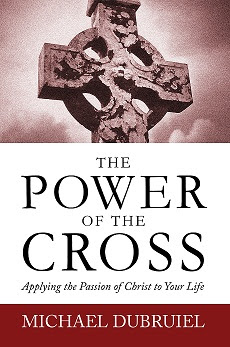
The Power of the Cross by Michael Dubruiel is a book well-suited to daily reading during Lent. The book is available here in pdf version. Daily excerpts will be reprinted in this space during Lent.

"michael Dubruiel"