Friday, February 3, 2023

Michael Dubruiel: How to Get the Most Out of the Eucharist - part 9a


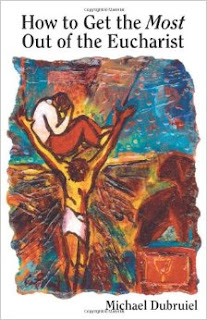
From How to Get the Most Out of the Eucharist by Michael Dubruiel


About Michael Dubruiel


From chapter 2 - Serve. 

“DYOU KNOW WHAT I HAVE DONE FOR YOU?”

When Jesus had finished washing the feet of his disciples, he rose and resumed his place at the table and asked them a simple question: “Do you know what I have done for you?”
There are several ways to take this question which Jesus posed to us, his followers; let me suggest two.

What Jesus Has Saved Us From

The first possible meaning relates to what Jesus has done for us by his sacrificial act on the cross Do we know what Jesus has saved us from?

You may know enough to say,“Jesus has redeemed us from the bondage of original sin,” but unless you know what the lived consequences of this sin are, you cannot fully appreciate what Jesus has saved you from.The Catechism of the Catholic Church spells out the nature and effects of original sin in paragraphs 397–412. Here I briefly summarize this teaching and contrast it with how Jesus has reversed the “curse” of original sin.
 First, in the sin:

    Man “let his trust in his Creator die in his heart and,abusing his freedom, disobeyed God’s command” (CCC 397).

— Jesus trusted in God completely, even to death on the Cross, praying in the Garden of Gethsemane, “not my will, but thine, be done” (Luke 22:42).

    Man “preferred himself to God,” thereby turning his back on the Creator (CCC 398).
— Jesus, though he was the form of God, did not deem equality with God; rather, Jesus lowered himself, taking the role of a servant (see Philippians 2:6–7).
As a result of original sin:

    People are “afraid of the God of whom they have con-ceived a distorted image” (CCC 399).
25

— At the Conception of Jesus, his Mother was told: “Do not be afraid, Mary, for you have found favor with God” (Luke 1:30). — Jesus told his followers, “I will warn you whom to fear: fear him who, after he has killed, has power to cast into hell; yes, I tell you, fear him! Are not five sparrows sold for two pennies? And not one of them is forgotten by God. Why, even the hairs of your head are a
ll numbered. Fear not; you are of more value than many sparrows” (Luke 12:5–7).
    The original “harmony in which they [Adam and Eve] found themselves … is now destroyed” (CCC 400). — Jesus set the example of reversing this disharmony, so that St. Paul would pray, “May the God of steadfastness and encouragement grant you to live in such harmony with one another, in accord with Christ Jesus” (Romans 15:5).

    “The control of the soul’s spiritual faculties over the body is shattered” (CCC 400).
— Jesus’s death and our incorporation into it at baptism restore the right order, as St. Paul wrote to the Romans, “Let not sin therefore reign in your mortal bodies, to make you obey their passions. Do not yield your members to sin as instruments of wickedness, but yield yourselves to God as men who have been brought from death to life, and your members to God as instruments of righteousness. For sin will have no dominion over you, since you are not under the law but under grace” (Romans 6:12–14).

LIVING THE UCHARIST
Is your Christian life dominated by the fallen worldview?  Do you strive with the help of the Holy Spirit and the nourishment of the Eucharist to live the new life of the kingdom that Jesus offers?

Thursday, February 2, 2023

When is Ash Wednesday? February 22, 2023

    An Excerpt from One of My Books:


(Michael Dubruiel)


This is an excerpt from one of my books, "Praying in the Presence of Our Lord with Fulton J. Sheen". This entry is from Part I under the heading "The Sanctification of the Present Moment." I quote this because I noticed somewhere online today the popularity of a spiritual guru who Oprah is promoting, Eckhart Tolle (I think it helps to have an estoteric name in the modern world) who's "Power of Now" is quite the rave. There is nothing new in what Tolle is promoting and any serious student of spirituality can find it in Catholicism. Fulton Sheen was preaching this years ago and as I point out in this entry from the book a very famous work of Christian Spirituality also does:


Bishop Sheen’s “Now-moment” corresponds to the thinking of the great spiritual writer Jean Pierre de Caussade. In Abandonment to Divine Providence, Fr. Caussade gives the reader a sure way of knowing the will of God at any moment—by simply confronting the present moment with all its reality. It seems simple, but if we reflect for a second most of us will find that we spend most of our lives avoiding the present moment.


A few years ago an English translation of the Father Caussade’s work appeared in the United States changing the original title to read “The Sacrament of the Present Moment.” This captures the essence of Father Caussade’s work and Bishop Sheen’s meditation that in the present time we are presented with an opportunity that is truly unique. Each moment is sacramental.


Most of us are capable of presenting ourselves with some amount of reflection as we celebrate the sacraments. If we celebrated the sacrament of Baptism as an adult certainly we came expecting to be changed by God. Each time we enter a confessional surely we have examined our conscience beforehand and are penitent expecting to be forgiven by God. Undoubtedly every time we approach the altar to receive the Eucharist we expect to encounter God. But what about the other moments of our lives?


As we awake in the morning, is our first thought of God? As we greet our brothers and sisters throughout the day do we expect that God might be present? Every moment of our lives is an opportunity to encounter God who is always present.

Spend some time reflecting on the following:


1. Go over the events of the present day and ask yourself where God might have been in each of them. Is there a consistent pattern to your day?


2. Reflect on the life of your favorite saint, and meditate on how he or she dealt with the people they met in their daily journeys. How could you imitate this saint? What enabled the saint to act in the way he or she did toward others?


3. Imagine as you leave from this time of prayer that God wishes to continue to be present to you as you go forth. How will you react to his presence in others?


Prayer

Lord, help me to search for you in the garden of life in the same way that St. Mary Magdalene did when she found your tomb empty. May my search be rewarded as hers was by knowledge of your abiding presence.

Amen.


Wednesday, February 1, 2023

February 2 - Feast of the Presentation

    From 2006:


Something to think about the next time you come forward to receive Holy Communion:
(Simeon) took him up in his arms and blessed God and said, "Lord, now lettest thou thy servant depart in peace, according to thy word; for mine eyes have seen thy salvation which thou hast prepared in the presence of all peoples, a light for revelation to the Gentiles, and for glory to thy people Israel.

Michael Dubruiel 

Tuesday, January 31, 2023

Michael Dubruiel: How to Get the Most Out of the Eucharist - part 8b


From How to Get the Most Out of the Eucharist by Michael Dubruiel


About Michael Dubruiel


From chapter 2 - Serve.  Part 7


THE INSTITUTION OF THE EUCHARIST BY JESUS

 On Holy Thursday, the day on which the Church celebrates the institution of the Holy Eucharist,the gospel reading for the Mass does not mention Jesus taking bread and wine but rather an act of service that Jesus performed at the Last Supper.The Lord taking bread and wine and declaring it his body and blood is mentioned in the Second Reading for that Mass,but not in the gospel.

The gospel for Holy Thursday is from John’s gospel. It is the story of Jesus rising from the table and shocking his disciples by doing something totally unexpected, washing their feet.
Peter refuses to have his feet washed at first but acquiesces when Jesus tells him that it is necessary if Peter is to have any inheritance in him.

If you are like me, you can relate to Peter. There is something in Peter’s character that perfectly illustrates what we all are like in our fallen nature.We are proud.We want to be in control.We like Jesus, and we want to be part of his crowd, but we also want to tell him what to do.

Monday, January 30, 2023

Michael Dubruiel: How to Get the Most Out of the Eucharist - part 8a


From How to Get the Most Out of the Eucharist by Michael Dubruiel


About Michael Dubruiel


From chapter 2 - Serve.  Part 6

GETTING THE MOST OUT OF THE EUCHARIST

If you want to get the most out of the Eucharist you have to check your “I” at the door.The “I” that wants things, that endlessly critiques the way things are done, and  that demands things be done in exactly a certain way (meaning “my way,” not God’s way). I think it was Peter Kreeft who once said that the famous song, “I Did It My Way,” sung by such great artists as Frank Sinatra and Elvis, is the national anthem of hell. The way of the world may be to do things “our way” but the way of Christ is to do things his Way.We therefore consciously have to leave “my way” at the door and in exchange take up an attitude that asks “how may we be of service to you, Lord, in this celebration of the Eucharist?”

Sunday, January 29, 2023

Michael Dubruiel: How to Get the Most Out of the Eucharist - part 7B


From How to Get the Most Out of the Eucharist by Michael Dubruiel

About Michael Dubruiel


Michael Dubruiel

From chapter 2 - Serve. Part 5


WHOSE WAY ARE WE PREPARING?


The greatest suffering that I’ve endured at any celebration of the Eucharist has been the few cases where someone, whether it was the presider, a musician, or, as in several cases, a member of the congregation, thought he or she could  make the liturgy more perfect by his or her own inventions. Here are some examples of this type of behavior, all of which actually happened:


    An Easter Sunday where a visiting priest tried to woo thecongregation by creating a “Mass” of his own making, never once using the words prescribed by the Church from beginning to end.
    A musician who saw himself as in a battle with the cele-brant and who continually and loudly played music over the presider’s attempts to pray the prescribed prayers of the Church.
    A congregant who screamed out for the priest to stopbecause “no one” —meaning herself — “knew where he was” in the liturgy.
    A congregant who held up a crucifix as he processedtoward the altar to receive the Eucharist and then, after receiving the Eucharist, turned and exorcised the congregation with loud prayers and wild gesticulations of the cross.

Now, you may think of some of these people as being mentally ill, and perhaps some of them were, yet a case could be made that when any of us “lords” it over another we are a little off in the head, especially if we are doing so and claiming to be a follower of Jesus. None of this is new, of course; even in Jesus’s time there were those who sought to take control and lord it over others.Yet Jesus addressed this issue directly, and clearly specified the subservient attitude that would be required of his followers:

Jesus called them to him and said, “You know that the rulers of the Gentiles lord it over them, and their great men exercise authority over them.It shall not be so among you; but whoever would be great among you must be your servant, and whoever would be first among you must be your slave; even as the Son of man came not be served but to serve, and to give his life as ransom for many.”
— M ATTHEW 2 0 : 2 5 – 2 8

Saturday, January 28, 2023

How to Get the Most Out of the Eucharist - part 7A


From How to Get the Most Out of the Eucharist by Michael Dubruiel

About Michael Dubruiel


Michael Dubruiel

From chapter 2 - Serve. Part 4


WHOSE WAY ARE WE PREPARING?

Every Sunday when I come to the Eucharist and am confronted by the words inscribed in stone over the entrance of my parish church, “Prepare the way of the Lord,” I am reminded that the first sacrifice I must make at this Mass is my own ego, and as I strive to relinquish the need to be in control of what will happen at this Eucharist I ask, “What does my lord bid his servant?” (Joshua 5:14).

We all face the same struggle. Some of you may protest:

    “The ushers don’t make me feel welcome in my church.”
    “My parish priest preaches too long.”
    “The musicians in our church are out of control.”
    “People are too loud and talk too much before theEucharist.”
    “The people dress too well or too poorly.”

Each of us, if given the opportunity to share what we think is keeping us from getting the most out of the Eucharist, is apt to come up with our own list. Recently I asked this question online and received a deluge of responses. Many were true abuses of the liturgy,and were worthy of being reported to the diocesan bishop, but just as many were not.

When I shared my amazement at the number of responses with my wife,she very keenly mused,“They all feel helpless,like they have no control.” As soon as she said this I realized that this was exactly the same thing I had heard from priests and musicians, the two groups who are most often the target of the congregation’s ire.Priests who come into a new parish and encounter established ways of doing things with which they do not agree and yet are powerless (at least at first) to change and musicians who are hired to provide a parish with beautiful music yet find themselves restrained by parish staff or established practice to playing pieces they feel are less than worthy of the liturgy often express frustration at their lack of control.

This brings home a point that we do not like to admit: None of us is in control, no matter what our function is in the liturgy. Yet we are all tempted to think that if we were in charge we could make it all perfect.