Tuesday, November 8, 2022

St. John Lateran - November 9


A visit to St. John Lateran, from 2006, by Michael Dubruiel:


After a quick lunch (pizza, what else?)we headed toward the Metro station to catch the A Train to St. John Lateran's to meet up with Zadok who had so generously agreed to give us a tour of two of Rome's greatest Churches. We were still pretty green when it comes to the whole Metro system and walked (rather than took a bus) to the station, so by the time we finally arrived we were late and Zadok was nowhere to be seen (at least not at the Metro station where Amy had thought he had said he was going to meet us). So Amy went out the other possible exits and Katie, Joseph, the baby (on my back) and I went a bit further and bought a bottle of water. When Amy came to say that he could not be found, we decided to go on further to the Church and see if he might have gone on there when we had not arrived on time. Sure enought there he was...
I should mention that at this point we had already walked quite a bit (given two treks through St. Peter's, a good half mile to the Metro and another two or three blocks from the Metro to St. John's) while we stood and listened to Zadok's interesting history of the surrounding landmarks, Joseph sat. And even looking at the front of the Church's pavement now, makes me tired to think about even walking that distance. Most people think that St. Peter's is the Cathedral Church of Rome, but it isn't--St. John Lateran's is. While the chair of Peter is in St. Peter's, the Bishop of Rome's chair is at St. John Lateran's and this is the central feature of the apse of the Church, now that I think of it in a similar way to the way that the Chair of Peter is in the apse of St. Peter's. When St. Francis of Assisi came to Rome to see the Pope, he came here to the Lateran and their are large statues of Francis and his crew directly across from St. John's that seem to be in communication with the large statues that are on the facade of St. John's. After his election as pope last April, Pope Benedict XVI came here to the Lateran to be formally installed as the Bishop of Rome (ever wonder why the Bishop of Rome isn't an "archbishop"?).
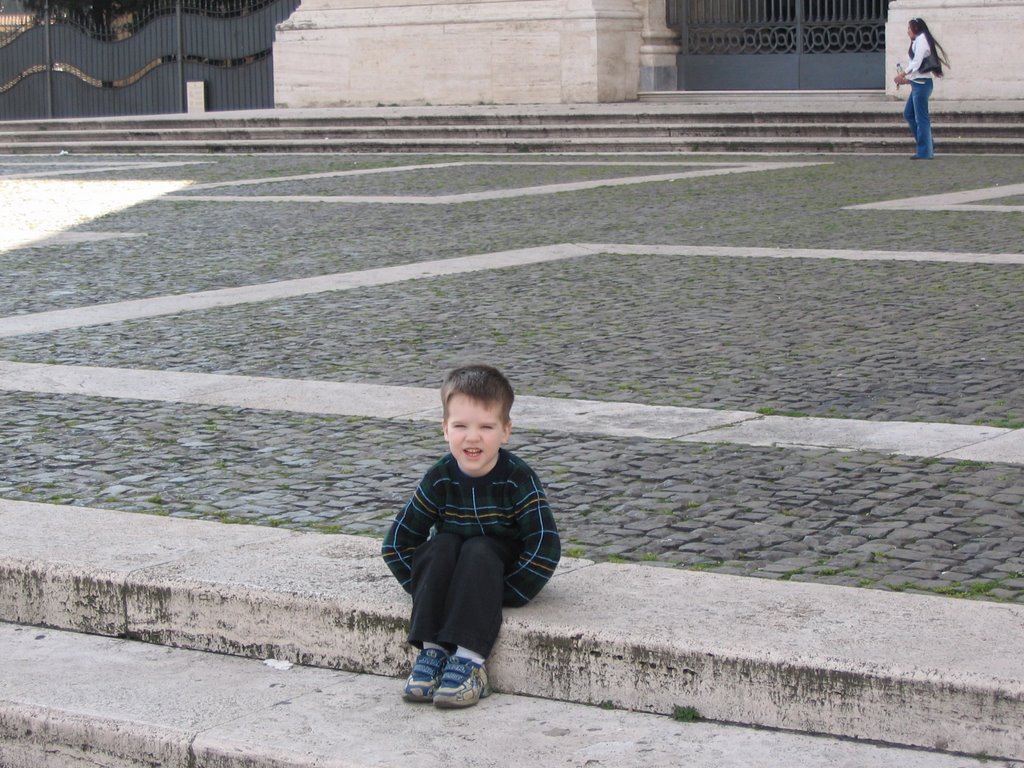
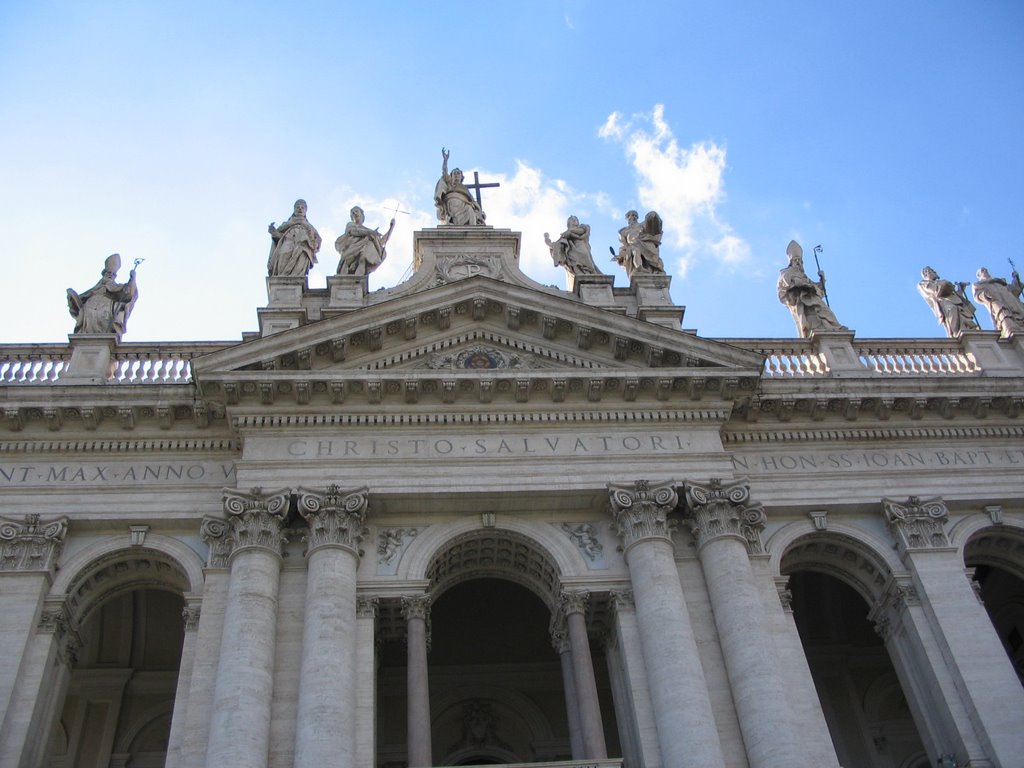
St John's has it's own Egyptian obelisk (just like St. Peter's) and a very impressive Baptistry which next to the Pope's chair is what I remember most about this part of our tour. The Baptistry was huge (I had seen one at the ruins of St. John's in Ephesus twenty-seven years earlier that was quite small in comparison). There was some type of festival going on outside of the Church that seemed to be a "Mardis Gras" or "Carnivale" type of celebration, remember this was just before the beginning of Lent. So next to the obelisk were booths, screaming kids and some people dressed in costumes giving the "pope's church" the feel of a regular parish back home.
Across the street we visited the Scala Santa--the holy stairs, said to have been brought to Rome by St. Helena the mother of Constantine and to have been the stairs that Jesus would have walked on during his Passion when he came before Pontius Pilate. The faithful climb up them on their knees and as this picture will attest--there were no shortage of takes on the day we were there, in fact there were so many that it was really impossible to get near the steps to see them.
We walked up the side steps to another chapel called the Holy of Holies because it contained many holy relics and an image of Christ reported to have been painted by St. Luke entitled "picture painted without hands"....any student of Catholic piety knows there are many images reported to have been painted by St. Luke (Our Lady of Czestochova being one example). I had never thought about it much before, but I wonder if another meaning might be that Luke's Gospel inspired the works? I doubt the people working their way up on their knees think so..
Around the other side of the Holy Stairs was the remains of the Papal dining hall and an impressive mosaic, as we were viewing this site a woman begging rather aggressively started coming at us, and we moved on toward the Church in the distance...St. Mary Major.
Walking along Zadok shared his knowledge of another area of his expertise the Irish Catholic Church begining with the Irish College, its history and various locations. We talked about the contributions the Irish priests had made to the world at large, Africa in particular and the United States (anyone who lives in the South knows the debt the Catholic Church owes to the Irish priests). What a marvel that where the Church is most vibrant right now is where the Irish planted the Faith. Pray for the Catholics in Ireland.
At this point I became very tired, I think the baby might have fallen asleep on my back and as we learned this made him very heavy. So we stopped and Zadok, Amy, Katie and Joseph had gelato. I sat.
Then up and at it again. A short visit into the Redemptorist Church where the original Our Lady of Perpetual Help is enshrined--a modern enshrinement, simple and I must say not much to my liking. Mass was being said so we weren't able to really get close.
Next to Saint Prassede, a very interesting Church decorated in a more Byzantine style with beautiful mosaics. This church contained the column that Christ was bound to when he was scourged.
Evening was falling as we arrived at Saint Mary Majors, built on the spot where snow fell one August after Pope Liberius had dreamed that this would be a sign for him to build a church dedicated to Our Lady. As we entered the Church, the chanting of Vespers could be heard. My back was aching from the baby on it and I stole away from our tour to go into the side chapel and join in the praying of Evening Prayer. I grabbed a book and went to the first empty seat I could find which was in the front where I sat next to Cardinal Bernard Law. In spite of the comotion that I created, he did not even seem to notice. I fumbled around in the book trying to locate the point the prayer was at, but to little avail and after about five minutes Michael the baby decided to join in speaking loudly his own version of chant--at which point I made my exit. We toured the church and then started making our way back to the Metro station, thanking Zadok for his time and well presented tour.
When we arrived back on Borgo Vitorio we stopped at a restaurant that Amy had spied the evening before. It was in the cellar and proved to be an excellent choice. We had a meal where everyone had what they wanted, for me it was a pasta with cheese and pepper and it was great,Joseph had a cheese pizzza, Katie a giant calzone, Amy another pasta dish, the baby had some of it all.
Evening came, the second day.

Monday, November 7, 2022

When is the first Sunday of Advent?

   Be Vigilant: Daily Meditations for Advent by [Dubruiel, Michael, Welborn, Amy]


Advent begins November 27, 2022


These brief daily meditations will help you focus on the spiritual side of Christmas. Author Michael Dubruiel died in February 2009. His wife, Amy Welborn, prepared these meditations for publication.

From a reader review:

This is my fourth year to go through this Advent devotional, and it has been truly a blessing to me and contributed to my Advent experience. The devotionals correlate with the USCCB daily readings, so it is best to read the readings and then read the devotional for the day. I myself am not Catholic, but I still get great insight out of these passages, and I can see that the author was a true follower of Christ and loved Christmas. I highly recommend this book to anyone who is looking for an Advent devotional. The book was free when I purchased it three years ago, but 99c is still a great value for this!

Sunday, November 6, 2022

Michael Dubruiel: 73 Steps to Communion with God 59b

    This is a continuation of the 73 Steps to Communion with God by Michael Dubruiel. The previous steps appear throughout the Archives, available to the left. This is the 59th step part 2:


Michael Dubruiel


(59) Not to fulfil the desires of the flesh (cf Gal 5:16).


Contrast the works of the flesh with the desires of the Spirit: "But the fruit of the Spirit is love, joy, peace, patience, kindness, goodness, faithfulness, gentleness, self-control," (Galatians 5:22). Notice the first three are all what the "desires'" of the flesh are motivated by, the desire to experience love, joy and peace, but of course they never lead to that, so we should strive to live by the Spirit.


How can w do it? St. Paul tells us, "those who belong to Christ Jesus have crucified the flesh with its passions and desires. If we live by the Spirit, let us also walk by the Spirit," (Galatians 5: 24-25). We need to subjugate ourselves to Jesus and to trust in the Holy Spirit at every moment of everyday, so that we seek to fulfill the will of God and not of our flesh.

Michael Dubruiel: 73 Steps to Communion with God 59a

   This is a continuation of the 73 Steps to Communion with God by Michael DubruielThe previous steps appear throughout the Archives, available to the left. This is the 59th step part 1: 


Michael Dubruiel


(59) Not to fulfil the desires of the flesh (cf Gal 5:16).


This counsel of St. Benedict's is a quote from St. Paul's letter to the Galatians, "But I say, walk by the Spirit, and do not gratify the desires of the flesh," (Galatians 5:16). St. Paul saw the flesh and the Spirit at war with one another and one would suspect that so would St. Benedict. The flesh for Paul was an obstacle to being the person God had created us to be.


But less we project all of our own ideas about what the "flesh" means, let us look at what St. Paul means when he speaks about the "flesh": "Now the works of the flesh are plain: fornication, impurity, licentiousness, idolatry, sorcery, enmity, strife, jealousy, anger, selfishness, dissension, party spirit, envy, drunkenness, carousing, and the like. I warn you, as I warned you before, that those who do such things shall not inherit the kingdom of God," (Galatians 5:19-21). If one peruses the list one will find that the "desires" of the flesh are all the ways that our desires can go mad and lead to our own destruction.

Friday, November 4, 2022

Michael Dubruiel: 73 Steps to Communion with God 58 Part b


  Michael Dubruiel


This is a continuation of the 73 Steps to Communion with God. by Michael Dubruiel The previous steps appear throughout the Archives, available to the left. This is the 58th step: Part 2


(58) To confess one's past sins to God daily in prayer with sighs and tears, and to amend them for the future.


I remember during a pilgrimage to Medjugordje in what is now Bosnia in the late 1980's standing in a confessional line and watching people emerge from the outside confessional stations (a chair with a priest, while the penitent knelt beside him) wiping tears away. It was touching, because it gave me the sense that these weren't just a listing off of faults but a heart felt conversion from a life without God to a life that the penitent truly wanted to live with the help of God. We should all pray for the gift of tears for our failings.


My great-grandfather would always be wiping tears away when he returned from receiving communion. I found this deeply significant as a child and it is something I've never forgotten. Involving our emotions in our relationship with God is a great grace that we should strive to have in our relationship with Him.


The final part of Benedict's maxim is to amend our lives. Real contrition for our sins involves a firm resolve to involve God in those parts of our lives that we have excluded Him in the past. By being aware of God's presence at all times we likely will amend our lives in the future.

Michael Dubruiel: 73 Steps to Communion with God 58:a

    This is a continuation of the 73 Steps to Communion with God. by Michael Dubruiel The previous steps appear throughout the Archives, available to the left. This is the 58th step: Part 1


(58) To confess one's past sins to God daily in prayer with sighs and tears, and to amend them for the future.


One of the areas of spirituality, which has been under attack for the past forty years, is the "emphasis on sinfulness" that seems to have dominated spirituality of all religions from the beginning of time. Those who have bought into this notion have found that after awhile God seems to slip further and further from the picture.


Sin essentially is anything that breaks my relationship with God. Remove sin from the picture and you are essentially removing God from the picture--because you are admitting that it really doesn't matter if you are offending God or not. It would be like being in a relationship with your spouse and refusing ever to admit any wrongdoing or to even consider that you are ever wrong (I've been accused of this before but I humbly submit that I am almost always wrong when it comes to my faults in my relationship with my wife), one would expect such a relationship to be in grave trouble.


Admitting that we are not living up to our part of the relationship is a healthy practice of constantly trying to stay in communion with God. Doing it with "sighs and tears" means that we are not just doing some per forma but rather are emotionally feeling what we are saying. St. Ignatius of Loyola would have retreatants pray for the gift of tears when they meditated on their sinfulness and this is a practice that should be restored.
Michael Dubruiel

Wednesday, November 2, 2022

November Devotional Reflection

   Standing up for truth.


Pope Benedict XVI recalls his own youth and a lesson:
My own years as a teenager were marred by a sinister regime that thought it had all the answers; its influence grew – infiltrating schools and civic bodies, as well as politics and even religion – before it was fully recognized for the monster it was. It banished God and thus became impervious to anything true and good. Many of your grandparents and great-grandparents will have recounted the horror of the destruction that ensued. Indeed, some of them came to America precisely to escape such terror.

Let us thank God that today many people of your generation are able to enjoy the liberties which have arisen through the extension of democracy and respect for human rights. Let us thank God for all those who strive to ensure that you can grow up in an environment that nurtures what is beautiful, good, and true: your parents and grandparents, your teachers and priests, those civic leaders who seek what is right and just.

The power to destroy does, however, remain. To pretend otherwise would be to fool ourselves. Yet, it never triumphs; it is defeated. This is the essence of the hope that defines us as Christians; and the Church recalls this most dramatically during the Easter Triduum and celebrates it with great joy in the season of Easter! The One who shows us the way beyond death is the One who shows us how to overcome destruction and fear: thus it is Jesus who is the true teacher of life (cf. Spe Salvi, 6). His death and resurrection mean that we can say to the Father “you have restored us to life!” (Prayer after Communion, Good Friday). And so, just a few weeks ago, during the beautiful Easter Vigil liturgy, it was not from despair or fear that we cried out to God for our world, but with hope-filled confidence: dispel the darkness of our heart! dispel the darkness of our minds! (cf. Prayer at the Lighting of the Easter Candle).

What might that darkness be? What happens when people, especially the most vulnerable, encounter a clenched fist of repression or manipulation rather than a hand of hope? A first group of examples pertains to the heart. Here, the dreams and longings that young people pursue can so easily be shattered or destroyed. I am thinking of those affected by drug and substance abuse, homelessness and poverty, racism, violence, and degradation – especially of girls and women. While the causes of these problems are complex, all have in common a poisoned attitude of mind which results in people being treated as mere objects ─ a callousness of heart takes hold which first ignores, then ridicules, the God-given dignity of every human being. Such tragedies also point to what might have been and what could be, were there other hands – your hands – reaching out. I encourage you to invite others, especially the vulnerable and the innocent, to join you along the way of goodness and hope.

The second area of darkness – that which affects the mind – often goes unnoticed, and for this reason is particularly sinister. The manipulation of truth distorts our perception of reality, and tarnishes our imagination and aspirations. I have already mentioned the many liberties which you are fortunate enough to enjoy. The fundamental importance of freedom must be rigorously safeguarded. It is no surprise then that numerous individuals and groups vociferously claim their freedom in the public forum. Yet freedom is a delicate value. It can be misunderstood or misused so as to lead not to the happiness which we all expect it to yield, but to a dark arena of manipulation in which our understanding of self and the world becomes confused, or even distorted by those who have an ulterior agenda.

Have you noticed how often the call for freedom is made without ever referring to the truth of the human person? Some today argue that respect for freedom of the individual makes it wrong to seek truth, including the truth about what is good. In some circles to speak of truth is seen as controversial or divisive, and consequently best kept in the private sphere. And in truth’s place – or better said its absence – an idea has spread which, in giving value to everything indiscriminately, claims to assure freedom and to liberate conscience. This we call relativism. But what purpose has a “freedom” which, in disregarding truth, pursues what is false or wrong? How many young people have been offered a hand which in the name of freedom or experience has led them to addiction, to moral or intellectual confusion, to hurt, to a loss of self-respect, even to despair and so tragically and sadly to the taking of their own life? Dear friends, truth is not an imposition. Nor is it simply a set of rules. It is a discovery of the One who never fails us; the One whom we can always trust. In seeking truth we come to live by belief because ultimately truth is a person: Jesus Christ. That is why authentic freedom is not an opting out. It is an opting in; nothing less than letting go of self and allowing oneself to be drawn into Christ’s very being for others (cf. Spe Salvi, 28).

-Michael Dubruiel