Tuesday, November 17, 2020

First Sunday of Advent - November 29

  Be Vigilant: Daily Meditations for Advent by [Dubruiel, Michael, Welborn, Amy]


These brief daily meditations will help you focus on the spiritual side of Christmas. Author Michael Dubruiel died in February 2009. His wife, Amy Welborn, prepared these meditations for publication.

From a reader review:

This is my fourth year to go through this Advent devotional, and it has been truly a blessing to me and contributed to my Advent experience. The devotionals correlate with the USCCB daily readings, so it is best to read the readings and then read the devotional for the day. I myself am not Catholic, but I still get great insight out of these passages, and I can see that the author was a true follower of Christ and loved Christmas. I highly recommend this book to anyone who is looking for an Advent devotional. The book was free when I purchased it three years ago, but 99c is still a great value for this!

Monday, November 16, 2020

73 Steps to Communion with God 56b

  This is a continuation of the 73 Steps to Communion with God by Michael Dubruiel.The previous steps appear throughout the Archives, available to the left. This is the 56th step part 2:


Michael Dubruiel


(56) To listen willingly to holy reading.


If we want to hear God speak to us, there is no surer way for this to happen than to listen intently to the word of God proclaimed at Mass. Perhaps we are afraid of what God might say to us--so we intently do not listen. That is a shame if it is the case.


If you want to be in communion with God listen intently to what He has to say to you when the Scriptures are read.

Sunday, November 15, 2020

73 Steps to Communion with God 56a

  This is a continuation of the 73 Steps to Communion with God by Michael Dubruiel.The previous steps appear throughout the Archives, available to the left. This is the 56th step, part 1: 


Michael Dubruiel


(56) To listen willingly to holy reading.


Another translation of this counsel has "to listen intently," both are correct but for a culture where "will" is a weak term, "intent" probably communicates the sense of the counsel better. St. Benedict was referring to the daily table reading that would be done and the fact that one has to be counseled to "listen intently" shows that even a monk's mind isn't freed from the clutter that we all find our minds filled with.


We all listen to holy reading every time that we attend Mass and there perhaps is no better counsel then to listen intently to the reading of the Holy Scriptures. The Scriptures are "living word" unlike much of what we read which consists of words that communicate a truth and usually little more. The Scriptures have the power to transcend their original purpose and to speak to us directly--if (and this is a big IF) we listen.

Saturday, November 14, 2020

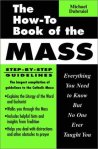
Learn about the Catholic Mass

 The How To Book of the Mass by Michael Dubruiel is also a great resource for inquirers and RCIA sessions.


You can find more information at this page. 

"amy welborn"

In this complete guide you get:
  • step-by-step guidelines to walk you through the Mass
  • the Biblical roots of the various parts of the Mass and the very prayers themselves
  • helpful hints and insights from the Tradition of the Church
  • aids in overcoming distractions at Mass
  • ways to make every Mass a way to grow in your relationship with Jesus
If you want to learn what the Mass means to a truly Catholic life—and share this practice with others—you can’t be without The How-To Book of the Mass.
Discover how to:
  • Bless yourself
  • Make the Sign of the Cross
  • Genuflect
  • Pray before Mass
  • Join in Singing the Opening Hymn
  • Be penitential
  • Listen to the Scriptures
  • Hear a Great Homily Everytime
  • Intercede for others
  • Be a Good Steward
  • Give Thanks to God
  • Give the Sign of Peace
  • Receive the Eucharist
  • Receive a Blessing
  • Evangelize Others
  • Get something Out of Every Mass You Attend


“Is this not the same movement as the Paschal meal of the risen Jesus with his disciples? Walking with them he explained the Scriptures to them; sitting with them at table ‘he took bread, blessed and broke it, and gave it to them.”
1347, Catechism of the Catholic Church

Friday, November 13, 2020

73 Steps to Communion with God - 55

 This is a continuation of the 73 Steps to Communion with God by Michael Dubruiel


MIchael Dubruiel


The previous steps appear throughout the Archives, available to the left. This is the 55th step:
(55) Not to love much boisterous laughter.

Written in the context of rules for monastic living this one is easily understood by anyone who has ever visited a good monastery. There is an atmosphere of silence that permeates the monastic environment and loud boisterous laughter would destroy such an atmosphere.
The maxim is not to "love much" explosive laughter. Again there is no prohibition against humor here but rather there is a caution of making a show of it. If one has ever been around someone who regularly explodes with loud laughter there is something rather unsettling about it--making one wonder about the sanity of the individual displaying it.
Loudness of any sort displays an excessive ego, "look at me I'm laughing." A good laugh is good for everyone, but the one who explodes in laughter is someone who is overdoing it. Parents often have to caution their children against this, it is even more embarrassing in an adult.
The obvious fault with this type of loudness is that it intrudes upon the space of those outside our immediate circle. The joy that we feel and those we are speaking to may share may not be shared by those who are loud laughter will inflict itself upon at a distance.
To not love explosive laughter can save us from much embarrassment and also preserve the decorum of respect of the people we live with.
There are those who will think that this injunction is not in keeping with the New Testament but read what the Letter of James says: "Submit yourselves therefore to God. Resist the devil and he will flee from you. Draw near to God and he will draw near to you. Cleanse your hands, you sinners, and purify your hearts, you men of double mind. Be wretched and mourn and weep. Let your laughter be turned to mourning and your joy to dejection. Humble yourselves before the Lord and he will exalt you," (James 4:7-10).
The genius of the maxims of St. Benedict is that they embrace all of Scripture, while most of us choose to only exchange a handshake with the word of God.

Thursday, November 12, 2020

St. Francis Cabrini - November 13


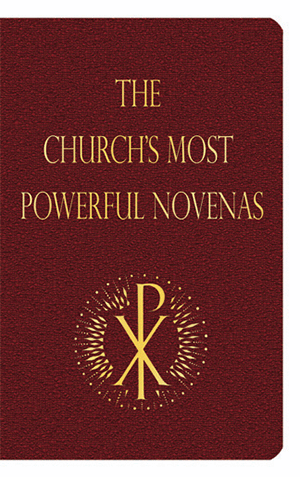
A novena to Mother Cabrini is included in The Church's Most Powerful Novenas by Michael Dubruiel

The Church's Most Powerful Novenas is a book of novenas connected with particular shrines.  Michael Dubruiel wrote in the introduction to this book he compiled:


A novena to Mother Cabrini is included in the book

When Jesus ascended into heaven, he told his Apostles to stay where they were and to "wait for the gift" that the Father had promised: the Holy Spirit.  The Apostles did as the Lord commanded them. "They all joined together constantly in prayer, along with the women and Mary the mother of Jesus, and with his brothers" (Acts 1:14). Nine days passed; then, they received the gift of the Holy spirit, as had been promised. May we stay together with the church, awaiting in faith with Our Blessed Mother, as we trust entirely in God, who loves us more than we can ever know. 

"michael Dubruiel"


73 Steps to Spiritual Communion with God - 54

This is a continuation of the the 73 Steps to Spiritual Communion with God by Michael Dubruiel, the previous posts are available in the archives to the right. This is step 54.


(54) Not to speak useless words and such as provoke laughter.


Benedict has a great concern for the choice of our speech, reflecting Our Lord's injunction in the Gospel to "let you no mean no and your yes mean yes." Most of us suffer from an endless chatter that means little and lessens the effectiveness of our speech in general. There is a further clarification here and we are warned not to "provoke laughter."


Is Benedict condemning humor or is this a warning not to appear silly to others? I think it is the latter.


Someone who talks endlessly might make others laugh at him or her but they probably will not be taken seriously. The danger here is that speech exists to communicate the truth and when it is not used specifically for that we misuse this great gift.


Benedict warns us not to use "useless words." Words are powerful weapons and gentle comforters if they are used correctly. But when speech is misused it lessens its effective use at anytime.


Another way of stating this maxim might be, "choose your words carefully and sparingly."


The Gospel of John identifies Jesus as the "Word made Flesh." There is a connection here with all the words that come from our mouth too. We should ever be mindful of The Word when a word comes to our lips.