Bishop Sheen’s “Now-moment” corresponds to the thinking of the great spiritual writer Jean Pierre de Caussade. In Abandonment to Divine Providence, Fr. Caussade gives the reader a sure way of knowing the will of God at any moment—by simply confronting the present moment with all its reality. It seems simple, but if we reflect for a second most of us will find that we spend most of our lives avoiding the present moment.
A few years ago an English translation of the Father Caussade’s work appeared in the United States changing the original title to read “The Sacrament of the Present Moment.” This captures the essence of Father Caussade’s work and Bishop Sheen’s meditation that in the present time we are presented with an opportunity that is truly unique. Each moment is sacramental.
Most of us are capable of presenting ourselves with some amount of reflection as we celebrate the sacraments. If we celebrated the sacrament of Baptism as an adult certainly we came expecting to be changed by God. Each time we enter a confessional surely we have examined our conscience beforehand and are penitent expecting to be forgiven by God. Undoubtedly every time we approach the altar to receive the Eucharist we expect to encounter God. But what about the other moments of our lives?
As we awake in the morning, is our first thought of God? As we greet our brothers and sisters throughout the day do we expect that God might be present? Every moment of our lives is an opportunity to encounter God who is always present.
Spend some time reflecting on the following:
1. Go over the events of the present day and ask yourself where God might have been in each of them. Is there a consistent pattern to your day?
2. Reflect on the life of your favorite saint, and meditate on how he or she dealt with the people they met in their daily journeys. How could you imitate this saint? What enabled the saint to act in the way he or she did toward others?
3. Imagine as you leave from this time of prayer that God wishes to continue to be present to you as you go forth. How will you react to his presence in others?
PrayerLord, help me to search for you in the garden of life in the same way that St. Mary Magdalene did when she found your tomb empty. May my search be rewarded as hers was by knowledge of your abiding presence. Amen.
Saturday, February 1, 2020
Fulton Sheen Meditation
Friday, January 31, 2020
Books by Fr. Benedict Groeschel
The genesis of this book was inspired by a set of talks that Father Benedict J. Groeschel C.F.R., gave several years ago in the Diocese of Manchester, NH. At the time while researching material for a project I was working on I came across an advertisement for the talks and found both the title and topic striking. The topic seemed to fit Father Benedict's lifetime of working among the poor and raising money to help their plight. I approached him, shortly after listening to the tapes and asked him to consider doing a book version. He liked the idea but was reluctant to pursue the project alone due to the shortage of time available to work on it.
Unwilling to let go of the project, I approached another friend of the poor, Bishop Robert J. Baker of the Diocese of Charleston. I knew that Bishop Baker's priestly ministry had been devoted to finding Christ in the poor and with a wealth of experience he had in this area that if I could join his thoughts with Fr. Groeschel' s we would have a book that would be of great benefit to the rest of us. After approaching Bishop Baker with my request he agreed and then Father Benedict agreed to collaborate on this book.
While the Bishop and Father Benedict were working on the written text of the book I came across a stunning work of iconography one day while visiting an Eastern Catholic church. On the back wall of the church was an icon of the Last Judgment taken from Matthew 25. I found that the great iconographer Mila Mina had written the icon. I immediately contacted Mila and asked if the icon might be used as an illustration for this book, her response was "anything to make the Gospel known!" Thanks to Mila and her son Father John Mina for allowing Joyce Duriga and David Renz to photograph the icon at Ascension of Our Lord Byzantine Catholic Church, Clairton, PA.
Fr. Groeschel has written the introductory text that begins each section as well as the final "What Should I Do?" at the end of the book, and Bishop Baker has written the individual meditations and prayers contained in each of the six sections.
While this book was being written, Father Benedict was involved in a horrific accident that nearly took his life. At the time of the accident the text he was working on was in his suitcase. He had just finished the introduction to "When I was a stranger..." as you read over the text for that section you might sense that he was having a premonition of what was about to happen in his life-where he would soon be in an emergency room under the care of doctors, nurses and as well as his family and religious community.
You will find that this book provides you with keys to finding Our Lord in the poor, and to overcoming the fears and obstacles (represented by the seven deadly sins in each section) that prevent you from responding to His call.
Thursday, January 30, 2020
Wednesday, January 29, 2020
Lent Stations of the Cross
Lent begins on February 26. It's time to order parish and school resources.
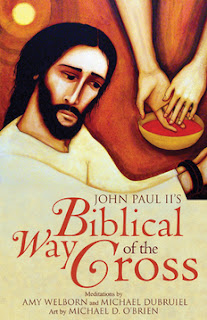
In 1991, Pope John Paul II introduced a new Bible-based interpretation of the Stations of the Cross. This devotional guide invites readers to prayerfully walk in solidarity with Jesus on his agonizing way of the cross—from his last torturous moments in the Garden of Gethsemane to his death and burial.
Now with full-color station images from previously unpublished paintings by Michael O'Brien, this booklet creates an ideal resource for individual or group devotional use, particularly during the Lenten season.
Tuesday, January 28, 2020
Thomas Aquinas - January 28
From 2003, by Michael Dubruiel
Aquinas Thought of Everything
Below is a quote from Summa Contra Gentiles. I've been familar with the notion that St. Thomas said we'd all be 33 in Heaven regardless of when we died (before or after that age), but no one every seemed to know where he'd said it. Well here it is, along with an interesting discussion on the other qualities of the glorified body:
From Jacques Maritain Center: GC 4.88:
"STILL we must not suppose, what some have thought, that female sex has no place in the bodies of the risen Saints. For since resurrection means the reparation of the defects of nature, nothing of what makes for the perfection of nature will be withdrawn from the bodies of the risen. Now among other organs that belong to the integrity of the human body are those which minister to generation as well in male as in female. These organs therefore will rise again in both. Nor is this conclusion impaired by the fact that there will be no longer any use of these organs (Chap. LXXXIII). If that were any ground for their absence from the risen body, all the organs bearing on digestion and nutrition should be absent, for there will not be any use for them either: thus great part of the organs proper to man would be wanting in the risen body. We conclude that all such organs will be there, even organs of which the function has ceased: these will not be there without a purpose, since they will serve to make up the restored integrity of the natural body.*
Neither is the weakness of the female sex inconsistent with the perfection of the resurrection. Such weakness is no departure from nature, but is intended by nature.* This natural differentiation will argue the thoroughgoing perfection of nature, and commend the divine wisdom that arranges creation in diversity of ranks and orders. Nor is there anything to the contrary in the expression of the Apostle: Till we all meet and attain to the unity of faith and recognition of the Son of God, even to a perfect man, to the measure of the full stature of Christ (Eph. iv, 13). This does not mean that in that meeting in which the risen shall go forth to meet Christ in the air* every one shall be of the male sex, but it indicates the perfection and strength of the Church, for the whole Church shalt be like a perfect, full-grown man, going out to meet Christ.*
Again, all must rise at the age of Christ,* which is the age of perfect manhood, for the sake of the perfection of nature, which is at its best in this age above others.
Monday, January 27, 2020
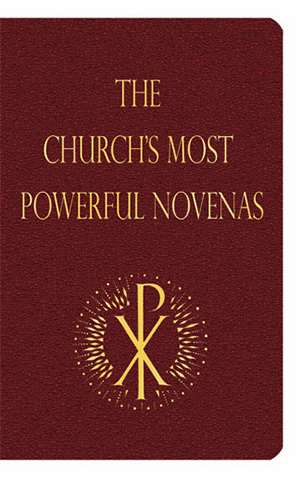
What is a Novena?
When Jesus ascended into heaven, he told his Apostles to stay where they were and to "wait for the gift" that the Father had promised: the Holy Spirit. The Apostles did as the Lord commanded them. "They all joined together constantly in prayer, along with the women and Mary the mother of Jesus, and with his brothers" (Acts 1:14). Nine days passed; then, they received the gift of the Holy spirit, as had been promised. May we stay together with the church, awaiting in faith with Our Blessed Mother, as we trust entirely in God, who loves us more than we can ever know.
Divine Mercy Novena
Sunday, January 26, 2020
How to Get the Most Out of the Eucharist - part 12
From How to Get the Most Out of the Eucharist by Michael Dubruiel
From chapter 2 - Serve. Part 8
F O S T E R I N G A N AT T I T U D E O F S E R V I C E
If you have ever held a position in a service industry then you know that one of the principal ways of fostering an attitude of service is by presuming that the customer is always right.Having been in that position myself in many different jobs over the course of my life, I know that many times the customer isn’t right,but I also know that when you treat them as if they are they are more apt to come to the truth than when you treat them in an arrogant manner.
H ELP FROM THE FATHERS OF THE C HURCH
Let your prayer, then, be no mere pronouncing of words with the lips. Devote your whole attention to it, enter into the retreat of your heart, penetrate its recesses as deeply as possible. May he whom you seek to please not find you negligent. May he see that you pray with your whole heart, so that he will deign to hear you when you pray with your whole heart.
— S T. A MBROSE
Fostering an attitude of service toward God in the Eucharist is not exactly the same thing as assuming that the customer is always right, however, because unlike the human customer, who may in fact be wrong, God is always right! Believing that can lead us to some rather startling conclusions,when we come to Mass and with every moment of our lives. A great illustration of this attitude of service is found in the Second Book of Samuel when King David flees Jerusalem after it has been taken over by his son Absalom. As David flees, a kinsman of King Saul named Shimei comes out as the king passes by and begins cursing him, continually throwing stones at David and his servants.One of David’s servants,Abishai, says to David,“Why should this dead dog curse my lord the king? Let me go over and take off his head” (2 Samuel 16:9).
King David’s response is to rebuke Abishai and to wonder “If he is cursing because the LORD has said to him,‘Curse David,’who then shall say, ‘Why have you done so?’ ” (2 Samuel 16:10). They travel on and Shimei continues to follow them, cursing while throwing stones and dust.
What if this were our attitude? What if we were to take a second look when something happens that isn’t in our plan, perhaps even to think that the person cursing us might be doing so because God is telling him or her to do so?
A servant is always ready to serve.This is a sacrifice that Christ demands of his followers, and one that when we embrace it will help us to get the most from the Eucharist we celebrate.
Subscribe to:
Comments (Atom)