Saturday, November 9, 2019

St. John Lateran - November 9


A visit to St. John Lateran, from 2006, by Michael Dubruiel:


After a quick lunch (pizza, what else?)we headed toward the Metro station to catch the A Train to St. John Lateran's to meet up with Zadok who had so generously agreed to give us a tour of two of Rome's greatest Churches. We were still pretty green when it comes to the whole Metro system and walked (rather than took a bus) to the station, so by the time we finally arrived we were late and Zadok was nowhere to be seen (at least not at the Metro station where Amy had thought he had said he was going to meet us). So Amy went out the other possible exits and Katie, Joseph, the baby (on my back) and I went a bit further and bought a bottle of water. When Amy came to say that he could not be found, we decided to go on further to the Church and see if he might have gone on there when we had not arrived on time. Sure enought there he was...
I should mention that at this point we had already walked quite a bit (given two treks through St. Peter's, a good half mile to the Metro and another two or three blocks from the Metro to St. John's) while we stood and listened to Zadok's interesting history of the surrounding landmarks, Joseph sat. And even looking at the front of the Church's pavement now, makes me tired to think about even walking that distance. Most people think that St. Peter's is the Cathedral Church of Rome, but it isn't--St. John Lateran's is. While the chair of Peter is in St. Peter's, the Bishop of Rome's chair is at St. John Lateran's and this is the central feature of the apse of the Church, now that I think of it in a similar way to the way that the Chair of Peter is in the apse of St. Peter's. When St. Francis of Assisi came to Rome to see the Pope, he came here to the Lateran and their are large statues of Francis and his crew directly across from St. John's that seem to be in communication with the large statues that are on the facade of St. John's. After his election as pope last April, Pope Benedict XVI came here to the Lateran to be formally installed as the Bishop of Rome (ever wonder why the Bishop of Rome isn't an "archbishop"?).
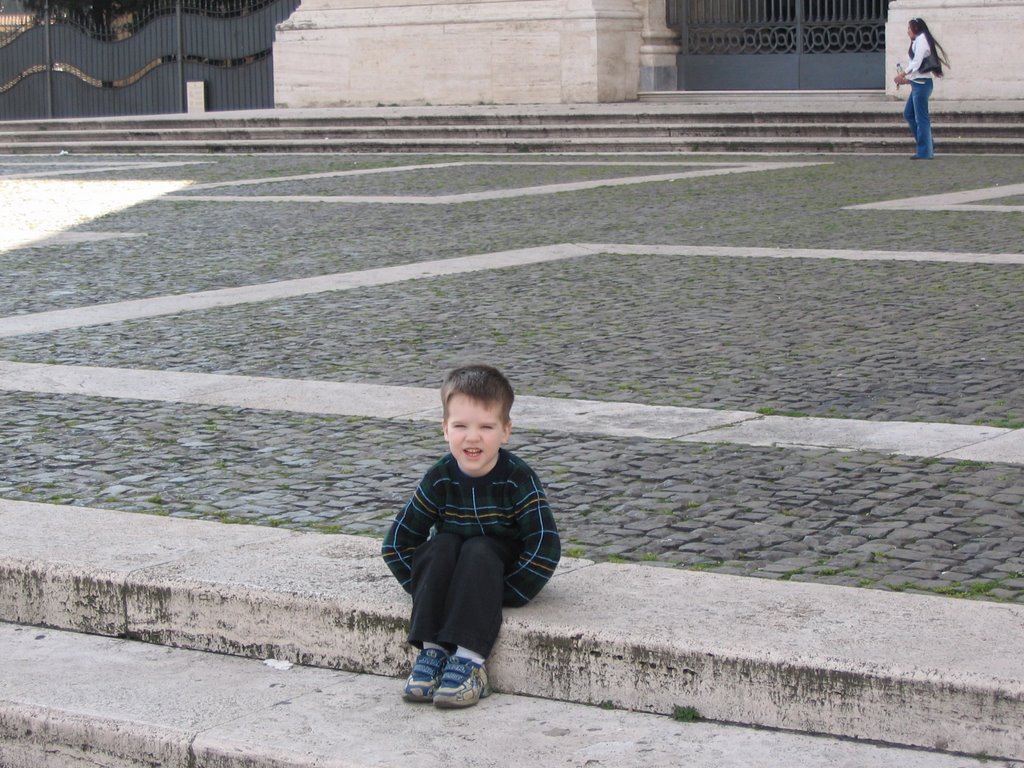
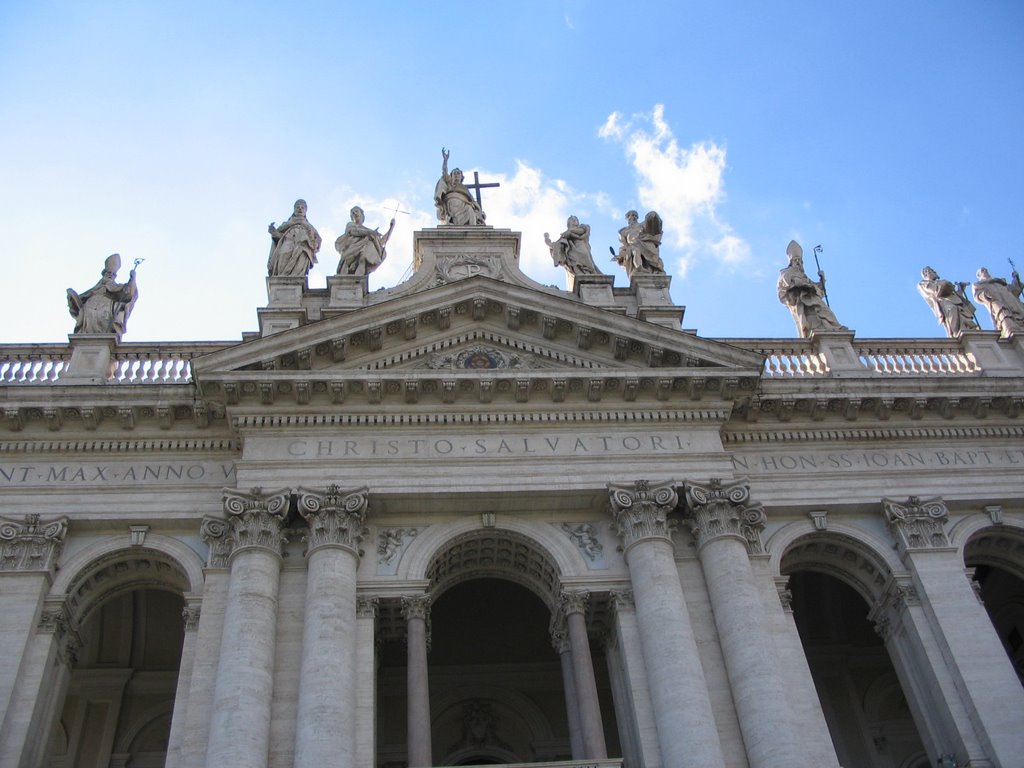
St John's has it's own Egyptian obelisk (just like St. Peter's) and a very impressive Baptistry which next to the Pope's chair is what I remember most about this part of our tour. The Baptistry was huge (I had seen one at the ruins of St. John's in Ephesus twenty-seven years earlier that was quite small in comparison). There was some type of festival going on outside of the Church that seemed to be a "Mardis Gras" or "Carnivale" type of celebration, remember this was just before the beginning of Lent. So next to the obelisk were booths, screaming kids and some people dressed in costumes giving the "pope's church" the feel of a regular parish back home.
Across the street we visited the Scala Santa--the holy stairs, said to have been brought to Rome by St. Helena the mother of Constantine and to have been the stairs that Jesus would have walked on during his Passion when he came before Pontius Pilate. The faithful climb up them on their knees and as this picture will attest--there were no shortage of takes on the day we were there, in fact there were so many that it was really impossible to get near the steps to see them.
We walked up the side steps to another chapel called the Holy of Holies because it contained many holy relics and an image of Christ reported to have been painted by St. Luke entitled "picture painted without hands"....any student of Catholic piety knows there are many images reported to have been painted by St. Luke (Our Lady of Czestochova being one example). I had never thought about it much before, but I wonder if another meaning might be that Luke's Gospel inspired the works? I doubt the people working their way up on their knees think so..
Around the other side of the Holy Stairs was the remains of the Papal dining hall and an impressive mosaic, as we were viewing this site a woman begging rather aggressively started coming at us, and we moved on toward the Church in the distance...St. Mary Major.
Walking along Zadok shared his knowledge of another area of his expertise the Irish Catholic Church begining with the Irish College, its history and various locations. We talked about the contributions the Irish priests had made to the world at large, Africa in particular and the United States (anyone who lives in the South knows the debt the Catholic Church owes to the Irish priests). What a marvel that where the Church is most vibrant right now is where the Irish planted the Faith. Pray for the Catholics in Ireland.
At this point I became very tired, I think the baby might have fallen asleep on my back and as we learned this made him very heavy. So we stopped and Zadok, Amy, Katie and Joseph had gelato. I sat.
Then up and at it again. A short visit into the Redemptorist Church where the original Our Lady of Perpetual Help is enshrined--a modern enshrinement, simple and I must say not much to my liking. Mass was being said so we weren't able to really get close.
Next to Saint Prassede, a very interesting Church decorated in a more Byzantine style with beautiful mosaics. This church contained the column that Christ was bound to when he was scourged.
Evening was falling as we arrived at Saint Mary Majors, built on the spot where snow fell one August after Pope Liberius had dreamed that this would be a sign for him to build a church dedicated to Our Lady. As we entered the Church, the chanting of Vespers could be heard. My back was aching from the baby on it and I stole away from our tour to go into the side chapel and join in the praying of Evening Prayer. I grabbed a book and went to the first empty seat I could find which was in the front where I sat next to Cardinal Bernard Law. In spite of the comotion that I created, he did not even seem to notice. I fumbled around in the book trying to locate the point the prayer was at, but to little avail and after about five minutes Michael the baby decided to join in speaking loudly his own version of chant--at which point I made my exit. We toured the church and then started making our way back to the Metro station, thanking Zadok for his time and well presented tour.
When we arrived back on Borgo Vitorio we stopped at a restaurant that Amy had spied the evening before. It was in the cellar and proved to be an excellent choice. We had a meal where everyone had what they wanted, for me it was a pasta with cheese and pepper and it was great,Joseph had a cheese pizzza, Katie a giant calzone, Amy another pasta dish, the baby had some of it all.
Evening came, the second day.

Friday, November 8, 2019

How to Receive Communion in a Catholic Mass

These were written by Michael Dubruiel many years ago. 


We say the words of the Centurion before communion everytime we go to Mass but do we really mean it? "Lord, I am not worthy..."
Most of us probably think there are times when we aren't worthy but plenty of other times that we are. The truth is that we are never worthy. The more we can foster that notion the less likely we are to sit in judgment of others, the less likely we are to ever think we know better than God.

If we are to truly look forward to the coming of Christ we have to foster within us a deep sense of our own unworthiness that creates space for Christ to enter into our lives. The Centurion realized that a mere word from the savior could save his servant. In faith we should open the Scriptures with the same belief and expectation.


Michael Dubruiel

Thursday, November 7, 2019

How to Pray

The letter to the Hebrews draws a strong connection
between the cross and prayer. Because every moment of our
earthly existence is threatened by death, and we know neither the
day nor the hour when that existence will come to an end, we,
too, need to cry out to the God who can save us. Like Moses, we
need the help of our fellow Christians to hold up our arms when
they grow tired. We, too, need the help of the Holy Spirit to
make up for what is lacking in our prayer. 


-The Power of the Cross by Michael Dubruiel


"michael dubruiel"

Wednesday, November 6, 2019

November Devotional Reflection

Standing up for truth.

Pope Benedict XVI recalls his own youth and a lesson:
My own years as a teenager were marred by a sinister regime that thought it had all the answers; its influence grew – infiltrating schools and civic bodies, as well as politics and even religion – before it was fully recognized for the monster it was. It banished God and thus became impervious to anything true and good. Many of your grandparents and great-grandparents will have recounted the horror of the destruction that ensued. Indeed, some of them came to America precisely to escape such terror.

Let us thank God that today many people of your generation are able to enjoy the liberties which have arisen through the extension of democracy and respect for human rights. Let us thank God for all those who strive to ensure that you can grow up in an environment that nurtures what is beautiful, good, and true: your parents and grandparents, your teachers and priests, those civic leaders who seek what is right and just.

The power to destroy does, however, remain. To pretend otherwise would be to fool ourselves. Yet, it never triumphs; it is defeated. This is the essence of the hope that defines us as Christians; and the Church recalls this most dramatically during the Easter Triduum and celebrates it with great joy in the season of Easter! The One who shows us the way beyond death is the One who shows us how to overcome destruction and fear: thus it is Jesus who is the true teacher of life (cf. Spe Salvi, 6). His death and resurrection mean that we can say to the Father “you have restored us to life!” (Prayer after Communion, Good Friday). And so, just a few weeks ago, during the beautiful Easter Vigil liturgy, it was not from despair or fear that we cried out to God for our world, but with hope-filled confidence: dispel the darkness of our heart! dispel the darkness of our minds! (cf. Prayer at the Lighting of the Easter Candle).

What might that darkness be? What happens when people, especially the most vulnerable, encounter a clenched fist of repression or manipulation rather than a hand of hope? A first group of examples pertains to the heart. Here, the dreams and longings that young people pursue can so easily be shattered or destroyed. I am thinking of those affected by drug and substance abuse, homelessness and poverty, racism, violence, and degradation – especially of girls and women. While the causes of these problems are complex, all have in common a poisoned attitude of mind which results in people being treated as mere objects ─ a callousness of heart takes hold which first ignores, then ridicules, the God-given dignity of every human being. Such tragedies also point to what might have been and what could be, were there other hands – your hands – reaching out. I encourage you to invite others, especially the vulnerable and the innocent, to join you along the way of goodness and hope.

The second area of darkness – that which affects the mind – often goes unnoticed, and for this reason is particularly sinister. The manipulation of truth distorts our perception of reality, and tarnishes our imagination and aspirations. I have already mentioned the many liberties which you are fortunate enough to enjoy. The fundamental importance of freedom must be rigorously safeguarded. It is no surprise then that numerous individuals and groups vociferously claim their freedom in the public forum. Yet freedom is a delicate value. It can be misunderstood or misused so as to lead not to the happiness which we all expect it to yield, but to a dark arena of manipulation in which our understanding of self and the world becomes confused, or even distorted by those who have an ulterior agenda.

Have you noticed how often the call for freedom is made without ever referring to the truth of the human person? Some today argue that respect for freedom of the individual makes it wrong to seek truth, including the truth about what is good. In some circles to speak of truth is seen as controversial or divisive, and consequently best kept in the private sphere. And in truth’s place – or better said its absence – an idea has spread which, in giving value to everything indiscriminately, claims to assure freedom and to liberate conscience. This we call relativism. But what purpose has a “freedom” which, in disregarding truth, pursues what is false or wrong? How many young people have been offered a hand which in the name of freedom or experience has led them to addiction, to moral or intellectual confusion, to hurt, to a loss of self-respect, even to despair and so tragically and sadly to the taking of their own life? Dear friends, truth is not an imposition. Nor is it simply a set of rules. It is a discovery of the One who never fails us; the One whom we can always trust. In seeking truth we come to live by belief because ultimately truth is a person: Jesus Christ. That is why authentic freedom is not an opting out. It is an opting in; nothing less than letting go of self and allowing oneself to be drawn into Christ’s very being for others (cf. Spe Salvi, 28).

-Michael Dubruiel 

Tuesday, November 5, 2019

Sacred Heart of Jesus


The promises of the Sacred Heart of Jesus to Saint Margaret Mary:

1. I will give them all the graces necessary for their state of life.
2. I will give peace in their families.
3. I will console them in all their troubles.
4. I will be their refuge in life and especially in death.
5. I will abundantly bless all their undertakings.
6. Sinners shall find in my Heart the source and infinite ocean of mercy.
7. Tepid souls shall become fervent.
8. Fervent souls shall rise speedily to great perfection.
9. I will bless those places wherein the image of
My Sacred Heart shall be exposed and venerated.
10. I will give to priests the power to touch the most hardened hearts.
11. Persons who propagate this devotion shall
have their names eternally written in my Heart.
12. In the excess of the mercy of my Heart, I promise you that my all powerful love will grant to all those who will receive Communion on the First Fridays, for nine consecutive months, the grace of final repentance: they will not die in my displeasure, nor without receiving the sacraments; and my Heart will be their secure refuge in that last hour.

Michael Dubruiel

Monday, November 4, 2019

73 Steps to Communion with God - Step 72 Part 2

This is a continuation of the 73 Steps to Communion with God by Michael Dubruiel. The previous postings are found in the archives to the right. This is the 72nd Step Part 2:


(72) To make peace with an adversary before the setting of the sun.


And what of us?


Are we aware of the control that others have over us by their actions and words?


Really this is a counsel to make sure that any time God is Lord over you. When we make someone an enemy we are in danger of making them an idol that we worship and serve. They and the actions that they commit against us are not all-powerful and do not deserve the time and emotion that we often waste on them. Making peace with our adversaries means making peace with God first, asking God to empower us to forgive and acknowledging that God is the judge over all. We let go and let God be God in our lives.

Sunday, November 3, 2019

73 Steps to Communion with God - Step 72 Part 1

This is a continuation of the 73 Steps to Communion with God by Michael Dubruiel. The previous postings are found in the archives to the right. This is the 72nd Step Part 1:


(72) To make peace with an adversary before the setting of the sun.


We should always strive to remain at peace with everyone. One wonders how different life would be if everyone were to embrace this counsel and practice it in their daily life. Would there ever be another war? Would anyone have reason to live in fear anymore?


But such is not the case and I cannot live with my focus on what others are or are not doing. I can only put this counsel into practice myself. Do I allow the sun to set without making peace with those who I'm either angry with or those who are angry with me.