Thursday, September 19, 2019

St. Januarius - September 19

Feast of St. Januarius


A sealed glass vial containing a dark unknown substance, allegedly the clotted blood of San Gennaro (St Januarius), is shown several times a year to a packed crowd in the Cathedral of Napoli (Naples). Whilst the container is being handled during a solemn ceremony, the solid mass suddenly liquefies before everybody's eyes. [1, 2]


This well-documented phenomenon is still regarded as unexplained [3] by believers and sceptics alike. Noted parapsychologist Hans Bender defined it the paranormal phenomenon with the best and historical documentation; [4] physicist Enrico Fermi seems to have expressed interest as well.


It is also one of the few recurrent non-medical, physical "miracles" that might be studied scientifically.


Above from CICAP, the Italian Committee for the Investigation of Claims on the Paranormal

-Michael Dubruiel

Wednesday, September 18, 2019

73 Steps to Spiritual Communion with God

This is a continuation of the 73 Steps to Spritual Communion with God by Michael Dubruiel. The previous posts are in the archives to the right. This is step 50:


(50) To dash at once against Christ the evil thoughts which rise in one's heart.


St. Benedict's counsel is wise. Our Lord gave his disciples "power" and that same "power" is available to us, we should avail ourselves tof this powert when we most need it. We need it most when evil thoughts are at their very infancy within our emotions, when they "rise in one's heart." At that moment we should run like a little toddler to Our Lord.


Being a disciple of Our Lord requires this child like faith. In fact the greatest evil thought that can arise in our hearts is to start thinking that we are finally "mature" enough in the spiritual life and don't need to do this. As Our Lord said when his disciples returned from a very successful missionary journey, "I saw Satan fall like lightning!" Pride over the gifts that we have been given can quickly cut us off from the source of our salvation.


So with child like faith we move through life ever vigilant over our thoughts, scrupulously turning to Our Lord at every moment where evil seems to lurk.


Benedict's image of 'dashing against" calls to mind a clutching disciple, grabbing hold of Our Lord's garment lest we fall. It is a good image because the desparation that it suggests is what we are faced with in our daily lives. As St. Paul said, "Examine yourselves, lest you fall."

Tuesday, September 17, 2019

73 Steps to Spritual Communion with God 49 Michael Dubruiel

This is a continuation of the 73 Steps to Spritual Communion with God by Michael Dubruiel The previous posts are in the archives to the right. This is step 49:


(49) To hold as certain that God sees us everywhere.


Almost all of us were raised with this notion, which was a useful tool that parents could use to insure that when they weren't around there was another, bigger and far meaner parent in the sky. The last part is the most unfortunate part of this. God is not meaner but far more loving than any human could ever be toward us.


Again because most of us were taught this as children it tends to immediately make us think of whether we are good or bad. But really another way to think of it is God is always there looking out for us. Always ready for us to call upon His name. That he watches over us and protects us.


Reflecting on this counsel, I think you can see is colored by your image of God. Does that image reflect what Jesus Christ showed God to be like or does it reflect what your parents, or some other religious figure revealed to you that God was like. More importantly, does whatever I was taught match to what the Gospels reveal about Jesus?


This is the "type" of God who sees us no matter where we are, a loving God. One who is not up there waiting to strike us dead and send us to Hell, but one who is willing to come down and become a man and walk in our midst and to suffer and die when we reject Him--and then to come back again to offer us forgiveness. "His mercy endures forever."


Today, and everyday be mindful of the presence of God, always with you no matter if you believe or not. In the words of an old Latin saying, Vocatus atque non vocatus Deus aderit, "Bidden or not bidden God is present."

Monday, September 16, 2019

73 Steps to Deeper Spirituality by Michael Dubruiel - 48

This is a continuation of the 73 Steps to Spritual Communion with God by Michael Dubruiel. The previous posts are in the archives to the right. This is step 48:


(48) To keep a constant watch over the actions of our life.


We read in the Book of Wisdom "To fix one's thought on her is perfect understanding, and he who is vigilant on her account will soon be free from care", (Wisdom 6:15). Vigilance is a hallmark of monastic life, it is why silence has always been valued in that setting.


Vigilance requires attentiveness. Everyone has had the experience where they arrive home after driving the daily route only to discover that they remember nothing about the trip they have just made presumably awake. Much of life can become so routine that we are oblivious to those around us.


Monks have a practice of keeping "vigil." I once tried something similar when I attended school at a monastery. I decided that I would simply spend the night with Jesus in the Blessed Sacrament. I took along a Bible, a rosary and sat in a small oratory. Just the Lord and me. The time passed rather quickly. There were no great revelations during that period of prayer, but what I did notice was that during the next few days everything seemed more intense. It was almost as though the world was suddenly in "high definition" vs. the black and white that it usually seems to be.


Unfortunately, for me it was a one time event. But I have noticed that the more I pray, the more vigilant I become. The more I notice others that cross my path. The less I travel through my day on automatic pilot.


Most of us might raise the excuse of there being too many distractions in life for us to be truly vigilant. But therein lies the distinction--distractions demand our attention. What we call distractions are things that we are ignoring that are clamoring for our attention. The vigilant persons pays attention to everything they are doing and thinking.


The image of a psychic who seems to see and hear voices that no one else hears seems an apt representation of the vigilant person. All of us carry with us intense memories of past experiences, these play a heavy role in the way we act toward others. The vigilant person will discern the "other" people in the room so to speak when they encounter their daily contacts.


Prayer and discernment are both necessary to be truly vigilant in our actions. We need to truly see what creates our reactions to people and events and bring them to God. To free ourselves from inordinate attachments. As the Book of Wisdom says to be vigilant will "free us from all care." No regrets, only gratitude.

Sunday, September 15, 2019

Our Lady of Sorrows - September 15

In northern Ohio there is a church dedicated to Our Lady
of Sorrows; in the basement is a room containing signs of
weakness that have been left behind by those who have experienced
the power of God at that shrine. Among whiskey bottles,
cigarettes, crutches, and leg braces is a mat that once
carried a paralyzed man there—who left empowered by God
to walk again.

I suspect that the most powerful stories of healing, however,
come from those who were unable to leave anything behind.
Their weakness, whatever it was, remained with them; however,
they had been empowered to carry their weakness in the power
of God. This type of healing often goes unnoticed. Even so, it is
the greater healing, because it enables us to share in the cross of
Christ, to embrace our weakness in the power of God. For the
follower of Christ, weakness need not mean defeat!


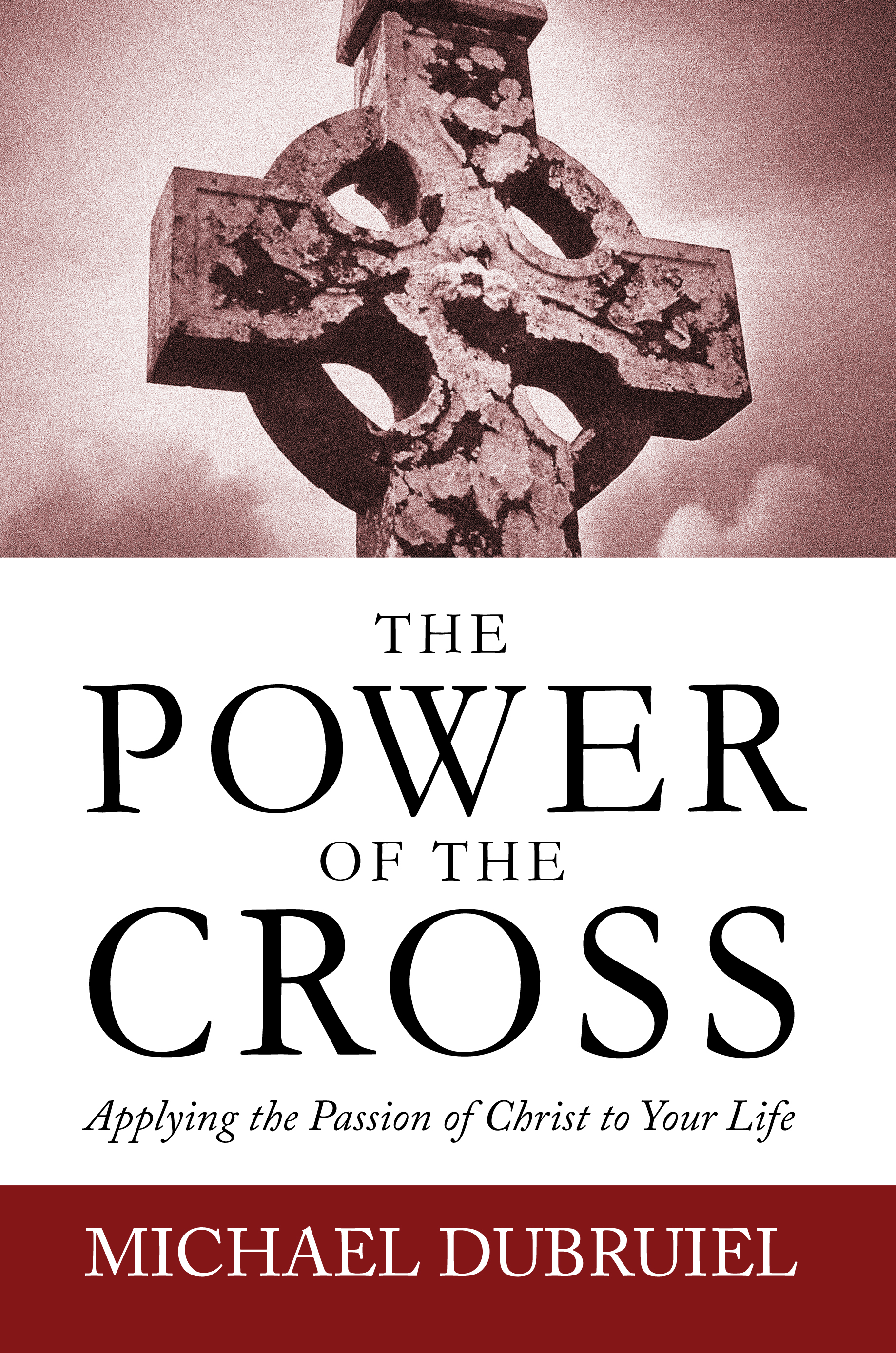
-The Power of the Cross by Michael Dubruiel
"michael dubruiel"

Saturday, September 14, 2019

Exaltation of the Holy Cross - September 14

Michael Dubruiel

Here's a link to a page with a free download of Michael Dubruiel's book The Power of the Cross.

It's in .pdf format.

Also on the page is a link to a series of interviews Michael did with Catholic radio station KVSS on the book.

St. Francis of Assisi taught his followers to reverence Christ and
his cross wherever they might find themselves. The prayer attributed
to St. Francis that begins, “Lord, make me a channel of your
peace,” was in fact not composed by St. Francis; it was misapplied
to him in a prayer book. The true prayer of St. Francis was one
he taught his friars to pray whenever they would pass a Church
or the sign of the cross made by two branches in a tree. They were
to prostrate themselves toward the church or the cross and pray,
“We adore you Christ and we praise you present here and in all
the Churches throughout the world, because by your holy cross
you have redeemed the world.”

The cross reminds us of the true Christ, the one in the
Gospels who was constantly misjudged by the religious figures
of his day. If we are not careful, he will be misjudged by us as well.
We need to worship him alone.

Friday, September 13, 2019

73 Steps to Spritual Communion with God - 47

This is a continuation of the 73 Steps to Spritual Communion with God by Michael Dubruiel. The previous posts are in the archives to the right. This is step 47:


(47) To keep death before one's eyes daily.


Momento Mori, "remember death" is an ancient spiritual maxim presented to us here by St. Benedict. Keeping one's end in mind helps us to focus on what really matters. Many self-motivators have picked up on this and while avoiding "death" have sought to get people to meditate on what is really important in life.


Of course what happens after death matters a great deal if we are to focus on death. If one believes that nothing happens after death that focusing on it could be a morose practice that would only depress the person. If on the other hand one believes in the after life and a judgment then every decision I make in the present is moving me along a road in one of two directions--either toward heaven or hell.


Many people believe in a after life for absolutely no good reason. Many of them do not believe in God, but reaping the harvest of Christendom continue to carry around with them a vague sense that death is not the end. But this belief does not come from science.

Others, nihilists, belief in nothing but the present but in a rather dark manner, since death is the end that the whole of life is rather meaningless and existence is a bore.


Then there are the Epicureans who "eat, drink and are merry" for tomorrow we die. Their focus is on death, but it is one where death is looked at as the great enemy that must be avoided at all costs by throwing as much pleasure as possible at the body while it is still alive. These are the saddest of people. Often their bodies are racked with pain from the abuse that they have subjected it to in pursuit of pleasure.


The final group is made up of believers. Our focus on death is to be hopeful. It is to help us to get through the present moment when it is difficult. It is to inspire us in the present moment when it seems meaningless. It is to keep our eyes on the gift that sin promises-death and the redemption that God through Jesus promises-life.


This focus is one of reality. We are all going to die. By facing it daily it will not catch us unprepared nor unready for God's judgment.