Monday, September 9, 2019

73 Steps to Spiritual Communion with God - 44

This is a continuation of the the 73 Steps to Spiritual Communion with God by Michael Dubruiel, the previous posts are available in the archives to the right. This is step 44.


(44) To fear the day of judgment.


A recent visit to a large Midwestern city was filled with moments where I paused to think about the tragedies of September 11, 2001 and what could happen again or as the United States government often relates-something worst. One of the buildings in this city, that towers over all the rest is especially impressive and the thought of it tumbling like the World Trade Centers was almost incomprehensible. Milling around the streets with thousands of others it was hard to envision some nuclear attack suddenly wiping out a million people in an instance.


Although the sun shone and it was a beautiful day there was a hint of an impending storm that post-9/11 seemed to hang heavy in the air. It made me think of the words of Our Lord when his disciples marveled at the size of the Temple in Jerusalem and its beauty (it was one of the Seven Wonders of the Ancient World), "As for these things which you see, the days will come when there shall not be left here one stone upon another that will not be thrown down," (Luke 21:7).


Driving home past abandoned motels and gas stations, I thought of the transitory nature of life. People that I once admired now lie cold in tombs, amusement parks that delighted me as a child now lie dormant, everything has a judgment day, everything!


St. Benedict says we should "fear" the day of judgment. It should be something ever on our minds. To keep "our" final end in sight has always been an important practice because it helps us to "order" our lives to that end. Most of us can point to our greatest lapses or sins as times when we had lost sight of our purpose in life.


Fear can be a horrible motivator or it can be a great one. When I was in basic training in the Army some years ago, I remember an incident where one of my fellow trainees was having difficulty producing urine for some medical procedure. He came out to the drill sergeant holding the empty container. The drill sergeant in response yelled in his face, "Go!" And he did, as the front of his fatigues darkened. I saw him a few minutes later squeezing what he could out of his pants into the container.


But Jesus also said, "Fear is useless, what is need is trust," and while fearing judgment day can help us to refocus on what truly matters and what the right thing to do is in any situation, ultimately it should always lead us back to placing our trust in God. Fearing judgment should always drop us to our knees and reconnect with God. Every moment is an invitation to prayer and every second has its own needs that require that special help from God.

Sunday, September 8, 2019

Nativity of Mary - Pray the Rosary

Michael Dubruiel conceived and put together the small hardbound book, Praying the Rosary.  Click on the cover for more information.

"Michael Dubruiel"


The Gospels show that the gaze of Mary varied depending upon the circumstances of life. So it will be with us. Each time we pick up the holy beads to recite the Rosary, our gaze at the mystery of Christ will differ depending on where we find ourselves at that moment.

Thereafter Mary’s gaze, ever filled with adoration and wonder, would never leave him. At times it would be a questioning look, as in the episode of the finding in the Temple: “Son, why have you treated us so?” (Lk 2:48); it would always be a penetrating gaze, one capable of deeply understanding Jesus, even to the point of perceiving his hidden feelings and anticipating his decisions, as at Cana (cf. Jn 2:5). At other times it would be a look of sorrow, especially beneath the Cross, where her vision would still be that of mother giving birth, for Mary not only shared the passion and death of her Son, she also received the new son given to her in the beloved disciple (cf. Jn 19:26-27). On the morning of Easter hers would be a gaze radiant with the joy of the Resurrection, and finally, on the day of Pentecost, a gaze afire with the outpouring of the Spirit (cf. Acts 1:14) [Rosarium Virginis Mariae, no. 10].


As we pray the Rosary, then, we join with Mary in contemplating Christ. With her, we remember Christ, we proclaim Him, we learn from Him, and, most importantly, as we raise our voices in prayer and our hearts in contemplation of the holy mysteries, this “compendium of the Gospel” itself, we are conformed to Him.


Saturday, September 7, 2019

73 Steps to Spiritual Communion with God - 43

This is a continuation of the 73 Steps to Spiritual Communion with God by Michael Dubruiel. The previous posts are below and in the archives to the right. This is the 43rd step:


(43) But as to any evil in himself, let him be convinced that it is his own and charge it to himself.


This counsel follows from the previous one. If God has created us as "good" then any evil is from our free choice to do other than what God wills for us. We should understand that what is "evil" is bad for us, to the point that if we persist in evil it leads to our self-destruction.


If God has created us as good, then anything that is not good can not be from God, it must have another source, St. Benedict concludes rightly that it must come from ourselves.


There are many maladies in life that may seem evil but really are not. Someones genetic makeup may make the prone to an early death and on the surface that may seem like an "evil" but in fact it is only our perception again of what our idea of "good" is. A person whose life is limited by their genetic or physical condition still has been put on this earth by God and still has a mission. They can do much good with the talents that God has given them. To bury the talents because of their perceived bad condition is to squander the good.


A woman born in a physical condition that gave her little chance to live beyond her twenties, described an incident that she says happened to her on the day of her birth. "God," she says, "asked me if I wanted to do something special for Him." She says that she responded, "Yes."


Virginia Cyr spent her short twenty-something years praising God in a body racked with pain, in and out of orphanages after her mother abandoned her, sexually abused by a drunken priest who took advantage of her physical condition which prevented her from running away--through it all she thanked God for the mission, He had blessed her with on her day of her birth.


Now this Indiana woman lies waiting the resurrection in a grave in Lafayette. The orphanage where she lived in Fort Wayne, no longer is there. Perhaps an answer to some prayer that God answered because she had so faithfully carried out His mission.


No matter what, evil is our choice and the good is God's blessing.

Friday, September 6, 2019

73 Steps to Spiritual Communion with God - 42 by Michael Dubruiel

This is a continuation of the 73 Steps to Spiritual Communion with God by Michael Dubruiel. The previous posts are below and in the archives to the right. This is the 42nd step:


(42) To refer what good one sees in himself, not to self, but to God.


If we have lived long enough, and are in touch with what motivates us, I think we will come to see the truth that there is a great good that is essential to who we are at our deepest core. God created us and as God says in the Book of Genesis when he looked upon his creation-He saw that it was "good."


God is responsible for the goodness that is at the core of every human being. It is there and we can both see it in others and in ourselves.


When God became Man, He had no problem recognizing the "good" that was in all of creation. Where some saw prostitutes or tax collectors, the Son of God saw precious creatures that had the same basic goodness as all who have been created by God.


When the rich young man called Jesus, "Good teacher," Jesus corrected him, "Why call me good? Only God is good." Here we have an application of this counsel by Jesus Himself.


Yes, only God is good, but He has shared that goodness in His creation. We are part of God's creation. Therefore when we worship Him, we come to know ourselves as we truly are and we come to see the goodness that is at the heart of who He has created us to be.


This original goodness has been marred by Original Sin, sadly people do not realize the great value that they possess. Often they are confused about their purpose in life and unfortunately many waste the talents that they have been blessed with because they take the definition of who they are from other people or from some other ideal of who they should be.


Jesus' death and resurrection make it possible for us to understand that God loves us. By being baptized the original goodness that is in us can come to the fore.


We are "good" because God created us. Our actions are good as much as we act out of the self that God created us to be. All is from God and God deserves all the praise both for who we are and the good that we do.

Thursday, September 5, 2019

Mother Teresa - September 5

The Cross of Christ Restores. . . The Image of God 


And the LORD said to Moses, “Make a fiery serpent, and set it on a pole; and every one who is bitten, when he sees it, shall live.” So Moses made a bronze serpent, and set it on a pole; and if a serpent bit any man, he would look at the bronze serpent and live. NUMBERS 21:8–9

“When you have lifted up the Son of man, then you will know that I am he, and that I do nothing on my own authority but speak thus as the Father taught me. And he who sent me is with me; he has not left me alone, for I always do what is pleasing to him.” JOHN 8:28–29

 Once when my wife and child were touring a large cathedral in the United States, a famous archbishop passed us by; a high-ranking cardinal, visiting the United States from the Vatican, followed him. The archbishop completely ignored us, but the cardinal stopped and took our baby in his arms, talking gibberish to him. We were moved by the actions of the cardinal, who had taken the gospel to heart. It is amazing how often Jesus took time to notice someone his disciples had passed by or ignored. In the kingdom of God, the first are last and the last are first. No one exemplified this principle better than Christ himself: the Prince of Heaven  became a helpless infant, was raised in obscurity, and died like a criminal.

People who have seen Mel Gibson’s The Passion of the Christ are shocked by the violence. What should shock us more is the idea that the all-powerful God would subject himself to being treated in such a fashion by mere mortals. Yet Jesus said in the Scripture that people would realize that he was from God when men “lifted him up” on the cross. The way of the cross is the path of humility. So often we seek perfection in how we look, the way we dress, the way we speak, or in what we possess. Jesus told his disciples not to worry about any of these things but to seek God’s kingship over them first. Jesus then showed them how to do this. Then he took up his cross and invited them to follow. It is in those who accept that invitation that the divine image is most perfectly restored.

 When Blessed Mother Teresa would visit one of her communities, the first thing she did was to pick up a broom and begin to sweep. Revered during her life as a saint, she sought no special treatment within her community; no task was beneath her. People who met Mother Teresa often remarked at the beauty of her deeply lined face. In her presence, they felt like they were in the presence of God. In the Image of the Father Jesus perfectly reveals to us what God is like. By following the way of the cross, we receive a divine “extreme makeover.” The path is not an easy one; our ego constantly tries to exert itself over us. Serpents in forbidden trees will whisper of easier paths. However, there is only one way to fulfill what God has planted in our hearts. “Truly, I say to you, unless you turn and become like children, you will never enter the kingdom of heaven,” Jesus warned his disciples (Matthew 18:3). Some people will go amazing lengths to retain their youth. Sadly, these same people will assiduously avoid the spiritual childhood that the gospel demands, the only sure path of eternal life.

Wandering in the desert, the Israelites complained about their lot, and God sent poisonous snakes. As people died around him, Moses prayed to God for mercy. God told Moses to make a fiery bronze serpent and to put it on a pole; all who looked upon this bronze serpent were healed of snakebite. This bronze image foreshadowed the healing tree of Christ; just as Moses had lifted up the serpent in the desert, Jesus told Nicodemus, so would he be lifted up on the cross, and all who would look upon him would be saved. We need to look at the cross of Christ to rediscover our soul’s inner beauty. God loves us so much that he died for us on that cross. As we gaze upon the cross of Christ, what really matters comes to the forefront in our lives, and we find we can let go of all the trivial pursuits that seem to dominate our time and thoughts. As the psalmist reminds us time and again, what matters is not to seek and be driven by the desire to please other people but to seek what pleases God. We will discover that not by hiding behind fig leaves, as our first parents did, but by coming to him whenever and wherever he calls us.


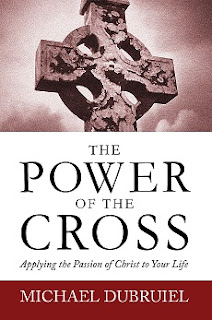
The Power of the Cross  by Michael Dubruiel is a book well-suited to daily reading during Lent. The book is available here in pdf version. Daily excerpts will be reprinted in this space during Lent.


"michael Dubruiel"

Wednesday, September 4, 2019

73 Steps to Spiritual Communion with God - 41

This is a continuation of the 73 Steps to Spiritual Communion with God by Michael Dubruiel. The previous posts are below and in the archives to the right. This is the 41th step:


(41) To put one's trust in God.


As if to remind us what all this is about, in the middle of these counsels, Saint Benedict gives this counsel that refocuses on the real issue here. Going through the counsels we can lose sight again that almost everything that is negative, not to do this or not to be this is all about a positive to "do this," to put our trust in God.


Most of us probably would say that we put our trust in God. But our reaction to all of these counsels of Saint Benedict is like a giant mirror that reveals whether we really do or not.


There is a story that I have heard so many times that it has lost it's punch for me, but perhaps not for you-so here it is. A man is walking along a mountainside when suddenly he hits some lose soil and goes tumbling over a steep precipice. Luckily he grabs on to a tree branch as he falls down.


Looking down, he sees that if he hadn't grabbed the branch he would have fallen to a certain death. But looking up he can see no way to reach the safety of the path again, and he realizes that he can't hold on forever. He yells for help, "Is anyone up there?"


A voice booms, "I'm here, it's God."


The man says, "Thank God! Can you save me?"


"Of course," God says, "but you have to do exactly what I tell you."


"Okay," the man says, "what do I need to do?"


"Let go," says God.


"Is anyone else up there?" The man screams.


Putting our trust in God means more than just giving lip service to Him. It means, "letting go," and whether we do or not ultimately decides whether we live or die-forever.

Tuesday, September 3, 2019

73 Steps to Spiritual Communion with God - 40

This is a continuation of the 73 Steps to Spiritual Communion with God by Michael Dubruiel. The previous posts are below and in the archives to the right. This is the 40th step:


(40) Not to be a detractor.


The Christian is to be someone who builds people up, not someone who tears others down. Often detraction is a sign of our own insecurity or feelings of inadequacy.


Someone who puts God first in their lives will recognize their own self in an entirely new light as well as all others.

If we see someone who seems less in our eyes, it is we who have the problem not them.


This of course does not mean that we turn our eyes from those who commit grievous sins against others. They should be confronted, and if personal confrontation does not work as Jesus said, the matter should be brought before the whole Church, and if that doesn't work they should be treated like a tax collector. Of course Jesus--welcomed tax collectors, so there is irony in the last part of his counsel.


Christianity is not a religion of castes. In Christ there is neither Greek or Jew, male or female--all are one. In order for that to be a lived reality we must see the importance of each individual and seek to build them up. In doing so we are aiding the Holy Spirit's work of building the Kingdom of God.