Friday, November 9, 2018

St. John Lateran - November 9


A visit to St. John Lateran, from 2006, by Michael Dubruiel:


After a quick lunch (pizza, what else?)we headed toward the Metro station to catch the A Train to St. John Lateran's to meet up with Zadok who had so generously agreed to give us a tour of two of Rome's greatest Churches. We were still pretty green when it comes to the whole Metro system and walked (rather than took a bus) to the station, so by the time we finally arrived we were late and Zadok was nowhere to be seen (at least not at the Metro station where Amy had thought he had said he was going to meet us). So Amy went out the other possible exits and Katie, Joseph, the baby (on my back) and I went a bit further and bought a bottle of water. When Amy came to say that he could not be found, we decided to go on further to the Church and see if he might have gone on there when we had not arrived on time. Sure enought there he was...
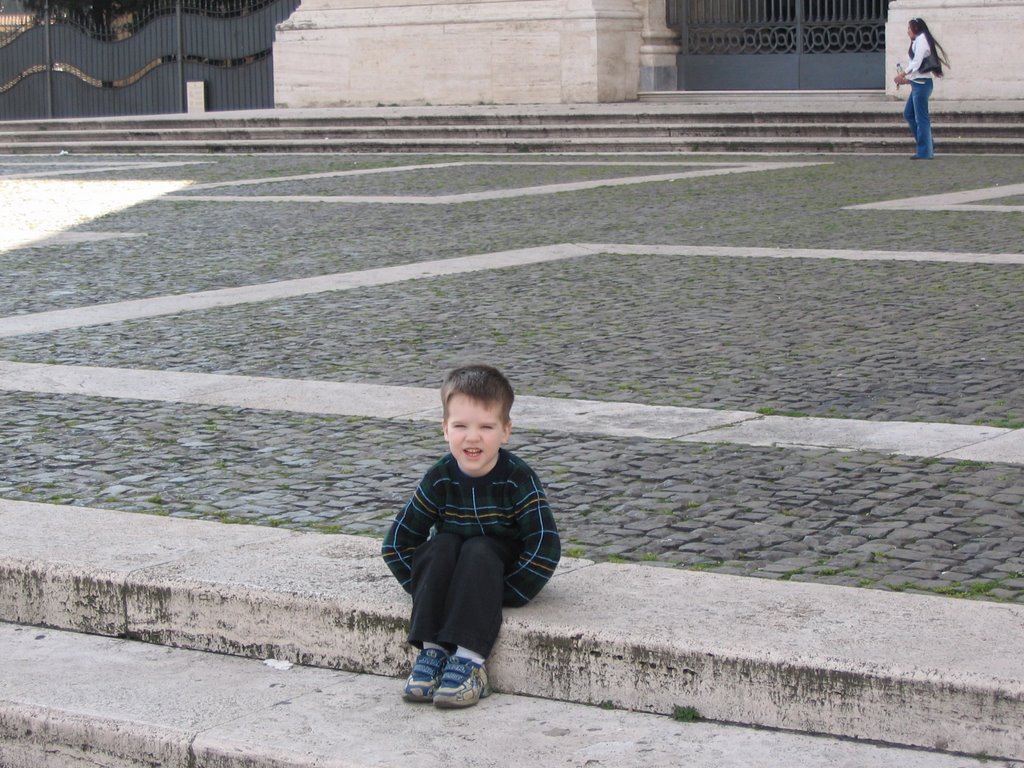
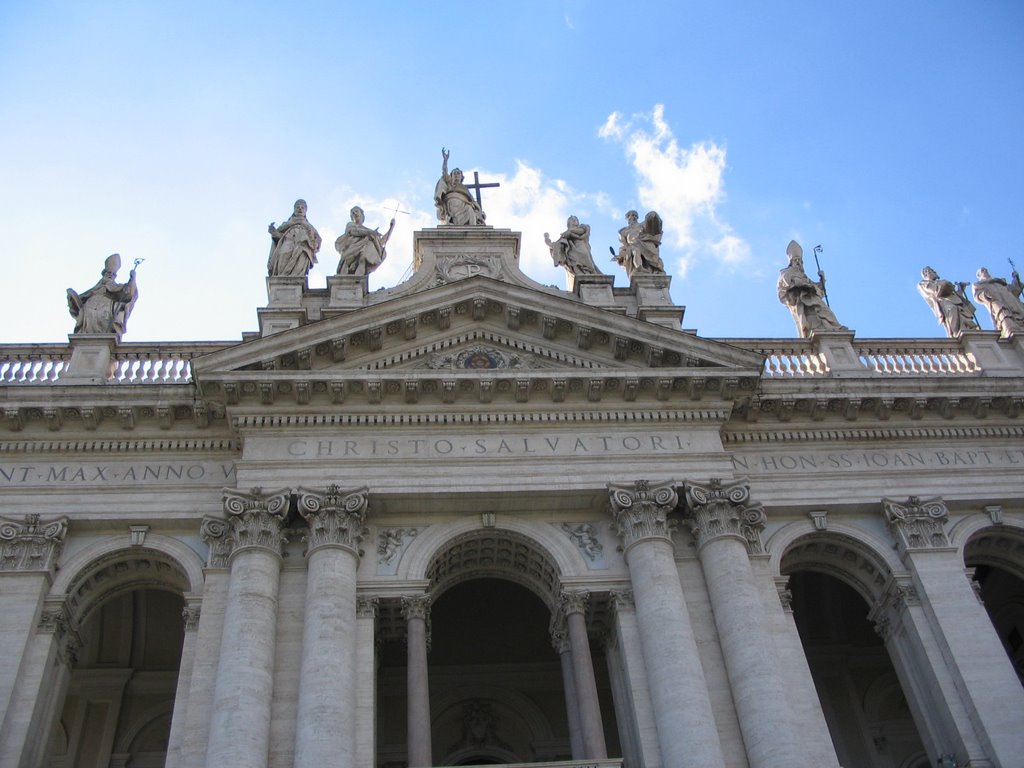
I should mention that at this point we had already walked quite a bit (given two treks through St. Peter's, a good half mile to the Metro and another two or three blocks from the Metro to St. John's) while we stood and listened to Zadok's interesting history of the surrounding landmarks, Joseph sat. And even looking at the front of the Church's pavement now, makes me tired to think about even walking that distance. Most people think that St. Peter's is the Cathedral Church of Rome, but it isn't--St. John Lateran's is. While the chair of Peter is in St. Peter's, the Bishop of Rome's chair is at St. John Lateran's and this is the central feature of the apse of the Church, now that I think of it in a similar way to the way that the Chair of Peter is in the apse of St. Peter's. When St. Francis of Assisi came to Rome to see the Pope, he came here to the Lateran and their are large statues of Francis and his crew directly across from St. John's that seem to be in communication with the large statues that are on the facade of St. John's. After his election as pope last April, Pope Benedict XVI came here to the Lateran to be formally installed as the Bishop of Rome (ever wonder why the Bishop of Rome isn't an "archbishop"?).
St John's has it's own Egyptian obelisk (just like St. Peter's) and a very impressive Baptistry which next to the Pope's chair is what I remember most about this part of our tour. The Baptistry was huge (I had seen one at the ruins of St. John's in Ephesus twenty-seven years earlier that was quite small in comparison). There was some type of festival going on outside of the Church that seemed to be a "Mardis Gras" or "Carnivale" type of celebration, remember this was just before the beginning of Lent. So next to the obelisk were booths, screaming kids and some people dressed in costumes giving the "pope's church" the feel of a regular parish back home.
Across the street we visited the Scala Santa--the holy stairs, said to have been brought to Rome by St. Helena the mother of Constantine and to have been the stairs that Jesus would have walked on during his Passion when he came before Pontius Pilate. The faithful climb up them on their knees and as this picture will attest--there were no shortage of takes on the day we were there, in fact there were so many that it was really impossible to get near the steps to see them.
We walked up the side steps to another chapel called the Holy of Holies because it contained many holy relics and an image of Christ reported to have been painted by St. Luke entitled "picture painted without hands"....any student of Catholic piety knows there are many images reported to have been painted by St. Luke (Our Lady of Czestochova being one example). I had never thought about it much before, but I wonder if another meaning might be that Luke's Gospel inspired the works? I doubt the people working their way up on their knees think so..
Around the other side of the Holy Stairs was the remains of the Papal dining hall and an impressive mosaic, as we were viewing this site a woman begging rather aggressively started coming at us, and we moved on toward the Church in the distance...St. Mary Major.
Walking along Zadok shared his knowledge of another area of his expertise the Irish Catholic Church begining with the Irish College, its history and various locations. We talked about the contributions the Irish priests had made to the world at large, Africa in particular and the United States (anyone who lives in the South knows the debt the Catholic Church owes to the Irish priests). What a marvel that where the Church is most vibrant right now is where the Irish planted the Faith. Pray for the Catholics in Ireland.
At this point I became very tired, I think the baby might have fallen asleep on my back and as we learned this made him very heavy. So we stopped and Zadok, Amy, Katie and Joseph had gelato. I sat.
Then up and at it again. A short visit into the Redemptorist Church where the original Our Lady of Perpetual Help is enshrined--a modern enshrinement, simple and I must say not much to my liking. Mass was being said so we weren't able to really get close.
Next to Saint Prassede, a very interesting Church decorated in a more Byzantine style with beautiful mosaics. This church contained the column that Christ was bound to when he was scourged.
Evening was falling as we arrived at Saint Mary Majors, built on the spot where snow fell one August after Pope Liberius had dreamed that this would be a sign for him to build a church dedicated to Our Lady. As we entered the Church, the chanting of Vespers could be heard. My back was aching from the baby on it and I stole away from our tour to go into the side chapel and join in the praying of Evening Prayer. I grabbed a book and went to the first empty seat I could find which was in the front where I sat next to Cardinal Bernard Law. In spite of the comotion that I created, he did not even seem to notice. I fumbled around in the book trying to locate the point the prayer was at, but to little avail and after about five minutes Michael the baby decided to join in speaking loudly his own version of chant--at which point I made my exit. We toured the church and then started making our way back to the Metro station, thanking Zadok for his time and well presented tour.
When we arrived back on Borgo Vitorio we stopped at a restaurant that Amy had spied the evening before. It was in the cellar and proved to be an excellent choice. We had a meal where everyone had what they wanted, for me it was a pasta with cheese and pepper and it was great,Joseph had a cheese pizzza, Katie a giant calzone, Amy another pasta dish, the baby had some of it all.
Evening came, the second day.

Wednesday, November 7, 2018

Fulton Sheen

From Praying in the Presence of the Lord with Fulton Sheen

Bishop Sheen’s “Now-moment” corresponds to the thinking of the great spiritual writer Jean Pierre de Caussade. In Abandonment to Divine Providence, Fr. Caussade gives the reader a sure way of knowing the will of God at any moment—by simply confronting the present moment with all its reality. It seems simple, but if we reflect for a second most of us will find that we spend most of our lives avoiding the present moment.
A few years ago an English translation of the Father Caussade’s work appeared in the United States changing the original title to read “The Sacrament of the Present Moment.” This captures the essence of Father Caussade’s work and Bishop Sheen’s meditation that in the present time we are presented with an opportunity that is truly unique. Each moment is sacramental.
Most of us are capable of presenting ourselves with some amount of reflection as we celebrate the sacraments. If we celebrated the sacrament of Baptism as an adult certainly we came expecting to be changed by God. Each time we enter a confessional surely we have examined our conscience beforehand and are penitent expecting to be forgiven by God. Undoubtedly every time we approach the altar to receive the Eucharist we expect to encounter God. But what about the other moments of our lives?
As we awake in the morning, is our first thought of God? As we greet our brothers and sisters throughout the day do we expect that God might be present? Every moment of our lives is an opportunity to encounter God who is always present.
Spend some time reflecting on the following:
1. Go over the events of the present day and ask yourself where God might have been in each of them. Is there a consistent pattern to your day?
2. Reflect on the life of your favorite saint, and meditate on how he or she dealt with the people they met in their daily journeys. How could you imitate this saint? What enabled the saint to act in the way he or she did toward others?
3. Imagine as you leave from this time of prayer that God wishes to continue to be present to you as you go forth. How will you react to his presence in others?
-Michael Dubruiel
PrayerLord, help me to search for you in the garden of life in the same way that St. Mary Magdalene did when she found your tomb empty. May my search be rewarded as hers was by knowledge of your abiding presence. Amen.
"michael dubruiel" "fulton sheen"

Monday, November 5, 2018

Catholic Meditation by Michael Dubruiel


One time in the late 80's I was traveling with another friend of mine, Brian, on our way to Chicago. The first night we stopped at the Monastery of the Holy Spirit in Conyers, GA about twenty miles east of Atlanta.

Fr. Francis (originally a monk at Gethsemani and one of the founding monks of Holy Spirit, then in his 80's) met us at the Guest House door, "Will you stay?"

Anyone who has read Thomas Merton's Seven Storey Mountain knows this is what you expect to hear when you arrive at a Trappist monastery. There is a double meaning to the question..."Will you stay?" and join our community, "Will you stay?" in the guest house and finally since in the Rule of St. Benedict the stranger is to be welcomed as Christ...Will you stay? Lord as in "Stay with us Lord for the day is far spent."

We answered "yes" as in yes we'll stay in the guest house tonight, which we did and attended prayers and Mass--then left the next morning on our way to Gethsemani. We arrived in Gethsemani that afternoon (about seven hours later). No one greeted us or asked us if we would stay. There were a few other pilgrims wandering around but no monks visible. We were settled in the chapel for Vespers when the first monks began to emerge from the cloister and enter into the chapel. Brian leaned over to me and whispered, "Its the same guys."

Well not exactly. Driving toward Birmingham and away from Gethsemani I thought of my friend Peter who has been a big fan of the Trappists from way back. I knew that he had thought about entering the Monastery of Our Lady of the Holy Spirit at one timea and still made visits there frequently--I also knew that he had visited Gethsemani several times. His experience and mine of both monasteries knew that one welcomed strangers and the other saw them as an intrusion and to be fair because of Thomas Merton Gethsemani got a glut of strangers.

When I first stayed at Gethsemani the beds were very Trappist--really nothing more than a pallet with a two inch mattress on it. Years laters a beautiful, state of the art guest house was built that was more along the lines of mid range hotel. Now the Welcome Center--the times they are a changing.

I called Pete to share my views about the Welcome Center and I share them here because for the most part they were inaccurate as my return trip proved but they say a lot about how our minds process religious experiences. I told Pete:

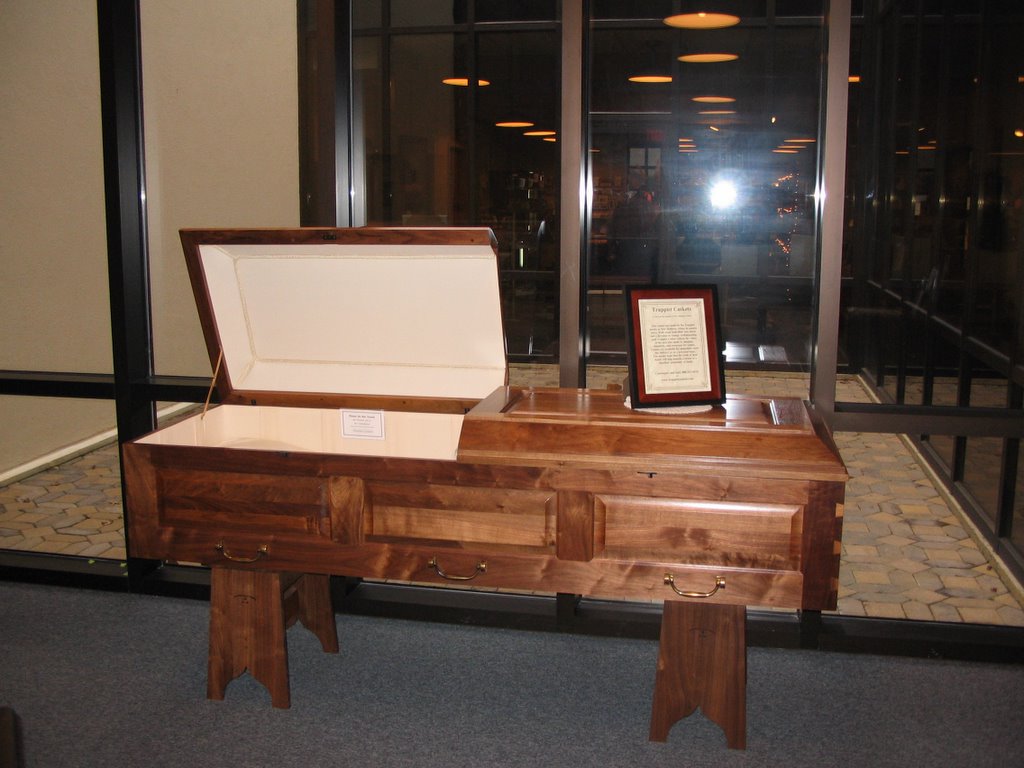
"The first thing you notice when you walk in through the cloister wall and into the building is a coffin...it is open but empty. In some ways it is symbolic of immediately reminding you of your final end and asking you the question what am I here for? Several monks were available to answer the question."

"Over the PA system there was an incessant crackling of flames--they made me think of the flames of Hell (another of the Last Things), when in fact a peak into the room to the left of the entrance showed that it was the Easter Fire being prepared and the flames providing the fire to illuminate the Easter Candle--symbolic of the light of Christ illuminating the darkness. The video featured the changing seasons...the crackling flames were replaced with crackling dead leaves falling from the trees surrounding the monastery, the barren trees introduced the funeral of a monk with living monks keeping vigil reading the psalms all night before the burial of their brother."

I told Pete that all of this left me with the impression that the Welcome Center was designed as a sort of funeral parlor and that unconsciously the monks were providing the guest with a modern morality play that the visitor was the staring player. Walking out of the Welcome Center I made my way toward the Chapel for Vespers--passing by another gate where the words "God Alone" were engraved. Long time readers of this blog will remember that this gate once graced the right hand column of this blog...the Gospel in two words, a reminder that after death all that matters will be God Alone...a reminder that in this life ultimately what matters is God Alone.

Then the Chapel and monks bending in unison at the waist singing "Praise to the Father, the Son and Holy Spirit both now and forever, until the end of the ages." punctuating the Psalms of praise and thanksgiving.

Death, Hell, Purgatory and Heaven all in a few minutes of each other. "Will you stay?"

No, not here anyway.

(Later my return to Getsemani later in the week and a more accurate description of the Welcome Center).

-Michael Dubruiel

Sunday, November 4, 2018

Book on the Catholic Mass

Michael Dubruiel wrote a book to help people deepen their experience of the Mass.  He titled it, How to Get the Most Out of the Eucharist.  You can read about it here. 

"michael Dubruiel"


How to Get the Most Out of the Eucharist gives you nine concrete steps to help you join your own sacrifice to the sacrifice of Christ as you:
  • Serve: Obey the command that Jesus gave to his disciples at the first Eucharist.
  • Adore: Put aside anything that seems to rival God in importance.
  • Confess: Believe in God’s power to make up for your weaknesses.
  • Respond" Answer in gesture, word, and song in unity with the Body of Christ.
  • Incline: Listen with your whole being to the Word of God.
  • Fast: Bring your appetites and desires to the Eucharist.
  • Invite: Open yourself to an encounter with Jesus.
  • Commune: Accept the gift of Christ in the Eucharist.
  • Evangelize :Take him and share the Lord with others.


Filled with true examples, solid prayer-helps, and sound advice, How to Get the Most Out of the Eucharist shows you how to properly balance the Mass as a holy banquet with the Mass as a holy sacrifice. With its references to Scripture, quotations from the writings and prayers of the saints, and practical aids for overcoming distractions one can encounter at Mass, this book guides readers to embrace the Mass as if they were attending the Last Supper itself.

Saturday, November 3, 2018

How to Pray by Michael Dubruiel

The letter to the Hebrews draws a strong connection
between the cross and prayer. Because every moment of our
earthly existence is threatened by death, and we know neither the
day nor the hour when that existence will come to an end, we,
too, need to cry out to the God who can save us. Like Moses, we
need the help of our fellow Christians to hold up our arms when
they grow tired. We, too, need the help of the Holy Spirit to
make up for what is lacking in our prayer. 


-The Power of the Cross by Michael Dubruiel 


"michael dubruiel"

Wednesday, October 31, 2018

All Saints Day - November 1


Tuesday, November 1, 2005


A Moment Frozen in Time - Michael Dubruiel

We spent part of last week attending the National Catholic Youth Conference in Atlanta. One moment from all that I experienced continues to stay with me, perhaps I might say even to haunt me. While Joseph, Katie and I were walking back toward the exhibit area where Amy and Michael were, we suddenly notice a quiet and people stopping (in an environment that was much like walking through midtown Manhattan on a weekday). Then enmasse young and old dropped to their knees.

Advancing were youth holding signs "Silence and Kneel"…everyone obediently did so as cassocked men holding candles, one swinging incense advanced in front of a coped priest with humeral veil wrapped around the base of a monstrance held the Eucharistic Body of Our Lord aloft.

Those who have seen the movie "The Mission" with one of the best scenes ever filmed about the spiritual life will remember Jeremy Irons playing a priest holding the monstrance in the midst of battle all around him, himself falling and an indigenous man picking up the monstrance and continuing the procession. That is what popped into my mind as I instructed young Joseph to make the sign of the cross as Jesus passed in our midst.

I'll bet that when all is said and done, I'm not alone in this being a moment that will be remembered by all. What is more I have realized that these Catholic prayer moments are the solid foundation that most Catholics never forget--long after they have forgotten most of what they were taught.

There is a lesson here for those of us who try to pass on the faith to our children--introduce them to Christ, like disciples on the road to Emmaus let Christ the stranger teach them, open the Scriptures to them so that they might recognize him in the breaking of the Bread--that they may pick up his Presence and carry it through the streets of life where a battle wages.

Such catechesis is the lesson plan of saints--may all the saints pray that we might take up that charge!

Should Catholics Celebrate Halloween? by Michael Dubruiel

The Great Christian Feast-Halloween - by Michael Dubruiel


This is one of those thoughts that comes to you in a moment of clarity with such force that you wonder how it could be that everyone just doesn't see the truth of it.

Last night when I made one of my few trips to the door to hand out candy, it just hit me. There I was confronted with a skull painted white on the face of an African American, who was standing there holding open a bag, expecting something from me.

A home invasion? No.

Trick or Treat!

I gladly obliged his request with a handful of candy and he turned and went on his merry way to join the other hordes of beggars that flooded our streets.

I had just fulfilled the mandate of the Gospel of Jesus Christ! I had just welcomed Him in the guise of the hungry, "When I was hungry, you gave me something to eat." Matthew 25!

"When did we see you Lord?"

"Whenever you did it to the least of my brethren, you did it to me."

Is there anytime left in our year when Americans are so blatantly Christian, welcoming the strangers that come to their door? Is there anytime that we reward those who on purpose try to repulse us by their costumes?

Yet the thought that it is better to give than receive dominates this day and truly the day fulfills its purpose of being the eve of All Saints Day! For if we are ever to join the saints we must learn to make everyday Halloween!

So that today when we meet those we might otherwise demonize, we give what we have freely as though we were meeting Christ Himself in the streets (and if we believe the Gospel message we are in fact meeting him)!

I used to joke that strangers could in fact be demons, (this was when the angel rage was in full swing and I use to make the point that yes a stranger might be an angel but who is to say if it is a good one or a bad one--sort of a twist of the Glenda the Good Witch's question to Dorothy in the Wizard of OZ, "Are you a good witch or a bad witch?"), but I would ask you to reflect on Halloween a bit more with me.

If we give to the stranger, indeed we welcome them as Christ. But if we look at the stranger only as someone who has something to give and we judge them based on that we are apt to conclude that all strangers are demons!

For example if we start viewing every middle eastern looking Arab that we do not know personally as a terrorist we are forgoing an opportunity to see them as Christ (who happened to be of middle eastern descent). Abraham was visited by three strangers (one would presume of middle eastern descent) and he fed them--they turned out to be angels and they gave him a blessing! But let's suppose that we in fact do come across some terrorists in our daily activities. What if our interaction with them, seeing them as Christ and giving them whatever we have to give at that moment (even if it is only a smile of acceptance) led them to change their whole way of viewing Americans?

It is sad to think that a day that is the perfect example of what it means to be a Christian has been protested by so many Christians in this country. Do they read the Gospels?

No one is celebrating or worshipping demons on Halloween. The children who dress up in their costumes are playacting and giving the individual behind every door an opportunity to imitate Christ.

It is also sad that many miss the point in the other direction. They overdo it in the name of "everyone else is doing it" and light their houses up as though it is Christmas, rather than encountering the little masked Christs in the darkness the way it is intended to happen and does happen in daily lives. The vacuous nature of their souls demands making a show of their giving. Sadly they have already received their reward--the empty praise of their neighbors and friends.

There have been moves lately among some Catholics to have children dress up as saints-- this may be a fine thing to do on All Saints day but it totally misses the point of Halloween. We will never be saints, nor will we imitate them, until we open the door everyday and welcome the ghouls we encounter as though they are Christ.