Sunday, January 28, 2007

Pope: St. Thomas Aquinas Model of Dialogue

From Asia News Italy:
The Pope made an appeal today against violence in Lebanon and Gaza, for leprosy patients on World Day of Leprosy, but above all to scientists and men and women of culture “not to be afraid” of the dialogue between faith and reason so that we can avoid the risk of “schizophrenia”, irrationality, and the conflict with cultures in the south of the world.

To talk again about the issue of “faith and reason”, which he so skilfully addressed in Regensburg, the Holy Father used as his starting point today’s saint, the philosopher and theologian Saint Thomas Aquinas, “a compelling model of harmony between reason and faith, dimensions of the human spirit, that are fully realised in their meeting and dialogue.”

“The relationship between faith and reason,” the Pope stressed, “represents a great challenge to the Western world’s prevailing culture and for this reason, the beloved John Paul II devoted an encyclical to the issue titled just that: Fides et ratio – Faith and Reason. I, too, recently took up the issue in my address at Regensburg University.”

The problem is that today man often reduces himself “to think only about material and experimental objects and shuts himself off from the main questions about life, himself and God” and therefore “becomes poorer”. Benedict XVI calls this situation, “schizophrenia”.

“In reality,” he said,” modern scientific development brings innumerable positive effects and this must be acknowledged. At the same time however, we must admit that the tendency to consider true only what can be demonstrated experimentally represents a limitation of human reason and causes a terrible schizophrenia in which rationalism, materialism, hyper-technology and unrestrained instinctiveness” live side by side.

From this comes the Pope’s appeal to “rediscover in new ways human rationality that is open to the light of the divine Logos and its perfect revelation Jesus Christ, Son of God made man. When the Christian faith is true it does not mortify freedom and human reason. If so, why then should faith and reason fear each other when meeting and engaging in dialogue can enable them to express what is best in each other? Faith supposes reason and perfects it, and reason, enlightened by faith finds the strength to rise to the knowledge of God and spiritual reality. Human reason loses nothing by opening up to the contents of faith; on the contrary, the latter need its free and conscious adherence.”

Referring to Saint Thomas Aquinas, who in the 13th century was able to achieve a synthesis of Christian, Islamic and Jewish cultures, Benedict XVI noted that by rediscovering reason open to faith it is possible to engage in dialogue with non European cultures which view with concern and fear the atheistic culture of the West.

“With far-sighted wisdom,” the Pontiff explained, “Saint Thomas Aquinas was able to fruitfully relate to the Arab and Jewish ideas of his time so much so that he can always be considered a relevant teacher of dialogue between cultures and religions. He was able to achieve that admirable Christian synthesis between reason and faith which represents a precious heritage upon which Western civilization can draw and which can be used effectively to engage in dialogue the other great cultural and religious traditions of the East and the South of the world.”

The Pope ended saying: “Let us pray that Christians, especially those that operate in the world of academe and culture, can express the reasonableness of their faith and bear witness to it in a dialogue inspired by love. Let us ask the Lord for this gift by the intercession of Saint Thomas Aquinas and especially of Mary, Seat of Wisdom.”

Pope's Latinist: "He Won't Do It!"

Extend the use of the Tridentine liturgy...

From the much loved Carmelite Fr. Reginald Foster, as recorded in the Telegraph:

"He is not going to do it," Fr Foster said. "He had trouble with Regensberg, and then trouble in Warsaw, and if he does this, all hell will break loose." In any case, he added: "It is a useless mass and the whole mentality is stupid. The idea of it is that things were better in the old days. It makes the Vatican look medieval."

Saturday, January 27, 2007

Right Now its Snowing in Winchester, NH

How do I know? The Weather Channel's new interactive map lets you zoom in to anywhere in the world. A fascinating way of connecting two technologies!

Friday, January 26, 2007

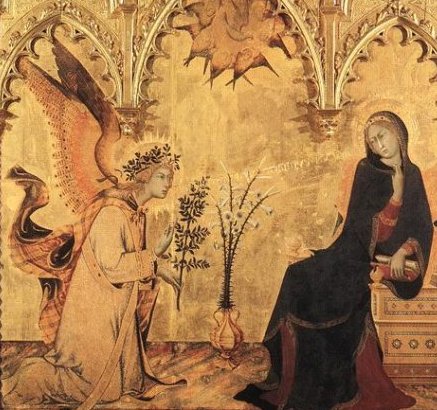
Martini's Annunciation

Christians are “too silent” in Bearing Witness to the World

Pope Benedict's message to close the week for Christian Unity. The address as remarkable as any this Pope gives raises interesting questions about the ecumenical movement in this country. Have we joined forces to speak out against politicians who continue to support abortion--or have we chosen to observe a polite silence--that is impolite to the many lifes destroyed by the policies of those who support abortion.
Have we joined forces with those who reject war and violence?
Have we raised our voice with those who stress forgiveness to the penitent?
Have we ?

From Asia News Italy:

Christians must ask themselves if they “have become too silent” and “lost the courage to speak and bear witness”. The Pope raised these questions in his address today during vespers on the Feast Day of the Conversion of Saint Paul, apostle, which is the traditional event that marks the end of the Week of Prayer for Christian Unity in Rome’s Basilica.

In addition to the need to pray, engage others in dialogue, ask for God’s help and better know our fellows in the faith, the Holy Father laid emphasis on the need to “bear witness” and of doing so together.


And:

“But the seed sown among thorns is the one who hears the word, but then worldly anxiety and the lure of riches choke the word and it bears no fruit (cf Mt 13, 22). We must ask ourselves: Have we Christians perhaps become too silent? Have we lost the courage to speak and bear witness?”

“Our world needs this witness. It is especially waiting for Christians to bear witness together. Hence listening to God who speaks requires us to listen to others and to the other Churches. An honest and loyal dialogue represents the typical and essential means to seek unity. The Decree on Ecumenism by the Second Vatican Council II emphasised that if Christians do not know each other progress towards communion is unimaginable. In dialogue we listen and communicate, we compare and, with God’s grace, converge around his Word, accepting its demands, which are valid for all.”
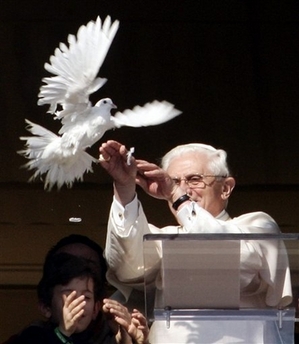
Silence Makes a Return at Catholic School

So teachers can hear if a student is choking...

From the International Tribune:

Alarmed by three recent incidents of choking in the cafeteria, a Catholic
school set a new rule this week: Silence at lunch.

All three students are fine, but "if the lunch room is loud we cannot
hear if a child is choking," school Jeannine Fuller, principal of St. Rose of
Lima School, said in a letter to parents.

Any child who breaks the rule will be put in lunch detention the
following day, Fuller's letter said.

Thursday, January 25, 2007

Pope Benedict Condemns Violent Video Games for Children

Theme: "Children and the Media: A Challenge for Education":
While affirming the belief that many people involved in social communications want to do what is right (cf. Pontifical Council for Social Communications, Ethics in Communications, 4), we must also recognize that those who work in this field confront "special psychological pressures and ethical dilemmas" (Aetatis Novae, 19) which at times see commercial competitiveness compelling communicators to lower standards. Any trend to produce programmes and products - including animated films and video games - which in the name of entertainment exalt violence and portray anti-social behaviour or the trivialization of human sexuality is a perversion, all the more repulsive when these programmes are directed at children and adolescents. How could one explain this ‘entertainment’ to the countless innocent young people who actually suffer violence, exploitation and abuse? In this regard, all would do well to reflect on the contrast between Christ who “put his arms around [the children] laid his hands on them and gave them his blessing” (Mk 10:16) and the one who “leads astray … these little ones” for whom "it would be better … if a millstone were hung round his neck" (Lk 17:2). Again I appeal to the leaders of the media industry to educate and encourage producers to safeguard the common good, to uphold the truth, to protect individual human dignity and promote respect for the needs of the family.