“You're a married priest? I didn't know we had married priests. I think the
Church should let all her priests marry.”
Words like these have greeted me frequently since my ordination to the priesthood in 1983, with dispensation from the rule of celibacy. I always assure those who favor optional celibacy that both my wife and I strongly support the Church's discipline of priestly celibacy. While I'm deeply grateful that the Church has made an exception for certain former Protestant clergy like me, the exception is clearly a compromise.
The priesthood and marriage are both full-time vocations. The fact is, no one
can do complete justice to both simultaneously.
T he objection usually persists. “But surely a married man is better qualified to teach people about marriage than is a celibate priest.” Again, I disagree (politely, of course). The purpose of marriage preparation is not to teach couples what the priest has experienced. Catholic couples need and have the right to be instructed in the
Church's revealed truth about the meaning of human sexuality and holy matrimony.
If both a married and a celibate priest are reasonably mature, and if each teaches in harmony with the Church, the married priest has no essential advantage over the celibate priest in giving marriage instruction.
Then comes the final argument. “Yes, that may be, but if priests could marry, it
would solve our priest shortage.” I reply that this is an assumption with no
evidence to support it. If the rule of celibacy is keeping men out of the priesthood, how do we account for the dioceses in this country that have an abundance of priests? As Pope Paul VI said 40 years ago, the decline in priestly vocations is due to lack of faith on the part of our people. The dissent that has been rampant in recent decades has created widespread confusion about the Church's teaching, especially with regard to the priesthood.
Monday, October 16, 2006
A Married Catholic Priest Extolls the Gift of Celibacy
Father Ray Ryland...in Crisis Magazine:

Sunday, October 15, 2006
Saints Behaving Badly
Tom Craughwell gives hope to all of us--who as we alone know are the worst of sinners, that there is still a chance that if we turn to God we can be saints! I know what you're thinking, "How could I ever be a saint?" Or maybe you're thinking "How could he ever be a saint?" Good questions.
In Saints Behaving Badly: The Cutthroats, Crooks, Trollops, Con Men, and Devil-Worshippers Who Became Saints ,just published by Doubleday, Tom Craughwill gives the answers.The list of the evils that some saints engaged in before their conversion is long: thievery, embezzling, satanists, promiscuity, idolatry, drunkedness and even anti-popery. The list brings to mind St. Paul "Know you not that the unjust shall not possess the kingdom of God? Do not err: neither fornicators, nor idolaters, nor adulterers, Nor the effeminate, nor liers with mankind, nor thieves, nor covetous, nor drunkards, nor railers, nor extortioners, shall possess the kingdom of God" and what follows "And such some of you were; but you are washed, but you are sanctified, but you are justified in the name of our Lord Jesus Christ, and the Spirit of our God" (1 Corinthians 6: 9-11). Indeed!
Craughwell's book is filled with both the well known (Augustine, Patrick, Francis of Assisi,Ignatius of Loyola) and the lesser known (Callixtus, Pelagia, Genesius, Fabiola). From the latter group is the story of St. Pelagia, an actress who before her conversion lived a life of rather loose morals. One can readily think of a number of similar actors, actresses, rock stars, politicians who might be the Pelagia's of today--whose popularity is matched by the wanton lifestyle they lead--leading others down a path of self-destruction. What keeps them and us from following Pelagia's path to saintdom--perhaps this event related by Craughwell provides a hint:
Most of us would probably believe that lie--and if you do you might need to read another book that has just been published by Ascension Press, Interview With an Exorcist . Pelagia didn't need that book, but she knew what to do:
Of course this exactly what Saints Behaving Badly does for the reader, it gives them a solid lesson in Christian spirituality by showing them how the great saints have overcome the very evils that plague many of us. It is a catechism of a different source, a real page turner and in the end a book that can change your life.
In Saints Behaving Badly: The Cutthroats, Crooks, Trollops, Con Men, and Devil-Worshippers Who Became Saints
,just published by Doubleday, Tom Craughwill gives the answers.The list of the evils that some saints engaged in before their conversion is long: thievery, embezzling, satanists, promiscuity, idolatry, drunkedness and even anti-popery. The list brings to mind St. Paul "Know you not that the unjust shall not possess the kingdom of God? Do not err: neither fornicators, nor idolaters, nor adulterers, Nor the effeminate, nor liers with mankind, nor thieves, nor covetous, nor drunkards, nor railers, nor extortioners, shall possess the kingdom of God" and what follows "And such some of you were; but you are washed, but you are sanctified, but you are justified in the name of our Lord Jesus Christ, and the Spirit of our God" (1 Corinthians 6: 9-11). Indeed!Craughwell's book is filled with both the well known (Augustine, Patrick, Francis of Assisi,Ignatius of Loyola) and the lesser known (Callixtus, Pelagia, Genesius, Fabiola). From the latter group is the story of St. Pelagia, an actress who before her conversion lived a life of rather loose morals. One can readily think of a number of similar actors, actresses, rock stars, politicians who might be the Pelagia's of today--whose popularity is matched by the wanton lifestyle they lead--leading others down a path of self-destruction. What keeps them and us from following Pelagia's path to saintdom--perhaps this event related by Craughwell provides a hint:
That night the devil woke Pelagia. "What evil have I ever done to you?" he asked. "Tell me how I have offended, and I will give you whatever you want. Only do not leave me. Do not make me a laughingstock."
Most of us would probably believe that lie--and if you do you might need to read another book that has just been published by Ascension Press, Interview With an Exorcist
. Pelagia didn't need that book, but she knew what to do:Pelagia made the sign of the cross and drove the devil away.
Of course this exactly what Saints Behaving Badly
does for the reader, it gives them a solid lesson in Christian spirituality by showing them how the great saints have overcome the very evils that plague many of us. It is a catechism of a different source, a real page turner and in the end a book that can change your life.Freddie Fender is Dead
From USA Today:
Freddy Fender, the "Bebop Kid" of the Texas-Mexico border who later turned his twangy tenor into the smash country ballad Before the Next Teardrop Falls, died Saturday. He was 69.
Fender, who was diagnosed with lung cancer in early 2006, died at noon at his Corpus Christi home with his family at his bedside, said Ron Rogers, a family spokesman.
Over the years, he grappled with drug and alcohol abuse, was treated for diabetes and underwent a kidney transplant.
Fender hit it big in 1975 after some regional success, years of struggling — and a stint in prison — when Before the Next Teardrop Falls climbed to No. 1 on the pop and country charts.
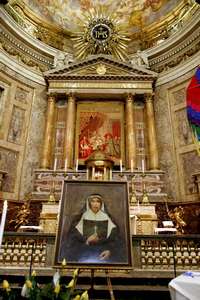
St Théodore (Anne-Thérèse) Guerin
 Indianapolis Star blog
Criterion Blog
From the Indianapolis Star:
Pope Benedict, seated on a gold-trimmed throne in front of St. Peter’s Basilica, accepted gifts from Hoosiers Phil McCord, Sisters of Providence Marie Kevin Tighe and Denise Wilkinson, giving each a personal blessing.
It was the medically unexplained healing on McCord’s eye in 2001 that was deemed as the second miracle necessary for Guerin to be declared a saint.
McCord, now 60, offered up a prayer asking Guerin to seek God’s favor in healing.
Tighe, who promoted the cause of sainthood for 10 years, said: “It was like it is sealed, it is finished,” she said of a cause that has been in the works for nearly a century.
Wilkinson, who presented the pope with a picture of Mother Theodore and a check for $5,000 for to serve the needs of women and children, is the current leader of the Sisters of Providence, the order that Guerin founded northwest of Terre Haute in 1840.
Saturday, October 14, 2006
Feast of St. Gerard Celebrated at Shrine
From the NJ Star-Ledger:
The novena to St. Gerard is included in my novena prayer book, which for some reason has jumped into the top 100 Catholic bestseller's at Amazon today:
Thousands of people, many of them expectant mothers, are expected to descend this weekend on St. Lucy's Roman Catholic Church for the Feast of St. Gerard, a colorful, spiritual 107-year-old tradition that continues today.
St. Gerard is widely revered by Catholics as a protector of aspiring and expectant mothers.
The highlight of the festival - located in the heart of Newark's Old Little Italy - is the procession of the church's St. Gerard statue through the streets of the neighborhood. The procession will be held today, tomorrow and Monday afternoons.
As the statue is marched in the street on a pedestal, the faithful pin dollar bills and donation envelopes on it, covering it almost entirely in green. The church usually makes about $200,000 from the festival, enough for about a quarter of its annual budget, Granato said.
The novena to St. Gerard is included in my novena prayer book, which for some reason has jumped into the top 100 Catholic bestseller's at Amazon today:
Friday, October 13, 2006
The Return of the Latin Mass?
Not really a return, it has been around. If you live in a big city, you can attend it every Sunday. Typical misreporting on this--a "widening" of its use would no doubt lead to it being done in a few more places, but it is hard to concieve that it will be many and if it so one can only hope that the young priests will have had lessons in Church Latin.
What I long for is the experience that I had as a young student at Saint Meinrad in the 1980's where in the monastic chapel the reformed rite of the Mass was celebrated exactly the way it is in the ritual. Only one hymn, a post communion thanksgiving hymn. The antiphons chanted at the entrance and other places, the psalm chanted, most of the prayers chanted, incense used, the homily on target with the Readings--something that if others experienced would have made the longing for the old days totally unnecessary...but what we all have experienced is a far cry from that and therefore the crisis in the liturgy continues...
From Time magazine:
Or buy a missal and follow along like they did in the old days.
For a real concise and excellent review of the issues surrounding this issue. Check out More Catholic Than The Pope: An Inside Look At Extreme Traditionalism by Pete Vere and Pat Madrid:
What I long for is the experience that I had as a young student at Saint Meinrad in the 1980's where in the monastic chapel the reformed rite of the Mass was celebrated exactly the way it is in the ritual. Only one hymn, a post communion thanksgiving hymn. The antiphons chanted at the entrance and other places, the psalm chanted, most of the prayers chanted, incense used, the homily on target with the Readings--something that if others experienced would have made the longing for the old days totally unnecessary...but what we all have experienced is a far cry from that and therefore the crisis in the liturgy continues...
From Time magazine:
The new permission, or "indult," would most immediately address a longstanding schism with the ultra-traditionalist group founded in 1969 by the French Archbishop Marcel Lefebvre, who opposed the Vatican II reforms. Lefebvre was excommunicated in 1988 after he consecrated four bishops without Rome's consent. But Benedict is believed to want to bring the Lefebvrites back in the fold.
Yet his olive branch may complicate matters in the American Church. Certainly, traditionalists who had to drive a hundred miles to find a priest with permission will be thrilled. More theologically liberal Catholics, however, may see it as a Lefebvrite-tinged step back from the principles they feel inspired Vatican II. "This would make it much more difficult for people to engage in full conscious and active participation, which was the goal of the Council," says Rev. James Martin, an editor at the Jesuit magazine America. Congregations could theoretically split on the issue, and many current priests would have to learn the old Mass (and more Latin, if they wanted to understand it).
Or buy a missal and follow along like they did in the old days.
For a real concise and excellent review of the issues surrounding this issue. Check out More Catholic Than The Pope: An Inside Look At Extreme Traditionalism
by Pete Vere and Pat Madrid:
Wednesday, October 11, 2006
Pope's Audience: St. Simon and St. Jude
From Asia News Italy:
Pressing ahead with his illustration of the personalities of the apostles, the pope today dealt with Simon the Canaanite and Jude Thaddeus. Coming as they did from totally different social realities, they “are an evident sign that Jesus calls his disciples and collaborators from the most diverse social and religious strata, without any preclusion. He is interested in people, not social categories or labels! And the great thing is that within the group of his followers, all lived together although they were different, overcoming the imaginable difficulties. It was Jesus himself, in fact, who was the reason for their cohesion, in who all came together. This clearly is a lesson for us, who are often inclined to stress differences and perhaps contradictions, forgetting that in Jesus Christ is given to us the strength to calm our conflicts.”
The pope then turned to a letter, attributed to Jude Thaddeus, that harshly criticizes “those who use the grace of God as a pretext to excuse their debauchery and to lead their brothers astray with unacceptable teachings, introducing division within the Church”. Benedict XVI said “such controversial” language is no longer used today to “state very clearly both what remains distinctive in Christianity as well as that which is incompatible with it. The way of indulgence and dialogue, which the Second Vatican Council happily took up, should surely be followed with firm constancy. All the same, it should not make one forget the duty to hark back to, and to highlight with the same force, the main and irrefutable lines of our Christian identity. On the other hand, we must bear in mind that this identity of ours is not only expressed on a merely cultural or superficial level. Rather it calls for the strength, clarity and courage of provocation that belong to the faith.”
The pope added: “It is clear that the author of these lines fully lives his faith, to which belong considerable realities like moral integrity and joy, faith and finally praise, all motivated solely by the goodness of our unique God and the mercy of Our Lord Jesus Christ. This is why both Simon the Canaanite and Jude Thaddeus help us to rediscover anew and to live tirelessly the beauty of the Christian faith, capable of bearing strong and at the same time serene witness.
Subscribe to:
Comments (Atom)