Mix of rain and snow. Highs in the upper 40s and lows in the upper 20s.
Sunday, October 8, 2006
Thursday's Forecast
For all of you who live in the south, here is what we are already looking at for this week (although it is supposed to be in the 70's today), from the Weather Channel:

Irish Priests and the Florida Missions
From the Sun Sentinel:
In 1914, none of the four Catholic pastors in South Florida was Irish born, according to the Rev. Michael McNally's book, Catholicism in South Florida. By 1940, Irish clergy predominated.
About 1,250 Irish-born priests were serving in the United States in 1997, according to a study by sociologist William Smith of Georgia Southern University.
The very uncertainty of a religious frontier was a lure for the Irish, said the Rev. Gerald Grace of Highland Beach, one of 16 foreign-born Irish still serving in the Diocese of Palm Beach. "It was the missionary endeavor, never knowing what you're going to find."
For Grace, pastor of St. Lucy church in Highland Beach and a theology instructor at St. Vincent de Paul Seminary west of Boynton Beach, the appeal of South Florida so far has lasted 41 years.
"Any time you serve the needs of others -- seeing their perspective, affirming their goodness -- it's always fulfilling," he said. "That's at the heart of the gospel."
Pope: The Family Against Hedonism and Relativism
From Asia News Italy:
Citing Gaudium et Spes and Vatican Council II, the pope recalled that “God himself is the author of marriage”. And it is precisely from this Origin that the definition of marriage is born as “no longer two, but one flesh”. For this reason, any division or breaking of the marital bond is excluded: ‘Therefore what God has joined together, let no one separate’ (Mk 10:8-9).
So the pope exhorted Christian spouses “to remain faithful to their vocation in every stage of life, ‘in joy and sorrow, in health and sickness’, as they promised to do in the sacramental rite. Aware of grace received, may Christian spouses build families open to life and capable of confronting together the many complex challenges of our time.”
Overcoming hedonism and relativism, parents are “true ‘missionaries’ of love and of life (cfr n.54).This mission is directed within the family – especially in reciprocal service and children’s education – and outside: the domestic family, in fact, is called to be a sign of God’s love towards all. It is a mission, this, that the Christian family can bring to fulfillment only if sustained by divine grace.”
Citing Gaudium et Spes and Vatican Council II, the pope recalled that “God himself is the author of marriage”. And it is precisely from this Origin that the definition of marriage is born as “no longer two, but one flesh”. For this reason, any division or breaking of the marital bond is excluded: ‘Therefore what God has joined together, let no one separate’ (Mk 10:8-9).
So the pope exhorted Christian spouses “to remain faithful to their vocation in every stage of life, ‘in joy and sorrow, in health and sickness’, as they promised to do in the sacramental rite. Aware of grace received, may Christian spouses build families open to life and capable of confronting together the many complex challenges of our time.”
Overcoming hedonism and relativism, parents are “true ‘missionaries’ of love and of life (cfr n.54).This mission is directed within the family – especially in reciprocal service and children’s education – and outside: the domestic family, in fact, is called to be a sign of God’s love towards all. It is a mission, this, that the Christian family can bring to fulfillment only if sustained by divine grace.”
Saturday, October 7, 2006
Feast of the Holy Rosary
Commemorating a different type of crusade, reminiscent of the one that engaged most of the 20th century against the spread of communism and needed today to overcome new battles of the decline of faith in the West.
The rosary book that Amy and I wrote:
Friday, October 6, 2006
Repent or Perish Luke 13:3

The Second Sorrowful Mystery: The Scourging at the Pillar
The path of faithfulness to the will of the Father is difficult. Our Lord is scourged at the pillar and endures horrible torture out of love for us. Ask Our Lady to help you pray this decade to experience sorrow for your sins that cause the Lord to suffer so greatly.
--from Praying the Rosary: With the Joyful, Luminous, Sorrowful, and & Mysteries by Michael Dubruiel and Amy Welborn.
Repent or Perish Luke 13:3
When someone experiences the love of God and converts everything seems so easy. Suddenly doing the will of the Father is not a task but a delight. Yet at some point the "felt" empowering love leaves the individual and it as though one is set free into a fog where one is not sure anymore.
The Passion of the Lord has been meditated since the inception of Christianity as the sure path of navigating these difficult waters. Trust in God, in the valley of darkness becomes the keystone of a person's faith. St. Ignatius of Loyola counseled remembering frequently the past consolations given by God during such periods--no doubt this counsel was inspired by the Psalmist who in the midst of trials would "remember" leading the rejoicing crowds into the Temple.
Following Christ is not easy. Doing the will of God requires a submission to His love as we walk our own Calvary path behind Christ. When Christianity fails to preach this hard truth it ceases to be Christianity. The suffering of the present moment is nothing compared to the glory that awaits those who trust in Him, as St. Paul counseled the early Church.
Thursday, October 5, 2006
Repent or Perish Luke 13:3
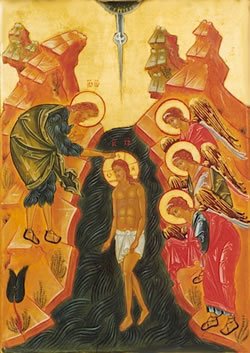 The First Luminous Mystery: The Baptism of the Lord
Our Lord, though innocent, takes on our sins as He enters the water of Jordan and is baptized by John. His mission of our salvation is blessed by the Father's praise and the Spirit's descent. Ask Our Lady to help you pray this decade, pondering the light that comes from submission to the will of God.
--from Praying the Rosary: With the Joyful, Luminous, Sorrowful, and & Mysteries by Michael Dubruiel and Amy Welborn.
Repent or Perish Luke 13:3
"I must decrease, He must increase" St. John the Baptist told his disciples after his encounter with Christ. Our submission to the will of God begins with our submission to Christ--our own dying with Him and rising anew in Him at our Baptism. But the act of submission needs to happen at every moment of the day. Every second brings with it a moment of prayer--will I submit to my will against His or will I bow down to His authority and choose Him. The world may cry out "I've got to be me," but the servant of God cries out "I've got to be His." St. Paul reiterates this when he declares, "I live, no not I, but Christ."
We fear this repentance. We secretly grieve that we won't be ourselves if we submit. Something within at a very early age urges us to resist (original sin) and it does not go away quietly. So many of us are slowly perishing, spending our demise judging others, living in darkness.
The biblical notion of this state of humanity is that of something that is lost. Will we continue to cling on to the lost being or will we allow ourselves to be found by Christ--at this moment and at every moment walking in His light and overcoming the darkness of the lost?
Subscribe to:
Comments (Atom)