Thursday, September 7, 2006

The Miracle Marlins

Two World Series...

Four No-hitters....

Twelve fans (including me)...


From The Chicago Sun-Times:


Anibal Sanchez stood behind the mound when the scoreboard caught his eye, confirming what he already knew: He was one out from a no-hitter.

He froze. For a couple of seconds, the Florida Marlins' rookie didn't move.

''I said, 'Wow. This hitter is the last one,''' Sanchez said.

Then he collected himself and, in this year of sensational rookies, finished the greatest performance yet.

Wednesday, September 6, 2006

Big News of the Day--Fashion at the Vatican

Not Katie Couric's performance on CBS evening news but this...


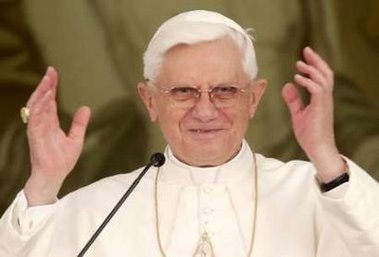
The Pope and his "hats"...this one is called a saturno after the Planet Saturn.

It actually reminds me of one of those little boy cowboy hats...I think the pectoral cross chain adds to that feel.

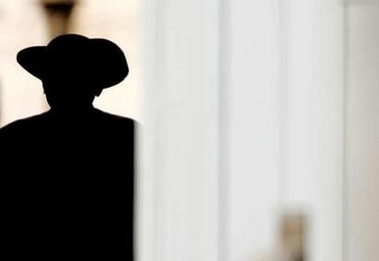
Around our house we call shadows "road people" given that they usually are seen on the surface of a parking lot we are walking across...here then is the road pope:


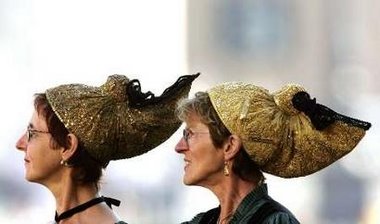
Attendees got a real show of style today as these Austrian women wear their finery for the audience:

Wednesday Catechesis-Philip the Apostle

"Come and See" "Show us the Father"

From Asia News Italy:

Benedict XVI started out from the gospel episode in which Philip exhorted the hesitant Nathaniel to get to know Jesus, telling him: “’Come and see!’ (Jn 1:46). In this reply, dry but clear, Philip shows the marks of a true witness: he is not content with making his announcement, rather he appeals directly to the interlocutor, suggesting that he himself undergoes the personal experience announced.” The pope continued: “We could imagine it is to us that Philip is addressing these two verbs, which presuppose a personal involvement. The apostle urges us to get to know Jesus close at hand. In effect, friendship requires closeness; in fact, it partly lives from this. Besides, we must not forget that, according to what Mark wrote, Jesus chose the Twelve with the primary scope that they should ‘be with him’; (Mk 3:14), that is, they should share his life and learn directly from him, not only his way of behaving but above all, who he was. Later, the Letter of Paul to the Ephesians would say that the important thing is to ‘learn Christ’ (4:20), that is, not only and not so much to listen to his teachings as much as to recognize him in person, his humanity and divinity, his mystery and his beauty. He is in fact not only a Teacher, but a Friend, no, a Brother. How could we get to know him deeply while keeping a distance? Intimacy, familiarity, habit lead us to discover the true identity of Jesus Christ. There: this is exactly what the apostle Philip is reminding us of.”

Benedict XVI then recalled the reply that Jesus gave to Philip when, during the Last Supper, he had asked him to show them the Father. ‘Have I been with you all this time, Philip, and you still do not know me? Whoever has seen me has seen the Father. How can you say, “Show us the Father”? Do you not believe that I am in the Father and the Father is in me? ... Believe me that I am in the Father and the Father is in me’ (Jn 14:9-11). Jesus refers to himself thus, implying that it is possible to understand him not only through what he says, but even more simply through who he is. To express ourselves through the paradox of the Incarnation, we could well say that God gave himself a human face, that of Jesus, and consequently, from that moment on, if we really want to know the face of God, we need to do nothing else other than contemplate the face of Jesus!”

Tuesday, September 5, 2006

Feast of Blessed Teresa of Calcutta

The Mother Teresa Center

The Mother Teresa Cause for Canonization

From the Franciscan Friars of the Renewal Site and Father Groeschel:

Today, although the world will hardly notice it, the Missionaries of Charity and their friends will be celebrating the new feast day of Blessed Teresa of Calcutta. September 5th is the anniversary of her death, and at present is acknowledged as her feast day. What a beautiful commemoration. Father Andrew and I had the great privilege of offering Mass for Mother Teresa the day before she went back to India. We knew when we said goodbye to her that we would not see her again in this world.

It was one of the most remarkable and memorable events of my life. Mother Teresa was filled with joy and happiness and even laughter. She was telling us how many convents and how many sisters and Missionaries of Charity fathers and brothers there were. It was a simple direct rejoicing. Always before that I had noticed that Mother Teresa was quite somber. I always thought she was thinking of the troubles of the world. I found out later that her soul was in spiritual darkness for many years, which others did not know.

Please join the Missionaries of Charity and the Franciscans of the Renewal in commemorating the passing of this holy woman, who is not only a saint in my eyes, but a prophetess. She has so much to teach us now.

Monday, September 4, 2006

Tropical Depression #6 Forms in Atlantic

Could become named storm by the end of the day...Florence

From Yahoo News:

At 5 a.m. EDT, the sixth depression of the season had top sustained winds near 35 mph and was moving toward the northwest near 12 mph, forecasters said.

The depression would be named Florence if it reaches tropical storm strength with winds of at least 39 mph. Forecasters said it could become a tropical storm by Monday or Tuesday

House of Mary

Based on Anne Catherine Emerich's visions this house was found in the 1900's by Germans. It since has become a shrine to the Blessed Virgin that includes a small Moslem prayer area. I visited the shrine in 1979 (I lived in Turkey from 1978-1979) and at that time Italian religious were in charge and covered up two of the women in our group who were wearing shorts.
This house in the last week was threatened by fire, but the fire stoppped when it reached the house. Miracle of Mary’s House in Ephesus, spared from the flames
Of course the visions of Anne Catherine Emerich were the basis for Mel Gibson's screenplay The Passion (I've always wondered how many evagelical Christians realized that?).

From the New York Times:

Whether this spot in Turkey was ever Mary’s house is indeed a matter of some controversy. It wasn’t until the early 19th century that anyone in the Church had any notion that Mary had once lived near Ephesus, and even then the first reports of the house came from a dubious source: the feverish visions of a bedridden German nun named Sister Anne Catherine Emmerich.

During her illness, Clemens von Brentano, a Romantic poet, began a vigil at her bedside and transcribed her visions and sayings, including a vision of Mary’s house near Ephesus. His notebooks remained unpublished for more than half a century. When they were finally made public in the 1880’s, a French abbot, Father Julien Gouyet, read them and found Sister Emmerich’s vision so compelling that he traveled to Turkey soon after to see if he could find it. With the help of local villagers, he found a small stone house that fit the poet’s description, geographically and architecturally.

It wasn’t until 1950, however, that the Church proclaimed the dogma of the Assumption of Mary into heaven and that the house on Nightingale Hill became an official shrine for pilgrims, although there are still scholars who doubt that Mary ever lived there. Over the years, stories have circulated that water from the well on the site has healing powers. At the entrance to the house there is a place for pilgrims to leave their crutches behind.

Sunday, September 3, 2006

Pope Gregory the Great Model for all Administrators

From the Sunday Angelus at Asia News Italy:
Benedict XVI emphasized the resistance of Gregory to becoming pope, perhaps also thinking back to his own election and, prior to that, his work in Rome as prefect for the Congregation for the Doctrine of the Faith. Gregory “sought in every way to avert his appointment, but at the end, he had to surrender and, reluctantly leaving the cloisters, he dedicated himself to the community, aware that he was carrying out his duty and of being a simple ‘servant of the servants of God’. ‘Neither is he truly humble, who understands how the good pleasure of the Supernal Will ought to bear sway, and yet contemns its sway. But, submitting himself to the divine disposals, and averse from the vice of obstinacy, it being already prevented with gifts whereby he may profit others also, he ought, when enjoined to undertake supreme rule, in his heart to flee from it, but against his will to obey’ (Pastoral Rule 1,6).”

Benedict XVI then outlined the commitments of St Gregory the Great in the field of liturgy, reform of the clergy, and efforts to integrate the Barbarian and Roman peoples: “With prophetic foresight, Gregory intuited that a new civilization was emerging from the encounter between the Roman heritage and the so-called ‘Barbarian’ peoples, thanks to the cohesive force and moral elevation of Christianity. Monasticism proved to be a source of richness not only for the Church but for the entire society. In poor health but of strong moral temperament, Gregory the Great undertook intense pastoral and civil activities. He left behind a vast body of correspondence, awesome homilies, a renowned commentary on the Book of Job and writings on the life of St Benedict, apart from numerous liturgical texts, famous for the reform of chant that was named ‘Gregorian’ after him. But his most celebrated work is doubtless Pastoral Rule, which for the clergy had the same importance as the Rule of St Benedict had for monks in the Middle Ages.”

Gregory the Great also inspired Vatican Council II: “The life of a shepherd of souls must be a balanced synthesis of contemplation and action, animated by the love that ‘rises wonderfully to high things when it is compassionately drawn to the low things of neighbours; and the more kindly it descends to the weak things of this world, the more vigorously it recurs to the things on high’ (II,5). The Fathers of Vatican Council II were inspired by this ever relevant teaching to describe the image of the Shepherd of our times.” The final prayer was to the Virgin Mary, “that the example and teaching of St Gregory the Great may be followed by Shepherds of the Church and also by managers of civil institutions.”