Friday, July 28, 2006

Spanish Bishops "The Church is sick"

And in need of a cure...fascinating document that was done in conjunction with the Congregation for the Doctrine of the Faith when the Pope was still a cardinal and the head of it. It lays out what the problem is, its origin and the cure...

From Magister:

The sickness is “the secularization within the Church”: a widespread loss
of faith caused in part by “theological propositions that have in common a
deformed presentation of the mystery of Christ.”

The cure is precisely that of
restoring life to the profession of faith: “You are the Christ, the Son of the
living God” (Matthew 16:16), in the four areas where it is most seriously
undermined today:

  • the interpretation of Scripture,
  • Jesus Christ as the only savior of all men,
  • the Church as the Body of Christ,
  • moral life.

The instruction is organized under these four main headings. In each section, the
document first presents the features of correct Christological doctrine, and
then denounces the theologies that deform it. It denounces the theologies, not
the theologians. The instruction does not target particular authors, but limits
itself to denouncing erroneous tendencies. The names found in the notes that
accompany the text are simply those of theologians already marked out in the
past by doctrinal condemnations and disciplinary sanctions by the Vatican
Congregation for the Doctrine of the Faith or by the Spanish bishops’
conference.


And from the actual document:

2. They are not few who, in the shadow of a nonexistent Council, in terms of both letter and spirit, have sown agitation and disquiet in the hearts of many of the faithful.


13. From the denial of one aspect of the profession of faith, one passes to the total loss of the faith itself, in that by selecting some aspects and refuting others one does not respect the testimony of God, but rather human reasoning. When one alters the profession of faith, the entire Christian life is compromised by this.


19. In some instances the biblical texts are studied and interpreted as if these were nothing more than ancient texts. There is also the application of methods that systematically exclude the possibility of revelation, miracles, and intervention of God. Instead of integrating the contributions of history, philology, and other scholarly disciplines with the faith and the Church’s tradition, frequently the ecclesial interpretation itself is presented as the problem and considered as extraneous, if not opposed, to “scientific exegesis.”

25. The historical-critical method has been abused without a recognition of its limits, and this has gone so far as the assertion that the pre-existence of the divine person of Christ is a mere philosophical deformation of the biblical evidence. [...] The mission of Christ has been understood as a merely earthly event, if not political-revolutionary, thus denying his voluntary death on the cross for mankind.

Wednesday, July 26, 2006

Florida Housing Heading in Other Direction

After rising steeply, now its heading in the other direction...

Weeping Icon a Fake?

And other horrors at Orthodox monastery in Texas. The ring leader is a former Benedictine monk who left years ago, sold land in Texas and then formed an Orthodox monastery.

Read more about it here:

Besides naming the two boys tracked down by investigators, Elsbury said Greene confirmed suspicions that the picture of the Virgin Mary that was said to weep tears of rose oil was a fake.

"The whole thing is going to be exposed as a sham," the sheriff said. "They just put the tear drops on there themselves and then got all these people making donations trying to get some kind of miracle cure."

US Catechism for Adults

Available on July 31st. 638 pages!

Give us Peace Today!

From Pope Benedict XVI:

Just a quick word of meditation on the reading we have just listened to. What is striking, against the background of the dramatic situation in the Middle East, is the beauty of the vision illustrated by the apostle Paul: Christ is our peace. He has reconciled us with one another, Jews and gentiles, uniting them in his body. He overcame enmity in his body, upon the cross. With his death he has overcome enmity, and has united us all in his peace.

But what strikes us even more than the beauty of this vision is its contrast with the reality we experience and see. And we can do nothing, at first, but say to the Lord: “But Lord, what does your apostle say to us – ‘We are reconciled’?” We see in reality that we are not reconciled... There is still war among Christians, Muslims, and Jews; and there are others who foment war and are still full of enmity and violence. Where is the efficacy of your sacrifice? Where in history is this peace of which your apostle speaks?

We human beings cannot solve the mystery of history, the mystery of human freedom to say “no” to God’s peace. We cannot solve the entire mystery of the revelation of the God-man, of his activity and our response. We must accept the mystery. But there are elements of an answer that the Lord gives to us.

A first element – this reconciliation from the Lord, his sacrifice – has not remained without efficacy. There is the great reality of the communion of the universal Church, found among all the peoples, the fabric of Eucharistic communion that transcends the boundaries of culture, civilization, peoples, and times. There is this communion, there are these “islands of peace” in the Body of Christ. They exist. And they are forces of peace in the world. If we look at history, we can see the great saints of charity who have created “oases” of this divine peace in the world, who have always rekindled his light, and were always able to reconcile and create peace. There are the martyrs who have suffered with Christ, have given this witness of peace, of the love that places a limit on violence.

And seeing that the reality of peace is there – even if the other reality also remains – we can go more deeply into the message of this Letter of Paul to the Ephesians. The Lord has triumphed upon the cross. He did not triumph with a new empire, with a power greater than the others and capable of destroying them; he triumphed, not in a human way, as we would imagine, with an empire more powerful than the other. He triumphed with a love capable of reaching even to death. This is God’s new way of winning: he does not oppose violence with a stronger form of violence. He opposes violence with its exact opposite: love to the very end, his cross. This is God’s humble way of winning: with his love – and this is the only way it is possible – he puts a limit on violence. This is a way of winning that seems very slow to us, but it is the real way to overcome evil, to overcome violence, and we must entrust ourselves to this divine way of winning.

Entrusting ourselves means entering actively within this divine love, participating in this work of peacemaking, in order to conform with what the Lord says: “Blessed are the peacemakers, those who work for peace, because they are the children of God.” We must bring, as much as possible, our love to all those who suffer, knowing that the judge of the last judgment identifies himself with the suffering. So whatever we do to the suffering we do to the ultimate judge of our lives. This is important: that in this moment we can bring this victory of his to the world, participating actively in his charity.

Today, in a multicultural and multireligious world, many are tempted to say: “It is better for peace in the world among religions and cultures that one not speak too much about the specifics of Christianity, about Jesus, the Church, the sacraments. Let us be satisfied with the things that can be held more or less in common...” But it’s not true. At this very moment – at a moment of a great abuse in the name of God – we need the God who triumphed upon the cross, who wins not by violence, but by his love. At this very moment, we need the face of Christ, in in order to know the true face of God and thus to bring reconciliation and light to this world. And so together, with love, with the message of love, with all that we can do for the suffering in this world, we must also bring the witness of this God, of the victory of God precisely through the nonviolence of his cross.

So let’s go back to the starting point. What we can do is give the witness of love, the witness of faith; and above all, raise a cry to God: we can pray! We are certain that our Father hears the cry of his children. At the Mass, preparing for holy communion, to receive the Body of Christ who unites us, we pray with the Church: “Deliver us, O Lord, from all evil, and grant us peace in our day.” Let this be our prayer in this moment: “Deliver us from all evil, and give us peace.” Not tomorrow or the next day: give us peace, Lord, today! Amen.

Tuesday, July 25, 2006

Way of Penitents for Divorced and Remarried in Italy?

Italian theologian tries to find a way for those living in an invalid marriage and excluded from Holy Communion that includes a life of penitence:

From Magister:

It would, moreover, require a certain span of time that should be determined with prudence, which would include some of the following penitential acts, according to the traditional threefold model of prayer, fasting, and almsgiving, practiced on a daily or weekly basis for a few months, according to a set schedule: the reading of the Scriptures, the prayer of the Psalms or of the Liturgy of the Hours, participation in the celebration of the Eucharist (but without receiving communion) and in adult classes of catechesis, the recitation of the Rosary, pilgrimages, moderate fasting from food and from diversions, especially in preparation for the Sunday liturgy, monetary donations to poor people nearby or far away, the assumption of roles of social service in a professional or volunteer capacity, an effort to establish forgiveness and reconciliation with the spouse, etc. Of course, this journey would need to be modeled in reference to the confession of sins, and thus to the actual condition of the penitent.
At this point it becomes clear that, according to our proposal, admission to the sacraments cannot be decided privately by the individual believer on the basis of the judgment of his own conscience, but rather passes entirely through the ecclesiastical celebration and the priestly ministry.
And again, the individual believer cannot simply make this decision under some extraordinary circumstances, for example at a child’s first communion or at the funeral for a relative. Nor can it simply be left to the prudential judgment of the individual priest. It is appropriate that there should be a common and specific ecclesiastical practice in this matter.


What I find appealing in this is that it is a step in the right direction not only for this issue but countless others that the face individuals in the Church today--that the focus is on conversion, deepening a relationship with Christ and it realizes that most of the sinful behavior committed in our lives is due to our lack of conversion.

Monday, July 24, 2006

Saint Louis--The Arch

First, from below...

Then from above...


The preferred method of viewing...


The New Busch Stadium before the big storm...


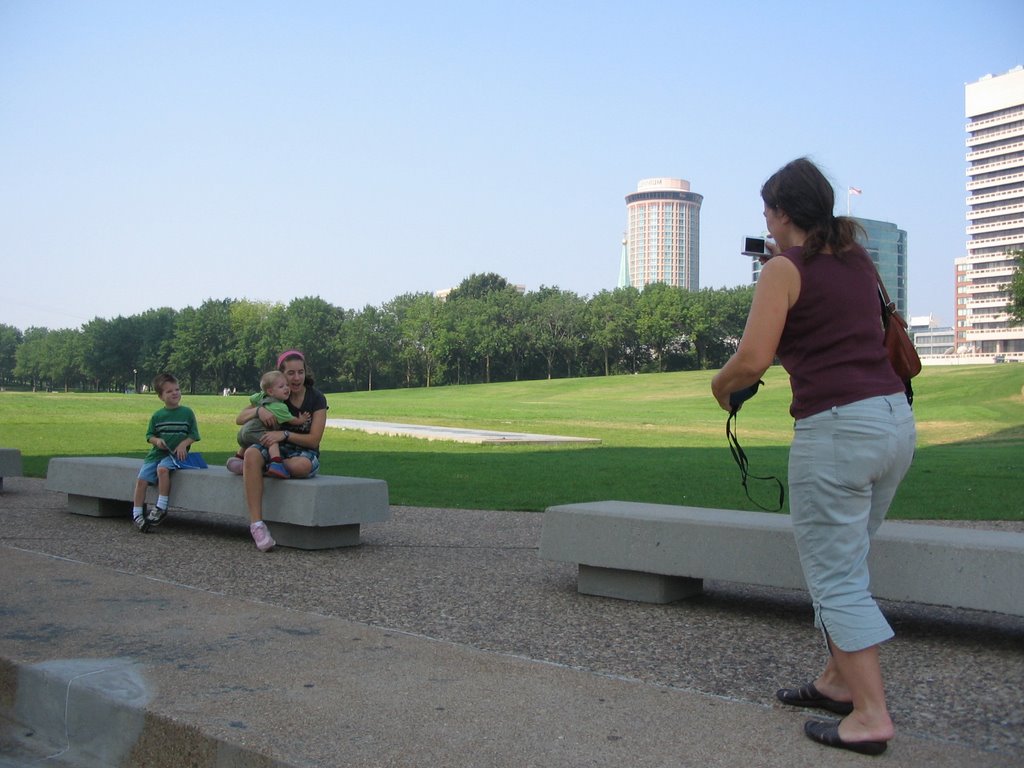
How Amy takes all those nice pictures...


On the banks of the Mississippi...