From the New Testament texts... Galatians 6:18 "The grace of our Lord Jesus Christ be with your spirit, brethren. Amen" and 2 Timothy 4:22 "The Lord be with your spirit."
Fr. Joseph Jungman S. J. had two footnotes about the origin of this, one in which he called the phrase a Semitism that simply meant "and also with you" (which obviously is what the original ICEL translators focused on to arrive at the translation that we have been using over these past years). Yet another footnote alludes to the fact that this reply in the usage of the Church's liturgy was given only to a priest or bishop and that the implication was that the greeting was to the Holy Spirit that the ordained minister had received upon their ordination. St. John Chrysostom mentioned this in a homily and an early Council of the Church reinforced its meaning.
What saying "And With Your Spirit" can teach us...
The Liturgy is the work of the Holy Spirit, not the individual presider. In fact there is no "individuals" in the liturgy save the Body of Christ. Our response acknowledges the one Holy Spirit poured upon the presider and reminds us that the work we witness in this Eucharist is the Opus Dei...the work of God.
Tuesday, June 20, 2006

Friday, June 16, 2006
And with your Spirit...
Approved
Catechise your parish now...A New Translation of the Mass Prayers?
And it is about the Bible!!!
Catechise your parish now...A New Translation of the Mass Prayers?
And it is about the Bible!!!
Thursday, June 15, 2006
A Glimpse Inside the Conclave
From Cardinal Anthony Okogie of Lagos as reported in Catholic News:
Reminiscing on his first Conclave experience, the Cardinal said that if he was elected Pope he would have collapsed, explaining that to be elected Pope one must be able to speak more than four international languages.
"That place they call Conclave is a top secret place and I was going there for the first time, like many of the cardinals. I was filled with big awe. I felt as if I wasn't really in the world especially when they said 'everybody out of the room.'
"You will swear and after that they will read the rules and regulations and thereafter the ballot papers are distributed. There is no nomination," he explained.
Cardinal Okogie said that they were free to interact with anybody until the order is given for all that non-eligible electors to go out as the papers are distributed to the electors.
"I believe really that there is something supernatural about the Conclave," he said, wondering how everybody could be backing one particular individual but after the first ballot, that person's name would suddenly disappear.
Mass Revision not Massive Changes
What the bishops are voting on is a more accurate translation of the Mass. If you've attended Mass in Spanish you already know that the English translation isn't exactly the same.
Aren't people use to the current translation? Absolutely.
So why change? Because the translation we currently use isn't exact and doesn't match the Scripture from which it is taken.
Pray for the bishops.
Aren't people use to the current translation? Absolutely.
So why change? Because the translation we currently use isn't exact and doesn't match the Scripture from which it is taken.
Pray for the bishops.
Wednesday, June 14, 2006
St. Andrew: Pope's Audience on a Hot Roman Day
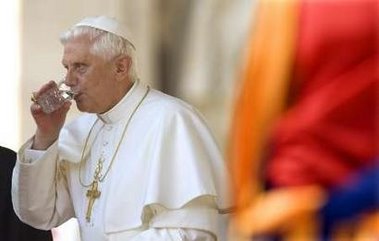
From Asia News Italy:
Today, Benedict XVI drew a picture of the personality of the brother of Simon, Andrew, who was the “first-called”, and therefore he is known as the “Protoclete”. The Pope said: “It is certain that because of the brotherly relationship between Peter and Andrew, the Church of Rome and the Church of Constantinople feel, in a special way, like sisters.” He continued: “To highlight this relationship, my predecessor Pope Paul VI, in 1964, restored the relics of St Andrew, which until then had been kept in the Vatican Basilica, to the Orthodox Metropolitan Bishop of the city of Patrasso in Greece, where according to tradition, the apostle was crucified.
The Pope did not talk merely about Andrew’s role as evangelizer of the Greek world; he also drew attention to his attitude when faced with the Cross on which he was to die. Tradition has it that Andrew defined the Cross as “blessed” because it was taking him to Jesus: an attitude that invites the faithful “to consider and to welcome” evils that strike us, “our crosses… as part of the cross of Christ”.
After recalling that the Gospels mention Andrew several times, showing him to be an eminent figure among the Twelve, the Pope added: “Very ancient traditions see Andrew not only as the interpreter of some Greeks meeting Jesus, they consider him as the Apostle of the Greeks in the years following Pentecost; they inform us that for the rest of his life, he proclaimed Jesus to the Greek world. Peter from Jerusalem reached Rome through Antioch to exercise his universal mission; Andrew, meanwhile, was the apostle of the Greek world: thus they appear in life and in death as true brothers – a brotherhood that is symbolically expressed in the special ties of the Sees of Rome and Constantinople, truly sister Churches”.
Benedict XVI also recalled the tradition of the death of Andrew at Patrasso, “where he too was submitted to the torment of crucifixion. At that supreme moment, however, like his brother Peter, he asked to be put on a cross different to that of Jesus. In his case, it was a saltire, x-shaped, tilted cross, that would become known as the ‘cross of St Andrew’. This is what the Apostle is said to have uttered on that occasion, according to an ancient narrative (from the early sixth century) entitled the Passion of Andrew: ‘Hail, O Cross that has been sanctified by the body of Christ, and adorned with his limbs as with precious stones! Before the Lord was nailed to you, you inspired fear on earth, but now you inspire heavenly love, and are desired as a blessing. Believers know how much joy you possess, how many gifts you have prepared. Thus I come to you assured and joy-filled, so that you may graciously receive me, the disciple of Him who hung upon you; O most beautiful cross that received majesty and beauty by carrying the body of Christ!... Take me, o cross, release me from my life among men and bring me to the Master so that through you he will receive me, he, who through you has saved me. Hail o Cross, yes hail!’” Evident here, continued Benedict XVI, is a very profound Christian spirituality, which considers the Cross not so much an instrument of torture as an incomparable means of full assimilation with the Redeemer. We must learn a very important lesson from this: our crosses acquire value if they are considered and welcomed as part of the cross of Christ, if they are touched by the reflection of his light. It is only through that Cross that our sufferings too are made noble and acquire their true meaning. The apostle Andrew, then, teaches us to follow Jesus promptly (cfr Mt 4:20; Mk 1:18), to speak to Him enthusiastically when we meet, and especially to cultivate a relationship of genuine familiarity with him, well aware that only in Him, we find the ultimate sense of our life and death.”
Subscribe to:
Comments (Atom)