The Holy Father has:
Appointed Bishop Michael Francis Burbidge, auxiliary of Philadelphia, U.S.A., as bishop of Raleigh, (area 82,524, population 4,073,983, Catholics 188,101, priests 138, permanent deacons 37, religious 118), U.S.A. He succeeds Bishop Francis Joseph Gossman, whose resignation from the pastoral care of the same diocese, the Holy Father accepted, upon having reached the age limit.
Appointed Msgr. Daniel E. Thomas of the clergy of the archdiocese of Philadelphia, U.S.A., pastor of the parish of Our Lady of the Assumption, as auxiliary of the same archdiocese (area 5,652, population 3,875,021, Catholics 1,479,895, priests 1,048, permanent deacons 224, religious 3,733). The bishop-elect was born in Philadelphia in 1959 and ordained a priest in 1985.
Thursday, June 8, 2006

Wednesday, June 7, 2006
Jesus Only Changed the Name of One

Simon bar Jonah, from the weekly audience:
Jesus did not usually change the names of his disciples”, in fact, “He never gave a new name to any of his disciples. However he did so with Simon, and that name, translated in Greek as Petros, would crop up several times in the Gospels and would end up by replacing his original name. This fact takes on particular significance when one recalls that in the Old Testament, changing a name was usually a prelude to entrusting one with a mission (cfr Jn 17:5; 32:28ff). In fact, the intention of Christ to attribute special importance to Peter within the Apostolic College emerges in many instances: in Capernaum, the Teacher went to lodge in Peter’s house (Mk 1:29); when the crowd flocked to the banks of the lake of Gennesaret, Jesus chose Peter’s boat from the two moored there (Lk 5:3); when in particular circumstances, Jesus took three disciples to accompany him, only Peter is always recalled as the first of the group: the same happened in the resurrection of the daughter of Jairus (cfr Mk 5:37; Lk 8:51); in the Transfiguration (cfr Mk 9:2; Mt 17:1; Lk 9:28), during the agony in the Garden of Gethsemane (cfr Mk 14:33; Mt 16:37). And again: it was Peter who was approached by the tax collectors at the Temple and the Teacher paid for himself and for Peter alone (cfr Mt 17: 24-27); it was Peter whose feet He washed first at the Last Supper (cfr Jn 13:6) and it was only for him that He prayed so that his faith would not fail and that he may in turn strengthen his brothers (cfr Lk 22: 30-31)”.
“Peter himself is, after all, aware of his unique position: it is he who often, in the name also of the rest, speaks out, asking for an explanation for some difficult parable (Mt 15:15) or the exact meaning of a precept (Mt 18:21) or the formal promise of reward (Mt 19:27).”
Tuesday, June 6, 2006
Three New Auxilary Bishops for Brooklyn
Monsignor Octavio Cisneros, Monsignor Guy Sansaricq, and Monsignor Frank J. Caggiano.
Monday, June 5, 2006
Conflict Over Textbook in Czech Republic
Catholic Church, educators clash over school textbook
Why does any religious educator think making fun of our faith is an acceptable way of teaching an eigth grader to embrace it?
Why does any religious educator think making fun of our faith is an acceptable way of teaching an eigth grader to embrace it?
Sunday, June 4, 2006
Pope: Stay Together and Pray if You Want the Holy Spirit
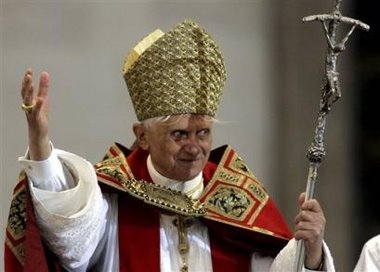
Actually, it is Jesus Christ who said this and the Pope is reminding us today in his homily:
Staying together was the condition imposed by Jesus to receive the gift of the Holy Spirit; a prerequisite of their harmony was prolonged prayer. In this, we can trace a formidable lesson for any Christian community. At times, it is thought that effective missionary work depends mainly on careful planning and consequent intelligent implementation through concrete commitment. Certainly, the Lord asks for our collaboration, but before any answer we may give, his initiative is necessary: it is his Spirit that is the true protagonist of the Church. The roots of our being and our actions lie in the knowing silence and providence of God.
The images that St Luke uses to indicate the descent of the Holy Spirit – wind and fire – recall Sinai, where God revealed himself to the people of Israel and conceded a covenant with them. (cfr Ex 19:3ff). The feast of Sinai, that Israel used to celebrate 50 days after Easter, was the feast of the Pact. Talking about tongues of fire (cfr Acts 2:3), St Luke wants to represent Pentecost as a new Sinai, as a feast of the new Pact in which the Covenant with Israel is extended to all the peoples of the Earth. The Church has been Catholic and missionary right from the time it was born. The universality of salvation is significantly highlighted by the list of numerous ethnicities of those who heard the first proclamation of the Apostles (cfr Acts 2:9-11).
The People of God, who found their first configuration on Sinai, have now been enlarged to the extent that they are no longer bound by any borders of race or culture, of space or time. As opposed to what happened with the tower of Babel (cfr Gen. 11:1-9), when men who wanted to build a path to heaven with their own hands, ended up by destroying their own capacity for mutual understanding, in Pentecost, the Spirit, with the gift of tongues, reveals how his presence unites and transforms confusion into communion. The pride and egotism of man always create division and build walls of indifference, of hate and of violence. The Holy Spirit, on the contrary, makes hearts capable of understanding the languages of all, because it re-establishes the bridge of authentic communion between Earth and Heaven. The Holy Spirit is love.
But how to enter into the mystery of the Holy Spirit, how to understand the secret of Love? The pages of today’s Gospel take us today to the Cenacle where, once the last Supper was over, a sense of confusion saddened the Apostles. The reason was that the words of Jesus had raised worrying questions: He talked about hatred of the world for him and his followers, he talked about his mysterious departure and there were many other things yet to be said, but for the time being, the Apostles were not capable of carrying the burden (cfr Jn:16:32). To tackle them, he explains the meaning of his distance: he will leave, but he will return; in the meantime, he will not abandon them, he will not leave them orphans. He will send the Consoler, the Spirit of the Father, and it will be the Spirit who will lead them to understand that the work of Christ is a labour of love: the love of He who has sacrificed himself, the love of the Father who gave him up.
Saturday, June 3, 2006
Subscribe to:
Comments (Atom)