Monday, December 19, 2005

O Radix Jesse

O ROOT OF JESSE, that stands for an ensign of the people, before whom the kings keep silence and unto whom the Gentiles shall make supplication: COME, to deliver us, and tarry not.

In the very last chapter of the Bible in Rev. 22:16 we read:
"I Jesus have sent my angel to you with this testimony for the churches. I am the root and the offspring of David, the bright morning star,"

And in response:
The Spirit and the Bride say, "Come." And let him who hears say, "Come." And let him who is thirsty come, let him who desires take the water of life without price.

While this antiphon mirrors the Revelation passage, it calls to mind the passage from Isaiah:
Behold, the Lord, the LORD of hosts will lop the boughs with terrifying power; the great in height will be hewn down, and the lofty will be brought low. He will cut down the thickets of the forest with an axe, and Lebanon with its majestic trees will fall. There shall come forth a shoot from the stump of Jesse, and a branch shall grow out of his roots. And the Spirit of the LORD shall rest upon him, the spirit of wisdom and understanding, the spirit of counsel and might, the spirit of knowledge and the fear of the LORD.

All of this put together is the Gospel message. A new generation will sprout from the cut down branches--the Lord is coming to save all his people. The Revelation passage calls to mind the fulfillment of the promise that is hinted in the antiphon's use of "ensign" in Matthew 2:2:
"Where is he who has been born king of the Jews? For we have seen his star in the East, and have come to worship him."


A great miracle has taken place, we who await his coming know where He may be found. Every celebration of the Eucharist is another renewal of begging the Lord to come, to come and rescue us! God has become one of us, sharing in our human nature, recognized as King and Lord by those who have no faith but have enough sense to realize this is the "Vine" that they need to be grafted to in order to have eternal life.

O Root of Jesse, Come!

Sunday, December 18, 2005

O Adonai

O LORD AND RULER of the House of Israel, who appeared to Moses in the flame of the burning bush and gave him the law on Sinai: COME, and redeem us with outstretched arms.

The name of God was so sacred and reverred that it was only spoken by the High Priest and then only once a year. Whenever God was referred to in Scripture His name would not be written but rather "Adonai" the Hebrew word that we translate Lord, in Greek it would be "Kyrios". In this reverential "O Antiphon" we have a plea for the Lord to come and save us, the mention of Moses who mediated the redemption of the Jewish tribes from slavery and in the midst of battle won the day as long as he could keep his arms outstretched points to the Lord who will come and redeem us with arms outstretch from the battle that humanity faces both from evil and death.

Redemption, I wonder how much that enters our mind this final week before we celebrate Christmas? A year ago, shortly after Christmas thousands of people were swept to sea to their deaths by a tsunami. Later in the year thousands have died here in our own country from the effects of deadly hurricanes that struck along the Gulf coast. Not to mention the millions who will not celebrate Christmas this year, whose lives ended from any variety of causes including the unnatural one of sin that infects all of creation, that we call original sin.

The "one thing necessary"--that perfect gift--won't be lying under the Christmas tree next Sunday. But the name of the day gives you a clue where you and I can find the Divine medicine offered in response to our prayer today--we will find Him with Mary His Mother and St. Joseph (who's representations stand sentinel in many Catholic Churches on either side of the altar)at Christ's Mass. Every day can be Christmas--
O Lord, Come!

Fourth Sunday of Advent: Pope's Angelus

dubruiel
Go to Joseph!

Michael Dubruiel

From Asia News Italy:

I would like today to turn my attention to the figure of St Joseph. In today?s gospel pages, St Luke presents the Virgin Mary as ?engaged to a man whose name was Joseph, of the house of David? (Lk 1:27). However it is the evangelist Matthew who gives the greatest prominence to the putative father of Jesus, pointing out that, through him, the Child was legally inserted in David?s line and thus he realized the Scriptures, in which the Messiah was prophesied as the ?son of David?. But Joseph?s role certainly cannot be reduced to this aspect. He is the model of the ?just? man (Mt 1:19), who in perfect sympathy with his spouse, welcomes the Son of God made man and guards over his human growth. For this reason, the days leading up to Christmas are as good a time as ever to establish a sort of spiritual conversation with St Joseph, because he helps us to live to the full this great mystery of faith.

The beloved Pope John Paul II, who was very devoted to St Joseph, left us an awesome meditation dedicated to him in the Apostolic Exhortation Redemptoris Custos, "Guardian of the Redeemer". Among the many aspects it highlights, particular emphasis is placed on the silence of St Joseph. His is a silence permeated by contemplation of the mystery of God, in an attitude of total availability to his divine wishes. In other words, the silence of St Joseph was not the sign of an inner void, but on the contrary, of the fullness of faith he carried in his heart, and which guided each and every one of his thoughts and actions...

...Let us allow ourselves to be ?infected? by the silence of St Joseph! We have much need of it in a world which is often too noisy, which does not encourage reflection and listening to the voice of God. In this time of preparation for Christmas, let us cultivate interior meditation to welcome and watch over Jesus in our lives.

Saturday, December 17, 2005

O Sapientia

O WISDOM, who came from the mouth of the Most High, reaching from end to end and ordering all things mightily and sweetly: COME, and teach us the way of prudence.

In these days with debate on intelligent design often dominating the Christian discussion of the origin of the cosmos comes the ancient prayer of the Church--the first O Antiphon, O Sapientia in Latin, O Sophia in Greek and O Wisdom in English. The "wisdom" of God which encompasses all of creation and orders all of creation is invoked to "teach us" the way.

In some ways this is another version of "God's ways are not our ways" and so we need to be taught that there is a higher power than ourselves guiding all things to "mightily and sweetly" even though this is beyond our natural perception.

Can we be taught to this way?

Yes, and this is precisely why dying to ourselves is so necessary if we are to follow Christ. It is also in my estimation the most neglected aspect of following Christ and the reason why we make so little progress in the spiritual life. We refuse to leave the "old man" behind. Like Augustine we hear the voices of our past crying out to us, but unlike Augustine we do not leave them.

In order to "see what the Lord has made known to us" we must go where the Angels tell us that we can find Him "in the House of Bread with Mary His Mother"--beyond the natural perception of the Shepherds who first heard the message and beyond the natural perception of those of us who living in the 20-05 still travel to encounter him in the Eucharist in the Churches that reverence His Mother (both in the East and West--isn't it strange how Eucharistic belief and devotion to Mary are maintained only in those churches?)

The Russian Orthodox theologian Fr. Sergius Bulgakov devoted his life to working out a theology of Sophia (again, the Greek word for wisdom)and what he taught fits in well with the first "O Antiphon". The Sophia of God is both within the Trinity but also within creation--in other words within you. Unleashing that Wisdom within you starts by inviting it, realizing that you need it, realizing that the foolishness of man is the wisdom of God.

O Wisdom...come!

Thursday, December 15, 2005

New Archbishop of San Francisco

From the Vatican Information Service:

The Holy Father:

- Accepted the resignation from the office of auxiliary of the archdiocese of San Antonio, U.S.A., presented by Bishop Thomas J. Flanagan, upon having reached the age limit.

- Appointed Bishop George Hugh Niederauer, bishop of Salt Lake City, as metropolitan archbishop of San Francisco (area 2,620, population 1,744,050, Catholics 425,210, priests 425, permanent deacons 62, religious 1,004), U.S.A. The archbishop-elect was born in Los Angeles, U.S.A. in 1936, he was ordained a priest in 1962 and consecrated a bishop in 1995.

Tuesday, December 13, 2005

New Bishop for Marquette, MI

A young one...

From Vatican Information Services...the Holy Father has:

Appointed Fr. Alexander King Sample of the clergy of Marquette, U.S.A., diocesan chancellor, as bishop of the same diocese (area 42,152, population 317,616, Catholics 68,360, priests 100, permanent deacons 28, religious 70). The bishop-elect was born in Kalispell, U.S.A. in 1960 and ordained as a priest in 1990. He succeeds Bishop James Henry Garland, whose resignation from the pastoral care of the same diocese, the Holy Father accepted, in accordance with canon 401 para. 2 of the Code of Canon Law.

Anniversary of Father Schmemann's Death


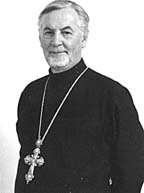
Father Alexander Schmemann died on this day in 1983. I find it a bit ironic that three of the people I quote the most all died within the same week in December. Anyway, Father Alexander was an Orthodox priest, theologian and in my estimation one of the greatest writers of the last century. Here is an excerpt from his Journal:

Nowadays, expecially in the U.S., the Church is perceived as an enterprise, an activity. The priest constantly harasses people to do something for the Church. And their activism is measured by quantitative criteria: how many meetings, how much money, how much "doing." I'm not sure it is all necessary. What is dangerous is not activity itself, but the reduction of the Church, the identification of this activity with life in the Church. The idea of the Church, the sacramental principle of its life, lies in taking us away from activity ("let us put aside all earthly cares"), in making us commune with a new life, eternity, the Kingdom. And the idea of the Church, the principle of its life also demands that we would bring into the world this experience of a new life so that we would purify this world, illumine it with the non-worldliness of the experience of the Church. Quite often the opposite happens: we bring activity into the Church, the fuss of this world, and submit the Church, poison its life with incessant fuss. What happens is not that life becomes the Church, but the Church becomes worldly.