O WISDOM, who came from the mouth of the Most High, reaching from end to end and ordering all things mightily and sweetly: COME, and teach us the way of prudence.
In these days with debate on intelligent design often dominating the Christian discussion of the origin of the cosmos comes the ancient prayer of the Church--the first O Antiphon, O Sapientia in Latin, O Sophia in Greek and O Wisdom in English. The "wisdom" of God which encompasses all of creation and orders all of creation is invoked to "teach us" the way.
In some ways this is another version of "God's ways are not our ways" and so we need to be taught that there is a higher power than ourselves guiding all things to "mightily and sweetly" even though this is beyond our natural perception.
Can we be taught to this way?
Yes, and this is precisely why dying to ourselves is so necessary if we are to follow Christ. It is also in my estimation the most neglected aspect of following Christ and the reason why we make so little progress in the spiritual life. We refuse to leave the "old man" behind. Like Augustine we hear the voices of our past crying out to us, but unlike Augustine we do not leave them.
In order to "see what the Lord has made known to us" we must go where the Angels tell us that we can find Him "in the House of Bread with Mary His Mother"--beyond the natural perception of the Shepherds who first heard the message and beyond the natural perception of those of us who living in the 20-05 still travel to encounter him in the Eucharist in the Churches that reverence His Mother (both in the East and West--isn't it strange how Eucharistic belief and devotion to Mary are maintained only in those churches?)
The Russian Orthodox theologian Fr. Sergius Bulgakov devoted his life to working out a theology of Sophia (again, the Greek word for wisdom)and what he taught fits in well with the first "O Antiphon". The Sophia of God is both within the Trinity but also within creation--in other words within you. Unleashing that Wisdom within you starts by inviting it, realizing that you need it, realizing that the foolishness of man is the wisdom of God.
O Wisdom...come!
Saturday, December 17, 2005

Thursday, December 15, 2005
New Archbishop of San Francisco
From the Vatican Information Service:
The Holy Father:
- Accepted the resignation from the office of auxiliary of the archdiocese of San Antonio, U.S.A., presented by Bishop Thomas J. Flanagan, upon having reached the age limit.
- Appointed Bishop George Hugh Niederauer, bishop of Salt Lake City, as metropolitan archbishop of San Francisco (area 2,620, population 1,744,050, Catholics 425,210, priests 425, permanent deacons 62, religious 1,004), U.S.A. The archbishop-elect was born in Los Angeles, U.S.A. in 1936, he was ordained a priest in 1962 and consecrated a bishop in 1995.
Tuesday, December 13, 2005
New Bishop for Marquette, MI
A young one...
From Vatican Information Services...the Holy Father has:
From Vatican Information Services...the Holy Father has:
Appointed Fr. Alexander King Sample of the clergy of Marquette, U.S.A., diocesan chancellor, as bishop of the same diocese (area 42,152, population 317,616, Catholics 68,360, priests 100, permanent deacons 28, religious 70). The bishop-elect was born in Kalispell, U.S.A. in 1960 and ordained as a priest in 1990. He succeeds Bishop James Henry Garland, whose resignation from the pastoral care of the same diocese, the Holy Father accepted, in accordance with canon 401 para. 2 of the Code of Canon Law.
Anniversary of Father Schmemann's Death
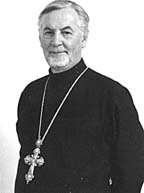
Father Alexander Schmemann died on this day in 1983. I find it a bit ironic that three of the people I quote the most all died within the same week in December. Anyway, Father Alexander was an Orthodox priest, theologian and in my estimation one of the greatest writers of the last century. Here is an excerpt from his Journal:
Nowadays, expecially in the U.S., the Church is perceived as an enterprise, an activity. The priest constantly harasses people to do something for the Church. And their activism is measured by quantitative criteria: how many meetings, how much money, how much "doing." I'm not sure it is all necessary. What is dangerous is not activity itself, but the reduction of the Church, the identification of this activity with life in the Church. The idea of the Church, the sacramental principle of its life, lies in taking us away from activity ("let us put aside all earthly cares"), in making us commune with a new life, eternity, the Kingdom. And the idea of the Church, the principle of its life also demands that we would bring into the world this experience of a new life so that we would purify this world, illumine it with the non-worldliness of the experience of the Church. Quite often the opposite happens: we bring activity into the Church, the fuss of this world, and submit the Church, poison its life with incessant fuss. What happens is not that life becomes the Church, but the Church becomes worldly.
Monday, December 12, 2005
Image of Guadalupe --A Pop Icon

From The Arizona Republic:
"The image of the beloved Virgin of Guadalupe has moved from the solemn walls of Catholic churches and onto the stylish hips of fashionistas like Priscila Ferrand.
The Mexican version of the Virgin Mary is on the Scottsdale nurse's $300 belt, threaded through her low-rise jeans. Her dark-skinned face shines on a silver buckle surrounded by green stones.
For almost five centuries, since her legendary appearance to a peasant Aztec atop a Mexican mountain, she has been the religious icon of the devout. Today, la Virgen de Guadalupe is also a pop icon. "
Sunday, December 11, 2005
Book Signing Today in Fort Wayne
At the Cathedral Bookstore in downtown Fort Wayne, this afternoon...come and get a Mass book...the perfect Christ-Mass gift!
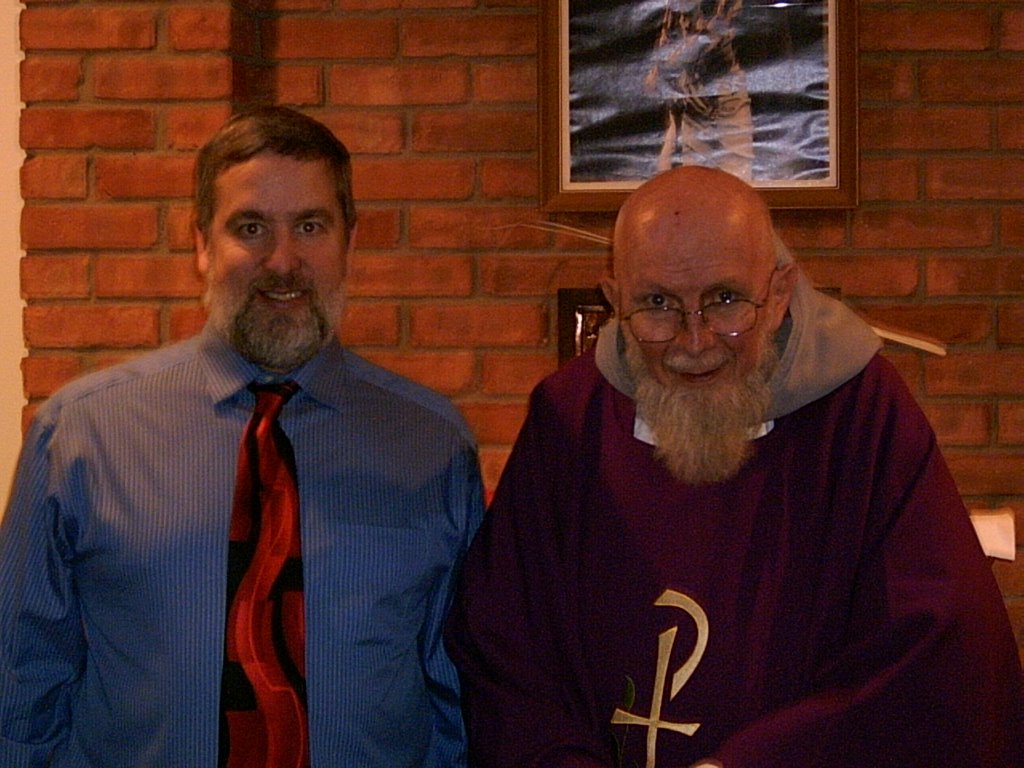
Me with Father Benedict who was at the Cathedral earlier this week:

Me with Father Benedict who was at the Cathedral earlier this week:
Third Sunday of Advent
From Pope Benedict's Angelus Today:
After having celebrated the feast of Mary’s Immaculate Conception, we enter these days into the striking climate of preparation for the Holy Christmas. In today’s consumeristic society, alas, this period has undergone a sort of commercial “pollution”, which threatens to change its authentic spirit, characterised by meditation, by sobriety, and by an intimate rather than external joy. And so it is providential that, almost like an entrance to Christmas, there is the feast of She who is the Mother of Jesus, and who can lead us to know, love and adore the Son of God made man better than anyone else can. Let us then allow Her to accompany us; let her sentiments animate us, so that we will prepare ourselves with sincerity of heart and openness of spirit to recognise the Son of God in the Child in Bethlehem, who came to earth for our redemption. Let us walk together with Her in prayer, and welcome the oft-repeated invitation which the Advent Liturgy extends to us, to be in waiting, a watchful and joyful waiting because the Lord will not delay: He comes to free his people from sin.
In many families, following a beautiful and consolidated tradition, the preparation of the Crib follows soon after the feast of the Immaculate Conception, as though to relive together with Mary these days full of trepidation which preceded the birth of Jesus. Making the Crib at home can turn out to be a simple but effective way of presenting the faith to transmit it to one’s children. The Crib helps us to contemplate the mystery of God’s love which revealed itself in the poverty and simplicity of the grotto in Bethlehem. St Francis of Assisi was so taken by the mystery of the Incarnation that he wanted to present it once again in the living Crib in Greccio, becoming thus the man who started the long popular tradition which still today conserves its value for evangelization. The Crib may in fact help us to understand the secret of the true Christmas, because it talks about the humility and merciful goodness of Christ, who “although he was rich, became poor” (2 Cor 8,9) for us. His poverty enriches those who embrace it and Christmas brings joy and peace for all those who, like the shepherds in Bethlehem, welcome the words of the gospel: “This will be a sign for you: you will find a child wrapped in bands of cloth and lying in a manger” (Lk 2:12). This remains the sign, for us too, men and women of 2000. There is no other Christmas.
As the beloved John Paul II used to do, soon I too will bless the statues of the Baby Jesus which the children of Rome will put in the Crib in their homes. With this gesture, I want to invoke the Lord’s help so that all Christian families will prepare to celebrate the upcoming Christmas festivities with faith. Mary helps us to enter into the true spirit of Christmas.
Subscribe to:
Posts (Atom)