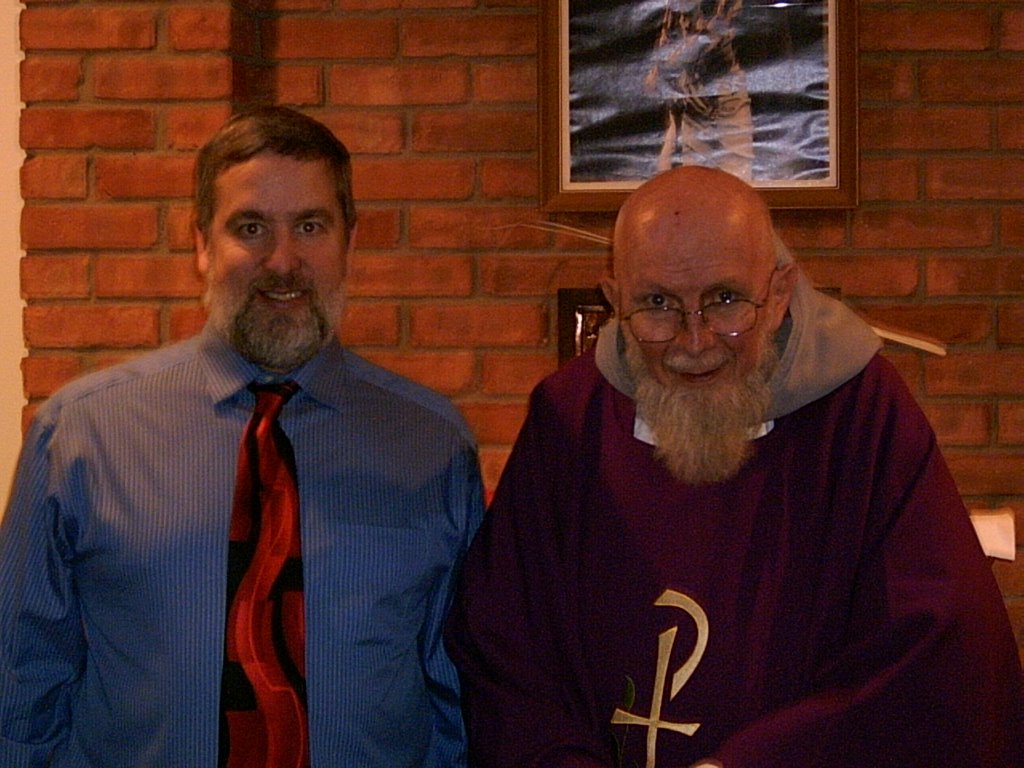
Me with Father Benedict who was at the Cathedral earlier this week:
After having celebrated the feast of Mary’s Immaculate Conception, we enter these days into the striking climate of preparation for the Holy Christmas. In today’s consumeristic society, alas, this period has undergone a sort of commercial “pollution”, which threatens to change its authentic spirit, characterised by meditation, by sobriety, and by an intimate rather than external joy. And so it is providential that, almost like an entrance to Christmas, there is the feast of She who is the Mother of Jesus, and who can lead us to know, love and adore the Son of God made man better than anyone else can. Let us then allow Her to accompany us; let her sentiments animate us, so that we will prepare ourselves with sincerity of heart and openness of spirit to recognise the Son of God in the Child in Bethlehem, who came to earth for our redemption. Let us walk together with Her in prayer, and welcome the oft-repeated invitation which the Advent Liturgy extends to us, to be in waiting, a watchful and joyful waiting because the Lord will not delay: He comes to free his people from sin.
In many families, following a beautiful and consolidated tradition, the preparation of the Crib follows soon after the feast of the Immaculate Conception, as though to relive together with Mary these days full of trepidation which preceded the birth of Jesus. Making the Crib at home can turn out to be a simple but effective way of presenting the faith to transmit it to one’s children. The Crib helps us to contemplate the mystery of God’s love which revealed itself in the poverty and simplicity of the grotto in Bethlehem. St Francis of Assisi was so taken by the mystery of the Incarnation that he wanted to present it once again in the living Crib in Greccio, becoming thus the man who started the long popular tradition which still today conserves its value for evangelization. The Crib may in fact help us to understand the secret of the true Christmas, because it talks about the humility and merciful goodness of Christ, who “although he was rich, became poor” (2 Cor 8,9) for us. His poverty enriches those who embrace it and Christmas brings joy and peace for all those who, like the shepherds in Bethlehem, welcome the words of the gospel: “This will be a sign for you: you will find a child wrapped in bands of cloth and lying in a manger” (Lk 2:12). This remains the sign, for us too, men and women of 2000. There is no other Christmas.
As the beloved John Paul II used to do, soon I too will bless the statues of the Baby Jesus which the children of Rome will put in the Crib in their homes. With this gesture, I want to invoke the Lord’s help so that all Christian families will prepare to celebrate the upcoming Christmas festivities with faith. Mary helps us to enter into the true spirit of Christmas.

Secular life is a life frantically dedicated to escape, through novelty and variety, from the fear of death. But the more we cherish secular hopes, the more they disappoint us. And the more they disappoint us, the more desparately do we return to the attack and forge new hopes more extravagant than the last. These too let us down. And we revert to the insufferable condition from which we have vainly tried to escape...
...In the sacred society, on the other hand, man admits no dependence on anything lower than himself, or even "outside" himself in a spacial sense. His only Master is God. Only when God is our Master can we be free, for God is within ourselves as well as above us. He rules us by liberating us and raising us to union with Himself from within. And in so doing He liberates us from our dependence on created things outside of us.
The only certain big thing on the horizon is the pope's first encyclical, a 46-page meditation titled "Deus Caritas Est" ("God Is Love"), which takes its inspiration from the first letter of St. John. It will be published in early December.
News about the encyclical's content, first reported by Catholic News Service in October, was one of the few tidbits to filter out of the Apostolic Palace in recent weeks. That, too, marks a change.
"We used to joke around here that 'pontifical secret' meant everyone knows except the pope. But under this pope, no one knows anything.

