Wednesday, October 12, 2005

Synod on the Eucharist

From the Orthodox Church
First the Greek...
METROPOLITAN JOHANNIS ZIZIOULAS OF PERGAMO, GREECE. "It is a great honor for me to be given the opportunity to address this venerable episcopal Synod and bring to it the fraternal greetings and best wishes of the Ecumenical Patriarch Bartholomew and the Church of Constantinople. The invitation to our Church to send a fraternal delegate to this Synod is a gesture of great ecumenical significance. We respond to it with gratitude and love. We Orthodox are deeply gratified by the fact that your Synod also regards the Eucharist as the source and summit of the life and mission of the Church. It is extremely important that Roman Catholics and Orthodox can say this with one voice. There may still be things that separate our two Churches but we both believe that the Eucharist is the heart of the Church. It is on this basis that we can continue the official theological dialogue of our two Churches, which is now entering a new phase. Eucharistic ecclesiology can guide us in our efforts to overcome a thousand years of separation. For it is a pity to hold the same conviction of the importance of the Eucharist but not be able to share it at the same table."
Then from the Russian and Preparation for Reception of the Eucharist
REV. FILIPPO VAYLTSEV OF THE PATRIARCHATE OF MOSCOW, RUSSIA. "The Eucharist is the central and most important point of the life of the Church and of every Christian. Hence, the weakening of Eucharistic awareness leads to a destruction of ecclesiastic awareness, ... and to errors in the understanding of Christian values. ... We would be very pleased if our experience of Eucharistic life, both past and present, proves useful and helpful to the Roman Catholic Church. ... It must not be forgotten that preparation for communion in the Russian Orthodox Church also includes, apart from inner preparation, 'The Rule' (strict fasting for three days, visits to Church during these three days, prayers for communion, and special Eucharistic fasting after midnight), and Confession is also compulsory. However, these strict rules are seen by the Church not as an obligation, but as a measure that was formed historically in accordance with tradition, and that people apply to themselves."
From the Syrian Orthodox
MOR SEVERIUS MALKE MOURAD OF THE SYRO-ORTHODOX PATRIARCHATE, SYRIA. "In our Syrian Orthodox Church, we celebrate the divine liturgy in Syriac-Aramaic, the language of our Lord Jesus; and during the divine liturgy the very same words which Jesus said in the Upper Room are recited. And the priest who celebrates this Sacrament, has to celebrate it alone. I feel proud that I live in the Monastery of St. Mark in the Old City of Jerusalem, where Jesus had His Last Supper. ... The presence of Christ in the Holy Eucharist is not only His bodily presence, but all His fullness in humanity and divinity. So Lord Jesus is present in all parts of the two elements. ... St. Paul the Apostle exhorts the believer to spiritually prepare himself before he comes to receive holy communion with faith, reverence and a pure conscience, and should cleanse his body and observe the pre-communion fast at 12 midnight. We used to give the sacraments of holy communion to the children immediately after they receive the sacraments of Baptism and Confirmation."
From the Anglicans Noting the Public Communion of Brother Roger (a Protestant)
Note to readers: This happened at the funeral of John Paul and Brother Roger received Communion from then Cardinal Ratzinger...
BISHOP JOHN HIND OF CHICHESTER, ENGLAND. "I bring greetings from the Archbishop of Canterbury and request for prayers for Anglicans at a difficult time. ... When is it appropriate to share holy communion? How should we interpret the public giving of communion to the Protestant Frere Roger Schutz? The Eucharist is not primarily a matter or rite or ceremonial but a living of the new life in Christ. If it is to be truly Christian, there must be criteria for mutual recognition. No less important is the extent to which we suffer with each other. ... In the Eucharist it is not our fellowship that is being celebrated, but our reconciliation with God which creates our fellowship. ... If the Eucharist is itself 'Mysterium fidei' then it must follow that our fellowship or communion in the Church is also a 'mysterion,' in other words, speaking something we cannot understand by reason alone. Finally, being united with Christ in His self?offering orients us not only towards God but also towards every single one of our human brothers and sisters, for whom in their amazing diversity the Son of God gave His life."
Against Married Priests
CARDINAL GEORGE PELL, ARCHBISHOP OF SYDNEY, AUSTRALIA. "Many Synod Fathers have spoken of the difficulties experienced by the Church throughout the world. Some of these are caused by our own mistakes. Vatican Council II brought great blessings and substantial gains, for example, continuing missionary expansion and the new movements and communities. But it was also followed by confusion, some decline, especially in the West, and pockets of collapse. Good intentions are not enough. ... My recommendations to the Synod on how to deal with these 'shadows' presuppose the maintenance in the Latin Church of the ancient tradition and life?giving discipline of mandatory celibacy for the diocesan clergy as well as the religious orders. To loosen this tradition now would be a serious error, which would provoke confusion in the mission areas and would not strengthen spiritual vitality in the First World. It would be a departure from the practice of the Lord Himself, bring significant practical disadvantages to the work of the Church, e.g. financial, and weaken the sign value of the priesthood; it would weaken, too, the witness to loving sacrifice, and to the reality of the Last Things, and the rewards of Heaven. ... Communion services or liturgies of the Word should not be substituted for Mass, when priests are available. Such unnecessary substitutions are often not motivated by a hunger for the Bread of Life, but by ignorance and confusion or even by hostility to the ministerial priesthood and the Sacraments."
From Turkey
BISHOP LUIGI PADOVESE O.F.M. Cap., APOSTOLIC VICAR OF ANATOLIA, TURKEY. "I speak as bishop of the Church of Anatolia, an area that saw the first great expansion of Jesus' message and in which Christians are now reduced to just a few thousand. The only Christians in the city of Tarsus, homeland of the Apostle Paul, are three nuns who welcome pilgrims; pilgrims who must get a permit in order to celebrate the Eucharist in the only remaining church-museum. The same is true for the church-museum of St. Peter in Antioch. In that city was born John Chrysostom, the 16th centenary of whose death in exile falls in 2007. With his homilies, Chrysostom reminds us that the Eucharist was and is the privileged place for announcing Christ. His memory, as well as the more recent recollection of bishops such as Clemens von Galen and Oscar Romero, is a living testimony of the bond between the memorial of Jesus' sacrifice and the people who found therein the motivation and strength for a proclamation undertaken with intelligence and courage and frankness."
Presenting Christ Boldly to the World!
MOYSES LAURO DE AZEVEDO FILHO, FOUNDER AND MODERATOR GENERAL OF THE SHALOM CATHOLIC COMMUNITY, BRAZIL. "One of the most important fruits of the Eucharist which we must cultivate is 'parresia.' Parresia is a Greek word which in the New Testament takes on the meaning of audacity in proclaiming Christ. In the period of carnival, in Brazil, when youngsters are exposed to serious dangers, the Catholic Shalom Community promoted ... a moment of adoration before the Most Holy Sacrament. It was impressive to see what many consider impossible: one hundred thousand young people in deep adoring silence before the real presence of Jesus in the Eucharist. This was a prelude to Cologne. Even more impressive were the fruits of this and of other actions of this type: many conversions, a large number of confessions, commitment to the Church with a return to participation in Mass, an awakening of priestly vocations, and love and service to the poor. We discovered that the best reply to the challenge of secularization is to present Christ with audacity!"
Tuesday, October 11, 2005
Feast of Bl. Francis Xavier Seelos
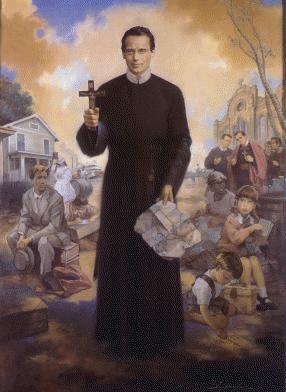
From Catholic Online - Saints & Angels - Bl. Francis Xavier Seelos:
"Francis Xavier Seelos was born in Fussen, Germany, in 1819. Expressing his desire for the priesthood since an early age, he entered the diocesan seminary of Augsburg after completing his studies in philosophy. Upon learning of the charism and missionary activity of the Congregation of the Most Holy Redeemer, he decided to join and go to North America. He arrived in the United States on April 20, 1843, entered the Redemptorist novitiate and completed his theological studies, being ordained a priest on December 22, 1844. He began his pastoral ministry in Pittsburgh, Pennsylvania, where he remained nine years, working closely as assistant pastor of his confrere St. John Neumann, while at the same time serving as Master of Novices and dedicating himself to mission preaching. In 1854, he returned to Baltimore, later being transferred to Cumberland and then Annapolis, where he served in parochial ministry and in the formation of the Redemptorist seminarians. He was considered an expert confessor, a watchful and prudent spiritual director and a pastor always joyfully available and attentive to the needs of the poor and the abandoned. In 1860, he was a candidate for the office of Bishop of Pittsburgh. Having been excused from this responsibility by Pope Pius IX, from 1863 until 1866 he became a full-time itinerant missionary preacher. He preached in English and German in the states of Connecticut, Illinois, Michigan, Missouri, New Jersey, New York, Ohio, Pennsylvania, Rhode Island, and Wisconsin. He was named pastor of the Church of St. Mary of the Assumption in New Orleans, Louisiana, where he died of the yellow fever epidemic caring for the sick and the poor of New Orleans on October 4, 1867, at the age of 48 years and nine months. The enduring renown for his holiness which the Servant of God enjoyed occasioned his Cause for Canonization to be introduced in 1900 with the initiation of the Processo Informativo . On January 27, Your Holiness declared him Venerable, de creeing the heroism of his virtues"
Blessed Francis'Relics Survive Hurricane Katrina...
From the Saint Louis Review:
While St. Mary’s Church in New Orleans was damaged from Hurricane Katrina, the relics of Blessed Francis Xavier Seelos, CSSR, were not, said Father Henry McKeever, CSSR.
"The chief relics were removed in time to save them from any damage. They will be returned as soon as things clear up down there," said Father McKeever, area contact for the National Shrine of Blessed Seelos, based at St. Mary’s Church in New Orleans.
St. Mary’s is the national headquarters for the canonization cause of Father Seelos. St. Louis, Father McKeever noted, has its own shrine "branch" where devotions to the priest are commended at St. Mary of Victories Chapel, 744 S. Third St. in Downtown St. Louis.
Pray for the people of New Orleans!
Notre Dame Football, The Catholic Faith and Gerry Faust
Interview with the Coach atThe Catholic Report - October 11, 2005
Synod on the Eucharist
The Secret of Success
CARDINAL IVAN DIAS, ARCHBISHOP OF BOMBAY, INDIA. "In the Synod sessions, among the many shadows in our Church today, the decreasing numbers of church?goers, the waning interest in sacramental Confession, and the lack of catechesis has been mentioned. These problems have been in the Church always, albeit in different ways. On the other hand, the Church has also had persons who have tackled such situations in ways which can inspire us even today. Everyone knows of the saintly Cure of Ars and great apostle of the confessional, John Mary Vianney, and of Archbishop Fulton Sheen, the brilliant speaker who reached millions of people through his television and radio broadcasts, The secret of their resounding success was the many hours they spent in prayer before the Blessed Sacrament. They could well be role models for priests and bishops today. There is a Chinese proverb which says: instead of cursing the darkness, light a candle. As we are immersed in the darkness of spiritual and moral ills all around us, would it not be wonderful if bishops and priests all over the world would spend an hour in praise and worship before the Blessed Sacrament everyday interceding for themselves, for the faithful entrusted to their pastoral care and for the needs of the whole Church? Their flocks would certainly be edified and encouraged at seeing their shepherds practising what they preach on devotion to the Blessed Eucharist."
And Problems
CARDINAL JULIAN HERRANZ, PRESIDENT OF THE PONTIFICAL COUNCIL FOR LEGISLATIVE TEXTSPerhaps we should be more sensitive to the reasonable requests of the faithful who express their 'hunger for the Eucharist.' In fact, many of them complain of the difficulty of finding a confessor, even where priests are not lacking in the parish; they point out liturgical abuses and trivializing desecration of Eucharistic celebrations; they suffer because, contrary to canonical norms on public worship, churches are always closed except during community celebrations, and people cannot remain in adoration in front of the Blessed Sacrament, etc. Since justice consists in giving each their rights ('unicuique suum tribuere'), we ask our Lady - 'Speculum Iustitiae' - to help us guarantee our lay brothers and sisters the exercise of their rights: for the good of their souls, but also for the apostolic vigor of the entire People of God."
Passivity of the Laity
BISHOP EDWARD GABRIEL RISI O.M.I., OF KEIMOES-UPINGTON, SOUTH AFRICA. "In the conference area of Southern Africa we have discovered that the role of the small faith?based community is essential in the preparation for and the celebration of the liturgy, and also the place where the gift of the Spirit is lived out. ... However, because of the shortage of priests, there are many communities who only celebrate Mass once a month, or once every two months. ... We notice that the most sacred part of the liturgy, the Eucharistic prayer, is the least attractive part of the Sunday liturgy. Although it is the central part of the Eucharist, the climax, it has proved to be the anti?climax. The priest does it alone, and the laity move from active to passive participation. We would propose that there be some form of responsorial participation which allows the people to participate more actively than simply by a respectful silence. We are not proposing that the role of the celebrant be diminished but rather that the people be given a role by which they support the celebrant and enhance their participation."
Monday, October 10, 2005
Synod on the Eucharist
A Suggested Name Change
- H.E. Most. Rev. Petru GHERGHEL, Bishop of Ia?i (ROMANIA)
I suggest a proposal to increase respect towards the Eucharist. Keeping in mind the Oriental tradition, the richness of such witness and the attempt of an exchange of gifts between our Churches, I propose using for the Holy Mass also the name “The Holy and Divine Liturgy”, next to the Latin one, already in use but not very precise. It would be a title that suggests in a better way the sacred and invites to meditation, to amazement, to silence, to adoration.
Finally, an appeal: let us conserve in the structures of our churches the most visible and accessible place for the Tabernacle, to avoid the risk of our churches becoming like lovely shells whose inhabitant no longer can be found there.
More Reverence
- H.E. Most. Rev. Gabriel MALZAIRE, Bishop of Roseau (DOMINICAN REPUBLIC)
In some of the dioceses that are predominantly Protestant and/or
strongly influenced by the evangelical culture some of the faithful have
difficulty appreciating the difference between the Mass and non-Catholic
worship. For practicing Catholics the Eucharist is very important for their
growth in the Faith.
Systematic formation on the Eucharist is most prevalent
for children and young adults preparing for first communion and Confirmation. By
and lager the adult population has depended on the Sunday homily for their
doctrinal and spiritual formation
Great efforts are made to ensure that the
Eucharist is celebrated with dignity, decorum and with true participation of the
faithful.
The awareness of the need for inculturating the liturgy is growing
in the Caribbean. Many of the faithful resist the short handshake for the sign
of peace. They want a more feeling expression of fraternity, such as a bear hug
or an embrace.
The Sacrament of Penance is not a regular part of the
spiritual life a growing number of Catholics.
Mixed marriages sometimes lead
to a diminished regard for the Eucharist. Intercommunion poses a problem in the
Antilles.
Many of the faithful believe Holy Communion leads to personal
sanctification and transformation of attitudes and engenders responsiveness to
the needs of others. However, for many others there is a disparity between what
they believe and how they live.
Some recommendations include: (1) A return
to the emphasis on Easter duties with its requirement for (at least) annual
Confession; (2) Reclaim the respect and reverence due to the holy places; (3)
The need for grater silence before and during the celebration of the Holy Mass;
(4) That pews with kneelers be returned to the Church so that people get into
the habit of showing reverence before the Blessed Sacrament.
The "Moment" of Consecration and Dialogue
- Rev. Peter-Hans KOLVENBACH, S.I., Superior General of the Society of Jesus (NETHERLAND)
The rediscovery of the Tridentine notion of sacramental representation by Odo Casel, recently integrated and founded under the biblical profile, opens encouraging horizons in the dialogue between Catholic and the Reformed Churches. Instead of saying that the Mass is the renovation of the sacrifice of the Cross, today we say more exactly that the Mass is the renovation of the memorial of the sacrifice of the Cross. In fact, the Mass is a sacramental sacrifice, i.e. the sacrament of that sacrifice, our sacramental re-presentation to the sole sacrifice.
The limit which sets the Catholic theology of the second millennium against the Orthodox one was that of analyzing the Eucharistic transformation on the basis of the notion of physical time, making it exclusively dependent either on the moment when the consecration words are pronounced or on the moment in which the consecratory epiclesis is pronounced. On the one hand as on the other, it has been forgotten that the moment when the transubstantiation (or metabolè) occurs is not that of our chronometer, but it is God’s instant, which is sacramental time. The Magisterium of the lex orandi teaches that this instant, being by its own nature, “beyond physical things”, admits two strong moments, both provided with an absolute consecratory efficacy: the institutional narration and the epiclesis. Referring to the consecration words and to the consecratory epiclesis, the notion of absolute consacretory efficacy does not support conflictuality or exclusivisms. Far be it from presenting itself as an obstacle, the question of the epiclesis is revealed as a real ecumenical bridge in the dialogue between Catholics and the Othodox.
Heaven
- H.E. Most. Rev. Jean-Louis BRUGUÈS, O.P., Bishop of Angers (FRANCE)
We need to take our part in the ongoing secularization: it is a weighty and lasting tendency. It has secreted a mentality - secularism - which singularly questions Christian conscience. Secularism challenges any form of relationship with the world beyond and the invisible world. There exists even a self-secularization within our Christian communities. What becomes of the Eucharist, “bread from Heaven” if there is no longer a heaven? The role that the Eucharist should play in the “new evangelization”, more precisely in evangelization by culture, should be defined. Our young people who have discovered in Eucharistic Adoration the source of their mission in the service of modern rationalism, should also be encourage.
Subscribe to:
Comments (Atom)