Monday, October 10, 2005

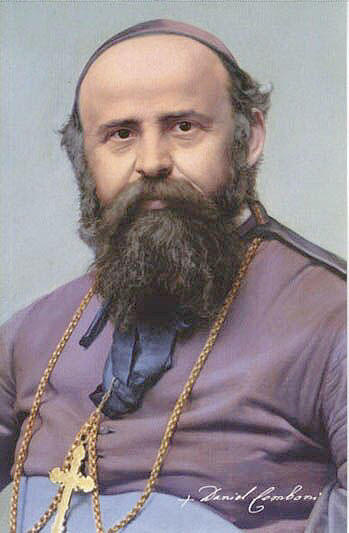
Saint Daniel Comboni


From a Homily of Pope John Paul on Daniel Comboni:

From the time of his priestly formation in the institute founded by the Servant
of God Nicola Mazza, Daniel Comboni felt called to give his own life to proclaim
the Gospel in the land of Africa. This awareness stayed with him throughout his
life and supported him in his missionary labours and pastoral difficulties. He
felt comforted in this dedication by the words he heard from Pope Pius IX:
'Labora sicut bonus miles Christi pro African' ('Work like a good soldier of
Christ for Africa' Scritti, n. 4085).

The modernness and boldness of his
work were expressed in the preparation and formation of future priests, in the
tireless promotion of the missions by his writing and publishing, in the
founding of two institutes one for men, the other for women exclusively
dedicated to the mission 'ad gentes', by struggling for the abolition of the
terrible slave-trade and by actively working 'for the rebirth of Africa through
itself'. These insights of the new blessed produced great fruit for the
evangelization of the African continent by paving the way to the consoling
growth of the Church in Africa today (cf. Apostolic Exhortation Ecclesia in
Africa, nn. 3338).

'Leading humanity to the light of eternal life':
Daniel Comboni's ideal continues today in the apostolate of his spiritual sons
and daughters. They still maintain strong ties in Africa, particularly in Sudan,
where their founder spent a great part of his energy as a tireless evangelizer
and where he died at a young age, worn out by his labours and illness. The
unconditional trust he had in the power of prayer (cf. Scritti n. 2324) is
effectively expressed in the 'Cenacles of missionary prayer' which are being set
up in many parishes and represent a significant way to promote and renew
missionary spirituality. "

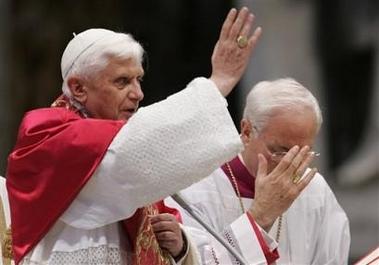
Pope's Angelus Message


From Asia News It:

This morning in St Peter Basilica, the beatification of Clemens August Von Galen, Bishop of Munster, Cardinal, took place; he was a fearless opponent of the Nazi regime. Ordained a priest in 1904, he undertook pastoral ministry for a long time in a parish in Berlin and in 1993 he became Bishop of Munster. In the name of God he denounced the neo-pagan ideology of National Socialism, defending the freedom of the church and gravely violated human rights, protecting Jews and the most vulnerable people, who the regime considered as rejects to be eliminated. Three homilies which the fearless Pastor delivered in 1941 are well-known. Pope Pius XII appointed him as Cardinal in February 1946 and he died barely a month later, surrounded by the veneration of the faithful, who saw him as a model of Christian courage. This is precisely what the timeless message of the Blessed Von Galen is: faith is not to be reduced to a private sentiment, possibly to be hidden when it becomes uncomfortable; rather it implies consistency and bearing witness in the public sphere in defence of mankind, of justice, of truth. I express my congratulations to the diocesan Community of Munster and to the Church in Germany, invoking upon all, through intercession of the new Blessed, abundant graces of the Lord.

In these days, as you know, the Assembly of the Synod of Bishops is under way in the Vatican, to delve into the theme of the Eucharist in the present-day life and mission of the Church. I presided over the meetings in the first week and the Synod will constitute my main commitment in the coming two weeks also. I ask you to continue to pray for the Synod, so that it may bear the hoped-for fruit. In particular, in this month of October, during which all church communities are called to renew their missionary commitment, I invite all to take in what Pope John Paul II wrote in the fourth part of the Apostolic Letter, Mane nobiscum Domine, about the Eucharist as the ‘principle and plan of mission’ (nn. 24-28):

‘The encounter with Christ, constantly intensified and deepened in the Eucharist, issues in the Church and in every Christian an urgent summons to testimony and evangelization’ (ivi 24). This is emphasised in the dismissal at the end of the mass: ‘Ite, missa est’, which recalls the ‘missio’, the task for all who participated in the celebration to take to all the Good News received and to animate society with it.

Let us entrust this intention to the intercession of the most Holy Mary and St Daniel Comboni, whose memory will be commemorated in tomorrow’s liturgy.

May he, an outstanding evangeliser and protector of the African continent, help the Church of our time to respond with faith and courage to the mandate of the Risen Lord, which sends it to announce the love of God to all peoples.”

Synod on the Eucharist


Request for Religious Freedom in Muslim Countries

H.E. Most. Rev. Berhaneyesus Demerew SOURAPHIEL, C.M., Metropolitan Archbishop of Addis Abeba, President of the Episcopal Conference, President of the Ethiopian Episcopal Conference (ETHIOPIA)

In some parts of the world, this is not possible: e.g. in Saudi Arabia or in some other Muslim countries. Sunday is a working day and the Eucharist is not celebrated because there are no Churches, nor priests, or there is simply no religious freedom.
From Eritrea and Ethiopia, there are many Christians who are working and living in Muslim countries. They are mostly Christians of the Ethiopian or Eritrean Orthodox Tewahdo Churches. They go there mostly to work as domestic workers, to take care of children or the elderly. I do not have the statistics of these Christians who go to Saudi Arabia, Yemen, the Gulf States, and other Muslim majority countries. They are in the hundreds of thousands. Only in Beirut, there are more than 20,000 Ethiopians working there. We are grateful for Caritas Lebanon for the help it gives to these Christians.
Before they go to the Muslim countries, they are forced to change their Christian names into Muslim ones and, especially, the women have to dress in Muslim attire. Once they reach their destinations, their passports are taken from them and they suffer all kinds of abuses and exploitations. Many are forced by the situation to become Muslims.
They are forced to go to these Muslim countries because of the poverty of their own countries, and because the doors of other Christian countries are closed to them. We know that many African Christians die crossing parts of the Sahara desert or get drowned in the Mediterranean Sea attempting to go to Christian countries in Europe and America.
It is poverty which is forcing them to give up their Christian heritage, their Christian culture, and even their human dignity.
They are denied their right of expressing their religion: the celebration of the Eucharist, and the Sunday Mass. It is one of the religious persecutions of the modem times.
I request the Synod Fathers, especially those working in Muslim countries where poor Christians go in search of employment, to extend their pastoral care to these Christians and to ask the Muslim governments to respect the religious freedom of the Christians.


An Alarming Drop in the Number of Catholics in Brazil

H. Em. Card. Cláudio HUMMES, O.F.M., Archbishop of São Paulo (BRAZIL)

According to the statistics of the Brazilian Government and the Church’s research in Brazil, the number of Brazilians who declare themselves Catholics has diminished rapidly, on an average of 1% a year. In 1991 Catholic Brazilians were nearly 83%, today and according to new studies, they are barely 67%. We wonder with anxiety: till when Brazil will be a Catholic country? In conformity with this situation, it has been found that in Brazil there are two Protestant pastors for each Catholic priest, and the majority from the Pentecostal churches.
Many indications show that the same is true for almost all of Latin America and here too we wonder: till when Latin America will be a Catholic continent?
The Church must pay more attention to this serious situation. The response of the Church in Brazil is, in the first place, the missions including the permanent home missionary visits. The parishes have to organize their faithful and to prepare them to be missionaries.
A missionary Church must also be deeply Eucharistic, for the Eucharist is the source of the mission. The Eucharist helps the disciple to grow, announcing the Word of God to him and bringing him to a personal and community meeting with Christ, through the celebration of the death and Resurrection of the Lord and through the sacramental communion with Him. The disciple, through this meeting realized in the Holy Spirit, is urged to announce also to others what he lived and experienced. Thus the disciple becomes a missionary. From the Eucharist, one goes on the mission.
Brazil and Latin America urgently need this missionary action nourished by the Eucharist.


Intercommunion

- H. Em. Card. Walter KASPER, President of the Pontifical Council for the Promotion of Christian Unity (VATICAN CITY)

The theme “Eucharist and unity” goes back to what Saint Paul says in his first letter to the Corinthians: “And as there is one loaf, so we, although there are many of us, are one single body, for we all share in the one loaf” (1 Cor 10:17). This assertion “one loaf - one body” and “participation in the single chalice”, which means “communion in the single body”, modeled the entire tradition of the Church in the Orient and in the West. First of all, we find this first of all in Saint Augustine and once again in Saint Thomas Aquinas. For Thomas, the ‘res’, that is, the species and the goal of the Eucharist is not the real presence of Christ, which Thomas no doubt teaches, but for him the real presence is only ‘res et sacramentum’, that is, an intermediate reality. The ‘res’, the goal of the Eucharist is the unity of the Church.
This view was renewed in Vatican Council II, which rediscovered the Church as communion, through the common participation in the sole Baptism and the sole Eucharistic bread. On this point, we agree with the Oriental Churches; the Communities that go back to the Reform had the same concept at their origins, they have only recently abandoned this. Therefore, the Catholic concept of the intimate tie between Eucharistic communion and ecclesial communion is not - as some would tend to believe - a vague anti-ecumenical concept, but an ecumenical concept per se.
However, because of this reason, the terminology, which unfortunately is found also in the Instrumentum laboris, and that speaks about “intercommunion”, is ambiguous and in itself contradictory. It should be avoided. Since this is not an “inter” communion, that is a “between” two communions (two Communities), rather a communion in the communion of the one body of Christ, which is the Church.


Devoloping a Spirituality of the Eucharist

- H.E. Most. Rev. Miguel Angel ALBA DÍAZ, Bishop of La Paz en la Baja California Sur (MEXICO)

To form ourselves in the Eucharist, for this reason, is to be formed in the experience of grace, in the contemplation of the marvels that God does. It is to feel ourselves as graced, to experience the gratuity of all we are and have.
It is to be formed to “give thanks always, in every place and in all the circumstances of life”, appreciating life with its sorrows and joys and discovering that “everything happens for the good of those the Lord loves”.
It is to be formed to make of our life a Eucharist, to love and serve God and humanity with grateful love, to ,make of our lives a living and permanent offering.
To form ourselves for the Eucharist is to be formed in order to give worship to the Father “in spirit and truth”. Perhaps seven years of seminary seem too many to learn to say Mass, but they are too few to learn to celebrate the Eucharist.
The Instrumentum Laboris gathers suggestions that denounce serious negative practices. They are not only transgressions of the rubrics, but the expression of attitudes that ignore or deform the sense of the reform of the Council.
If precipitation in applying the liturgical reform has lead us to lose our equilibrium, in looking again for this balance, before proposing new initiatives, we must promote a spirituality that allows for the overcoming of both a passive ritualization and an excessive creativity, so that the Mystery can speak through the Liturgy.

Sunday, October 9, 2005

Flooding in N.H.

In the city where I was born...

From Yahoo News:

"This is classic river flooding," said Jim Van Dongen, spokesman for the state Emergency Management office. "It's been raining since Friday night and there is nowhere for the water to go."

The most severe flooding was in Keene, where some major roads were under as much as four to six feet of water, according to fire officials. About 500 people were evacuated to the city's recreation center, officials said.

Saturday, October 8, 2005

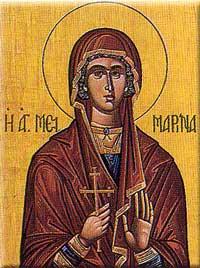
St. Pelagia


From Catholic Online - Saints & Angels - St. Pelagia:

Pelagia, more often called Margaret, on account of the magnificence of the pearls for which she had so often sold herself, was an actress of Antioch, equally celebrated for her beauty, her wealth and the disorder ofher life. During a synod at Antioch, she passed Bishop St. Nonnus of Edessa, who was struck with her beauty; the next day she went to hear him preach and was so moved by his sermon that she asked him to baptize her which he did. She gave her wealth to Nonnus to aid the poor and left Antioch dressed in men's clothing. She became a hermitess in a cave on Mount of Olivette in Jerusalem, where she lived in great austerity, performing penances and known as 'the beardless monk' until her sex was discovered at her death.

7.6 Magnitude Earthquake and Bin Laden

Might earthquake have meant the end of Osama bin Laden?


From 7.6 Magnitude Earthquake hits North India and Pakistan border region:


The center of the earthquake is not too far away from the Chitral region in Pakistan, which is believed to be the hiding spot for Osama bin Laden, but it is not yet certain whether this area was badly affected by the earthquake today.

Psychological Evaluations of Seminarians

At some point the evidence vs. the psychological evaluation has to come to the fore. What good are they? How accurate are they?

Knowing the facts of the Erickson case posted throughout this week, and now hearing from the diocese that every time he was sent to a psychologist he received a glowing report, and add to that the number of abuse cases where those charged were sent to a psychologist who at some point declared them "okay" to return to ministry one has to seriously question the effectiveness of this "science" in dealing with issues that matter this much.

There is an added caveat here, I have experience of reading these reports from my days as a faculty member at a major seminary. One report received read: "This candidate has an abnormally high libido and will find it nearly impossible to lead a celibate life." The rector read the report and added a cover letter that he sent to the bishop dismissing the report essentially by saying "the psychologist does not share in the Christian faith," in fact the psychologist was a devout Jew. The rector also made the decision not to use this psychologist in future cases, even though he was considered to be among the best by his peers. The seminarian, who tested with the high libido, ended up being ordained, had a number of affairs--some conducted in the church parking lot and eventually left to marry. Much pain could have been averted if the psychologist's report had been heeded.

Given this experience I wonder if more sympathetic psychologist aren't searched for...in the way the courts find sympathetic professional witnesses to bolster their cases and the blame rests on those who really do not want to face the truth but want to hear only glowing reports.

I wrote a piece in The Priest magazine almost fifteen years ago that made the conclusion that if seminaries really weeded out those not capable of living a celibate life were asked to leave that the numbers would plummet overnight--but we would have an accurate picture of those who are called and gifted as celibates versus those who think they are called and are not gifted with this charism of the Holy Spirit.

In the case of the psychologist who examined Erickson, the press should turn up the heat on them. Children have been sexually abused, two men murdered and Erickson himself tragically has committed suicide because they either didn't apply their craft rightly or were more concerned about giving the kind of report that the diocese liked to receive. Either way, they should answer for the tragedy that has unfolded because of their inability to correctly diagnose a very sick individual.

From the Winona Daily News:

6. Were there any additional psychological evaluations required of Erickson?

As required by the admittance process at St. Paul Seminary School of Theology, Erickson was evaluated in September 1996. The psychological evaluation stated: "The allegations of inappropriate sexual behavior do not appear to be significant in the context of this gentleman’s overall psychological makeup. He does not appear to be predatory or exploitative in his overall orientation and he does not seem to be a high risk for acting in a sexually aggressive or manipulative manner in the future. The alleged sexual misconduct behaviors he described to us appear to be benign."

That psychological evaluation indicated that Erickson was a heterosexual and that the major concern was that he might be vulnerable to women who would take romantic or affectionate initiatives with him.

Upon the conclusion of his theological studies, the rector and faculty of St. Paul Seminary recommended that he be ordained as a priest.