Archbishop Nikola Eterovic, secretary general of the Synod of Bishops, asked those present to pray for the victims of the hurricane that struck Central America. He then announced that the Holy Father, consenting to the request of various Synod Fathers, has ordered that from 5 p.m. to 6 p.m. on Monday, October 17, an hour of Eucharistic adoration will be celebrated in the Vatican Basilica.
Friday, October 7, 2005
Bishops to Pray Holy Hour on Monday
From the Vatican Information Service:

Synod on the Eucharist

On the Redistribution of Priests
BISHOP LUCIO ANDRICE MUANDULA OF XAI-XAI, MOZAMBIQUE. "On the basis of the supposition that the Eucharist is the 'source and summit of the life and mission of the Church,' and considering the fact that current statistics confirm the great shortage of priests in the world, I feel we must ask to what point an ecclesial community deprived of the Sacrament of the Eucharist can achieve the dynamism of life that enables it to transform itself into a missionary community, one capable of joyfully accomplishing the missionary project with which the Lord Jesus Himself entrusted us? ... For this reason we must insist on a fair redistribution of priests in the world, as Synod Fathers have so often asked. Furthermore, there is an urgent need to propose once again to the entire Church, and especially to priests, a 'Eucharistic spirituality' characterized by gratitude for the sacrifice of Christ, Who gives Himself as Eucharistic bread that we might all achieve the new life of grace."
The Witness of the Martyrs of the Eucharist
ARCHBISHOP LUCIAN MURESAN OF FAGARAS AND ALBA IULIA OF THE ROMANIANS, ROMANIA. "In Romania the communists tried to give man material bread alone, and sought to expel 'the bread of God' from society and from the human heart. ... Priests were imprisoned simply for being Catholic, so they could not celebrate or speak about God. Even lay people who participated in clandestine Masses suffered the same fate. In the famous period of 're-education' and 'brainwashing' in the Romanian prisons, to compromise priests, to ridicule the Eucharist and to destroy human dignity, the persecutors made them celebrate with excrement, but they never succeeded in destroying their faith. ... How many humiliations, when during winters at minus 30 degrees they were undressed for body searches; how many days spent in the famous 'black room' as a punishment for having been caught in prayer? No one will ever know, ever. These modern martyrs of the 20th Century offered all their suffering to the Lord for dignity and human freedom. ... There is no lack of hope, and I think first of all of the deep religious sense of our people, the deep devotion with which they approach liturgical celebrations and the Eucharist."
For Universal Perpetual Adoration
ARCHBISHOP CHARLES MAUNG BO, S.D.B., OF YANGON, MYANMAR. "Over 2,500 parishes around the world now have perpetual Eucharistic adoration. About 500 in the Philippines, the United States has about 1,100 chapels of perpetual adoration, the Republic of Ireland about 150, South Korea has about 70 and lesser numbers in India, Sri Lanka and Myanmar. Holy Father, if the perpetual adoration chapels were to be established in all the dioceses in the world and in all possible parishes, what a magnificent result that would be for the Eucharistic Year. ... This is true: until the Church cries out that Jesus in the Blessed Sacrament is worthy of perpetual adoration for all He has done for our salvation, she will continue to be defeated by her enemies. I believe that the best, the surest and the most effective way of establishing everlasting peace on the face of the earth is through the great power of perpetual adoration of the blessed Sacrament."
Communion and Politicians
CARDINAL ALFONSO LOPEZ TRUJILLO, PRESIDENT OF THE PONTIFICAL COUNCIL FOR THE FAMILY. "Can access to Eucharistic communion be allowed to people who deny human and Christian principles and values? Politicians and lawmakers have great responsibility. The so-called personal option cannot be separated from sociopolitical duty. This is not a 'private' problem, the Gospel, the Magisterium and true reason have to be accepted! ... The Lord is truly present in the Eucharist, the Lord of the family, of life, of love, of the alliance that unites husband and wife. God is the Creator of human dignity. The question cannot be resolved conjecturally by following the various attitudes of different countries, because the conscience of Christians and ecclesial communion would become obscured and confused. All these questions are clarified and illuminated by the Word of God in the light of the Church's Magisterium. ... Politicians and lawmakers must know that, in proposing or defending iniquitous laws, they have a serious responsibility, and they must find a remedy to the evil done ... in order to have access to communion with the Lord, Who is the Way, Truth and Life."
Problems with Married Priests, Distribution of Priests, Necessity of Married Priests
(I think he covers all the bases)
CARDINAL NASRALLAH PIERRE SFEIR, PATRIARCH OF ANTIOCH OF THE MARONITES, LEBANON. "The Maronite Church admits married priests. Half of our diocesan priests are married. Yet it must be recognized that if admitting married men resolves one problem, it creates others just as serious. A married priest has the duty to look after his wife and family, ensuring his children receive a good education and overseeing their entry into society. ... Another difficulty facing a married priest arises if he does not enjoy a good relationship with his parishioners; his bishop cannot transfer him because of the difficulty of transferring his whole family. Despite this, married priests have perpetuated the faith among people whose difficult lives they shared, and without them this faith would no longer exist. On the other hand, celibacy is the most precious jewel in the treasury of the Catholic Church. How can it be conserved in an atmosphere laden with eroticism? Newspapers, Internet, billboards, shows, everything appears shameless and constantly offends the virtue of chastity. Of course a priest, once ordained, can no longer get married. Sending priests to countries where they are lacking, taking them from a country that has many, is not the ideal solution if one bears in mind the question of tradition, customs and mentality. The problem remains."
Need for Liturgical Ministers to Set Aside Ego
CARDINAL FRANCIS ARINZE, PREFECT OF THE CONGREGATION FOR DIVINE WORSHIP AND THE DISCIPLINE OF THE SACRAMENTS. "Focussing on the Eucharistic celebration, 'ars celebrandi' refers to both interior and exterior participation on the part of the celebrating priest and on the part of the congregation. ... 'Ars celebrandi' helps the priest to have a faith?filled and disciplined posture at Mass. On the one hand, he cannot isolate himself from the presence of the people. On the other hand he should not become a showman who projects himself. The liturgy is not primarily what we make but what we receive in faith. On the part of other contributors to the Eucharistic celebration ? the altar servers, the readers, the choir, etc ? 'ars celebrandi' demands good preparation, faith, humility and focussing attention on the sacred mystery rather than on self. When the Mass is celebrated in this spirit it nourishes faith and manifests it powerfully - 'lex orandi, lex credendi.' With a genuine understanding of the role of liturgical norms, such a celebration is free of banalization and desacralization. It sends the people of God home properly nourished, spiritually refreshed and dynamically sent to evangelize."
Importance of the Homily
ARCHBISHOP CORNELIUS FONTEM ESUA, COADJUTOR OF BAMENDA, CAMEROON. "In order to highlight the importance of the liturgy of the Word during the Eucharistic celebration, in the first place, there should be in our parishes a proper organization of biblical pastoral ministry. ... Secondly, the importance of the homily, which breaks the Word of God for the consumption of the faithful, should be emphasized. It links the Word to the Eucharist and enables the participants to continue to live the Eucharist, to witness it in charity and to go on mission at the end of the celebration. ... Without the homily the Eucharistic celebration could be considered a magical act. It is the homily which makes the Christian celebration of the Eucharist different from the sacrifices of African traditional religions which are often accompanied by invocations and incantations, sometimes in languages not understood by the participants. ... In some particular Churches in Africa, for example in many dioceses in Cameroon, the liturgy of the Word is introduced by a solemn lectionary or bible procession which begins immediately after the opening prayer and not just before the proclamation of the Gospel. The assembly is thus invited to listen to the Word of God with attention and reverence just as they do when a traditional ruler addresses them or when a message from him is proclaimed to them."
Question About Former Priests
BISHOP DENIS GEORGE BROWNE OF HAMILTON IN NEW ZEALAND. "It is important for us as a Church to remember that small communities of Catholic people have as much right to participate in the Eucharist as their brothers and sisters in large busy parishes. We, as Church, need to be continually open to finding ways in which the Eucharist can become easily available to all of our faithful people. 'Sir,' they said, 'give us that bread always.' We need to be sensitive to the questions that the faithful often ask us, for example: 'Why does it seem to be possible for former married priests of the Anglican Communion to be ordained and function as Catholic priests while former Catholic priests who have been dispensed from their vow of celibacy are unable to function in any pastoral way?'"
Feast of the Holy Rosary

From True Devotion to Mary by St. Louis De Montfort:
Here is what our Blessed Lady revealed to Blessed Alan de Rupe as recorded in his book, The Dignity of the Rosary, and as told again by Cartagena: "Know, my son, and make it known to all, that lukewarmness or negligence in saying the Hail Mary, or a distaste for it, is a probable and proximate sign of eternal damnation, for by this prayer the whole world was restored."
These are terrible words but at the same time they are consoling. We should find it hard to believe them, were we not assured of their truth by Blessed Alan and by St. Dominic before him, and by so many great men since his time. The experience of many centuries is there to prove it, for it has always been common knowledge that those who bear the sign of reprobation, as all formal heretics, evil-doers, the proud and the worldly, hate and spurn the Hail Mary and the Rosary. True, heretics learn to say the Our Father but they will not countenance the Hail Mary and the Rosary and they would rather carry a snake around with them than a rosary. And there are even Catholics who, sharing the proud tendencies of their father Lucifer, despise the Hail Mary or look upon it with indifference. The Rosary, they say, is a devotion suitable only for ignorant and illiterate people.
Thursday, October 6, 2005
Head of Human Life International Blasts President's Choice
From Catholic News Agency:
Fr. Euteneuer chided Bush, saying that his choice of close friend Miers sends a message of: ''If you are pro-life keep your mouths shut and hide in the closet if you ever hope to advance in your career.'“
'The nomination of Miers”, he said, “is a slap in the face to pro-life lawyers and judges who have not been ashamed of the principles that inform their conscience; evidently courage of conviction disqualifies candidates for the bench.'
'We know very little about Miers, but her nomination revealed a lot about President Bush. It has become clear he is afraid to fight for the values on which he campaigned.'
Fr. Euteneuer recalled that 'Last year Bush asked faithful Catholics to fight for him, campaign for him and vote for him and they did in record numbers; now the President lacks the stomach to fight for the values of those who put him in office.”
He added that Bush “is asking us to trust him in a gamble with the lives of millions of unborn babies, with the health and well being of mothers, with the fate of our nation.”
Terror Threats and October 7th
Tommorrow is a dangerous day for terror threats...two events happened on October 7th both of which would mark the US and the Christian West for an attack:
The United States launches the war on terror against the Taliban:
The current issue of The Priest magazine contains a column by Father Benedict Groeschel that exhorts priests to pray the rosary daily for peace (in answer to Our Lady of Fatima's plea in 1917). Father warns that any future "explosions" might be linked to our failure to carry out this mandate. I mention this here so that you the reader might also take Father's plea to heart and pray the rosary for peace!
October 7, 1571
October 7, 2001
Pope Pius V institutes the Feast of the Holy Rosary:
The feast of Our Lady of the Rosary was instituted to honor Mary for the Christian victory over the Turks at Lepanto on October 7, 1571. Pope St. Pius V and all Christians had prayed the Rosary for victory. (This victory was seen as the final one of the crusades, steming the advance of Muslims into Europe)
October 7, 2001
The United States launches the war on terror against the Taliban:
Good afternoon. On my orders, the United States military has begun strikes against al Qaeda terrorist training camps and military installations of the Taliban regime in Afghanistan. These carefully targeted actions are designed to disrupt the use of Afghanistan as a terrorist base of operations, and to attack the military capability of the Taliban regime. (President Bush addressing the nation)
The current issue of The Priest magazine contains a column by Father Benedict Groeschel that exhorts priests to pray the rosary daily for peace (in answer to Our Lady of Fatima's plea in 1917). Father warns that any future "explosions" might be linked to our failure to carry out this mandate. I mention this here so that you the reader might also take Father's plea to heart and pray the rosary for peace!
Synod of the Eucharist

Bread of Life vs. Culture of Death
ARCHBISHOP JUAN FRANCSICO SARASTI JARAMILLO C.I.M., OF CALI COLOMBIA. "The Eucharist is the response to the negative signs of modern culture. In the first instance, in the face of a culture or anti-culture of death that traffics in arms, builds systems of wide-scale destruction, legalizes abortion and authorizes research on human embryos, Jesus defines and gives Himself to us as 'Bread of Life.' In the second instance, our culture is marked by hatred and terrorism. ... The Eucharist offers the permanent possibility of reconciliation with God and our brethren, an invitation to find reconciliation among ourselves before worshipping the Lord. This is the reason that so many communities feel so deeply about the 'rite of peace', as renewed by liturgical reform. Another modern trait is that of scientific positivism or relativism, yet the Eucharist reaffirms the reality of the 'mystery' and the value of belief and love as a way to knowledge; with Eucharistic faith, upheld by ecclesial tradition and based on the words of the Lord, we have access to real, though imperfect, certainties. Finally, in the face of the solitude and desperation that undermine mankind today, the Eucharist offers us ... profound companionship and a promise of eternal life that fills us with definitive hope."
Regaining the Sacredness of the Event
BISHOP JAVIER ECHEVARRIA RODRIGUEZ, PRELATE OF THE PERSONAL PRELATURE OF OPUS DEI. "Paragraph 34 of the 'Instrumentum Laboris' highlights the importance of a sense of the sacred in celebrating the Eucharist. We should study practical ways to help the faithful to a clearer understanding of the sacredness of Eucharistic sacrifice. ... It would therefore be useful, on the basis of the Instruction 'Redemptionis sacramentum,' to try to remove abuses that harm the sacred nature of Eucharistic celebrations, and to rethink certain regulations which may be interpreted and applied in an abusive fashion. For example, I suggest reviewing the appropriateness of Eucharistic ceremonies in which there is such an excessive number of concelebrants as to make the dignified celebration of the liturgy impossible; and re-evaluating whether communion should actually be given to all participants in a Mass where great numbers of believers are present, when such general distribution may harm the dignity of worship
Sacrifice
BISHOP EDWARD OZOROWSKI, AUXILIARY OF BIALYSTOK, POLAND. "The Eucharist, as the Sacrament of the Body and Blood of Jesus Christ, brings the sacrifice of the cross into the present day. The sacrifice is the 'primum principium' of the Eucharist and creates a hierarchy of all the truths related thereto. ... Eucharistic teaching underlines many important themes: banquet, communion, listening to the word of God, sacrament, etc., however these themes lack a 'keystone.' One consequence of this is a certain 'protestantization' of the theology of the Eucharist, which such teaching reveals as being a beautiful rite, but one with little meaning for life. Yet it is the sacrifice of Christ on the cross, to which man has access through the Eucharist, that is most important in this mystery. The sacrifice of Christ on the cross brought salvation to humanity. ... Thanks to the Eucharist, sacrifice in human life is transformed into the sacrifice of Christ. Only by walking the path of the cross can we reach the glory of the resurrection."
What Kind of Training is Necessary for Priests?
BISHOP ARNOLD OROWAE, COADJUTOR OF WABAG, PAPUA NEW GUINEA. "Experiences of injustice, violence, corruption, poverty, etc., show that there is a separation between the Eucharist and life. Thus the real saving and transforming presence of Jesus in the Eucharist should not be understood vaguely and taken lightly but Catholics should be serious in their faith, with due respect and adoration. ... How can this be true for communities who live in the remote villages that do not have the opportunity for frequent celebration and reception of the Eucharist? This poses the question, what kind of priest do we need in our situation? Does one need years of intellectual formation in philosophy and theology to give much-needed service to poor people in remote areas who may not equal his intellectual capabilities? The issue here is not having more vocations, but justice and equality for all the children of God, having the right to make the Eucharist the center of their lives by celebrating and receiving it as often as they can. ... Should the Church allow for mature Christian men who are strong in faith, very committed, and have the respect of the people, to be easily trained to preside at the Eucharistic celebration, which will make it easy for the people to participate in the Eucharist, so that the importance and centrality of the Eucharist becomes true for the people?"
Restore the "Breadiness" of the Eucharist
ARCHBISHOP ANTHONY SABLAN APURON O.F.M. Cap., OF AGANA, GUAM. "In the Pacific, the scarcity of priests and the aggressiveness of the evangelistic sects are challenging the very survival of the Catholic faith. In my experience, the only answer to this double predicament is to 'form communities based on faith,' as Pope Benedict told the youth in Cologne. ... Today, the Church needs to make clearly visible the signs of the Eucharist: maybe the Church needs to restore the 'breadness' of the bread which becomes the Body of Christ to be eaten by all, and wine drunk by all which becomes the Blood of Christ. These signs fully and powerfully represent the reality that they signify and not just approximate them. ... I urge leaders of the Church today, to do everything possible to help people come to really know Jesus Christ through the signs of the Eucharist and the reality they signify."
Feast of St. Bruno
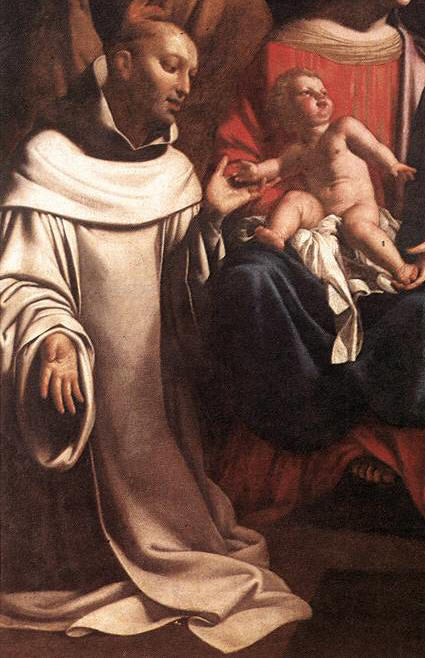
Founder of the Carthusians, patron of the possessed.
I have a good friend who is a Carthusian. We attended college together some years ago and I had lost touch with him after that. Recently I caught up with him after I had mentioned him in a book that I wrote called The Power of the Cross. Turns out he was carrying a cross way back then that I was not aware of at the time.
Now ordained a priest for his order, he told me that after college his life went in a downward spiral of drugs, alcohol and sex--homosexual sex. Now, even after he told me that he was/is a homosexual, I found it hard to believe.
The drugs and alchohol were an attempt to flee from the path he knew that he must trod and in sobriety he set out once more for the house of the Father.
He is a good man, a holy man, a chaste monk. I believe and he believes he is where God wants him to be, in the order that St. Bruno founded. Pray for him today and the many like him who have restless hearts until they rest in God.
Subscribe to:
Comments (Atom)