Sunday, March 10, 2019

First Sunday of Lent Meditation

The Cross of Christ Teaches Us. . . 
Our Mission


 And the angel of the Lord said to him, “Why have you struck your ass these three times? Behold, I have come forth to withstand you, because your way is perverse before me; and the ass saw me, and turned aside before me these three times. If she had not turned aside from me, surely just now I would have slain you and let her live.” Then Balaam said to the angel of the Lord, “I have sinned, for I did not know that thou didst stand in the road against me. Now therefore, if it is evil in thy sight, I will go back again.” And the angel of the Lord said to Balaam, “Go with the men; but only the word which I bid you, that shall you speak.” NUMBERS 22:32–35

 Then Jesus said to him, “Begone, Satan! for it is written, ‘You shall worship the Lord your God and him only shall you serve.’” Then the devil left him, and behold, angels came and ministered to him. MATTHEW 4:10–11 

One of the strangest stories in the Old Testament recounts the mission of the prophet Balaam. A pagan king wanted to conquer the Israelites, and wanted Balaam to help him achieve this ambition by pronouncing a curse on the enemy. So he summoned Balaam.

At first Balaam refused to come, but eventually Balaam set out on his donkey to meet with the king. Although this story is found in the Book of Numbers, it is the Second Letter of Peter that gives us insight to Balaam’s motives: “Forsaking the right way. . . they have followed the way of Balaam, the son of Be’or, who loved gain from wrongdoing, but was rebuked for his own transgression; a dumb ass spoke with human voice and restrained the prophet’s madness” (2 Peter 2:15–16).

Balaam was not setting out to do God’s will; he was trying to profit by the gifts that God had given him. Balaam was stopped en route by his donkey, which saw an angel barring the path. When Balaam beat his donkey, the animal protested that he was trying to save his master’s life. Finally Balaam’s eyes were opened to the angel of the Lord, who affirmed that, indeed, the donkey had saved his life. The angel told him to go along to the king: “Go. . . but only the word which I bid you, that shall you speak” (Numbers 22:35). In the end, Balaam blessed the Israelites, accomplishing God’s purposes. However, Peter’s epistle reveals that Balaam’s temptation moved him along the path to do the will of God. He did not start out intending to do good, but God intervened.

Spiritual U-Turns 


A friend once told me of the time he decided to give in to a certain temptation that he had been fighting for years. As he went to get into his car that night, he discovered that one of his car’s tires was flat. Most people would see a flat tire as a momentary inconvenience; my friend saw the flat tire as a sign from God. He stayed home that night, and from that moment on the temptation left him. God used my friend’s momentary lapse to put him on the pathway to holiness.

 Scripture has many examples of God using Satan’s ploys to accomplish his own purposes. The Gospel of Matthew offers one such example. When Jesus was about to begin his ministry in Israel, he went into the desert to fast for forty days—symbolic of the forty years the Israelites wandered in the desert. During that time, Satan presented three types of temptations to Our Lord. Ironically, each of the particular temptations Satan chose was related to the mission that God had given to Jesus. Each of them was a perversion of Jesus’ true mission and purpose.

Bread of Life. First the evil one tempted Jesus to turn stones to bread. After all, Jesus was hungry from fasting. However, Jesus knew that his greatest hunger was not physical but relational: He had a hunger only God could satisfy.

The significance of this temptation became clearer on the night before Jesus died, when he took the bread and changed it into his own Body and Blood. “I am the bread of life,” Jesus declared. “If anyone eats of this bread, he will live for ever; and the bread which I shall give for the life of the world is my flesh” (John 6:48, 51).

Those who partake in the Body and Blood of Christ under the appearance of bread and wine, wrote St. Cyril of Jerusalem, become “united in body and blood with Him.” Similarly, St. Pio of Pietrelcina (Padre Pio) observed that after communion, “the heart of Jesus and my own—allow me to use the expression— were fused. No longer were two hearts beating but only one. My own heart had disappeared, as a drop of water is lost in the ocean.” The miracle of the Eucharist is that Our Lord transforms our hearts of stone into hearts of flesh.

 Source of Life. In the second temptation, Satan tempted Jesus to demonstrate his power by throwing himself off the Temple roof, so the angels would rush to his defense. Jesus recognized that his enemy had twisted Scripture to achieve his own purposes. “You shall not tempt the Lord your God,” he replied firmly (Matthew 4:7).  The things that tempt us most in life can lead us to discover our true calling.

As with the temptation to turn stones to bread, Satan’s temptation was a perversion of the real mission of Christ. By dying on the cross, Jesus threw himself into the hands of the Father, trusting that God would raise him on the third day.

When Franz Jaegerstaetter, a saintly Austrian who refused to fight in the Nazi army, faced certain death because of his refusal to give in to the Nazis’ wishes, Franz wondered if he were committing suicide. It was a meditation on the mission of Jesus, who went to Jerusalem knowing that they were going to kill him there, that finally convinced Franz that standing up to the evil of his day, no matter what the personal cost, was the right thing to do.

 Prince of Life. Finally the Lord was tempted to bow down to Satan in order to win the world. However, just as Jesus rejected the attempts of his followers to make him king or to win the kingdom by the sword, so he rejected this bloodless solution. Jesus knew that real victory would not come easily, and that his kingdom was not an earthly one. His message was not a popular one; ultimately it led to his death on the cross. This “King of the Jews,” as the Romans named him, knew of but one way to win over the world: “. . .when I am lifted up from the earth, [I] will draw all men to myself” (John 12:32).

Those who would be powerful continue to bow to Satan in order to win the world, selling their souls for a temporary advantage. Politicians, religious, and others who promote evil in order to win—whether the prize is power, approval, or other earthly glory—may succeed for a time. But such victory is fleeting, and leaves in its wake an emptiness that is as close to hell as one can get on this earth.

Find Your Mission 


Just as Satan tempted Christ with a perversion of his true mission, the things that tempt us most in life can lead us to discover our true calling. However, we will recognize God’s purpose for us only by the light of the cross. Using God’s gifts to achieve anything other than the divine plan will not bring long-term satisfaction. The path to true joy comes from placing our gifts under the control of the Holy Spirit, and allowing the cross of Christ to reveal Satan’s lies and deceptions for what they are. St. Augustine, who spent his early years tempted by the beauty of creation and even fathering an illegitimate child, later found in God the beauty he was seeking. “Too late, O ancient Beauty, have I loved Thee,” he wrote.

***********

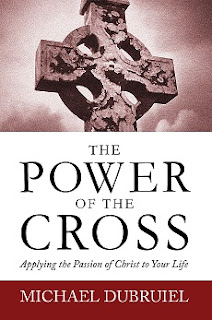
The Power of the Cross by Michael Dubruiel is a book well-suited to daily reading during Lent. The book is available here in pdf version. Daily excerpts will be reprinted in this space during Lent.

"michael Dubruiel"

Saturday, March 9, 2019

Repent or Perish

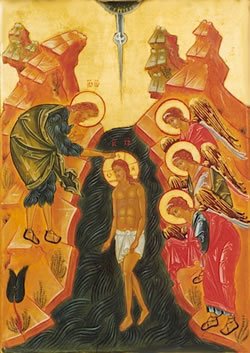
The First Luminous Mystery: The Baptism of the Lord
Our Lord, though innocent, takes on our sins as He enters the water of Jordan and is baptized by John. His mission of our salvation is blessed by the Father's praise and the Spirit's descent. Ask Our Lady to help you pray this decade, pondering the light that comes from submission to the will of God.
--from Praying the Rosary: With the Joyful, Luminous, Sorrowful, and & Mysteries by Michael Dubruiel and Amy Welborn.

Repent or Perish Luke 13:3
"I must decrease, He must increase" St. John the Baptist told his disciples after his encounter with Christ. Our submission to the will of God begins with our submission to Christ--our own dying with Him and rising anew in Him at our Baptism. But the act of submission needs to happen at every moment of the day. Every second brings with it a moment of prayer--will I submit to my will against His or will I bow down to His authority and choose Him. The world may cry out "I've got to be me," but the servant of God cries out "I've got to be His." St. Paul reiterates this when he declares, "I live, no not I, but Christ."
We fear this repentance. We secretly grieve that we won't be ourselves if we submit. Something within at a very early age urges us to resist (original sin) and it does not go away quietly. So many of us are slowly perishing, spending our demise judging others, living in darkness.
The biblical notion of this state of humanity is that of something that is lost. Will we continue to cling on to the lost being or will we allow ourselves to be found by Christ--at this moment and at every moment walking in His light and overcoming the darkness of the lost?

Michael Dubruiel

Friday, March 8, 2019

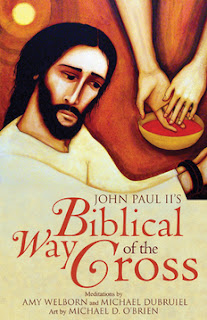
Friday Stations of the Cross by Michael Dubruiel


In 1991, Pope John Paul II introduced a new Bible-based interpretation of the Stations of the Cross. This devotional guide invites readers to prayerfully walk in solidarity with Jesus on his agonizing way of the cross—from his last torturous moments in the Garden of Gethsemane to his death and burial.
Now with full-color station images from previously unpublished paintings by Michael O'Brien, this booklet creates an ideal resource for individual or group devotional use, particularly during the Lenten season.
"michael Dubruiel"

Thursday, March 7, 2019

Daily Lent Devotional Michael Dubruiel

The Power of the Cross by Michael Dubruiel is a book well-suited to daily reading during Lent. The book is available here in pdf version. Daily excerpts will be reprinted in this space during Lent.


"michael Dubruiel"


From the Introduction (part 4)

“What Do I Do Now?” 

Start reading this book. Each section is designed to be read and pondered on its own; read one of the entries each day, or take up  one section each week. There are parts of this book with which you may readily agree; other sections will probably anger you. Don’t worry about that; parts of this book elicit the same reaction in me. When faced with the cross, my inner demons rebel. Surrendering to the cross of Christ is the only way to rid oneself of whatever evil may be lurking in our lives. 

The way of the cross is the only sure way to joy and freedom. The world offers us happiness and rejects the cross, to be sure, but it is a happiness that is short lived. For those who embrace his cross, Jesus promises a joy that never ends. The evil one makes it hard for us to see the truth of Jesus’ claim at times. But those who seek the truth will experience—either first-hand or through living saints like Pearl—true reality: What the world promises is a lie. 

We are all headed to Cross City, whether we are following Christ or not. For those who follow Christ, Cross City is the gate to eternal life. For those who venture along that path without Christ, the cross brings only suffering and ultimately death. The crucified Christ is the Vine; we are called to be the branches. May his joy be in you, “that your joy may be full” (John 15:11).   More

For more about Michael Dubruiel.  

Wednesday, March 6, 2019

Ash Wednesday in Rome

From a 2006 trip by Michael Dubruiel
I often blog what the Pope says at his General Audience on Wednesdays, but I will never do so without the sense of what it is like to actually be there. Thanks to several people we knew that to get a good seat at the General Audience we needed to be there as soon as they allowed people in, around 8:00 a.m.(two and half hours before the audience begins, although one of our contacts told us that Benedict had been beginning them about a half hour early). So we were there, dressed for warm weather, because it was rather warm at the time. We found the shortest line and waited about ten minutes until the mad rush began. The security was fairly lax at the entrance point that we were at, police with wands, but not really using them. So once through the entrance we ran (sort of the way people were running through the columns when Pope Benedict was about to be announced as the successor of St. Peter last year).
We were able to get to the fourth row right against the center rail, which turned out to be a pretty good spot. The two men sitting in front of me were from Brazil, I think the people behind us were from Ireland. There was a group from Steubenville near us, as well as the St. Thomas folk who were just behind us.
Then it turned cool, the sun disappeared and the clouds covered the sky. The temperature must have dropped ten or fifteen degrees. I think Joseph fell asleep, as well as the baby and for the most part we sat in silence with some outbursts of enthusiastic groups now and then.
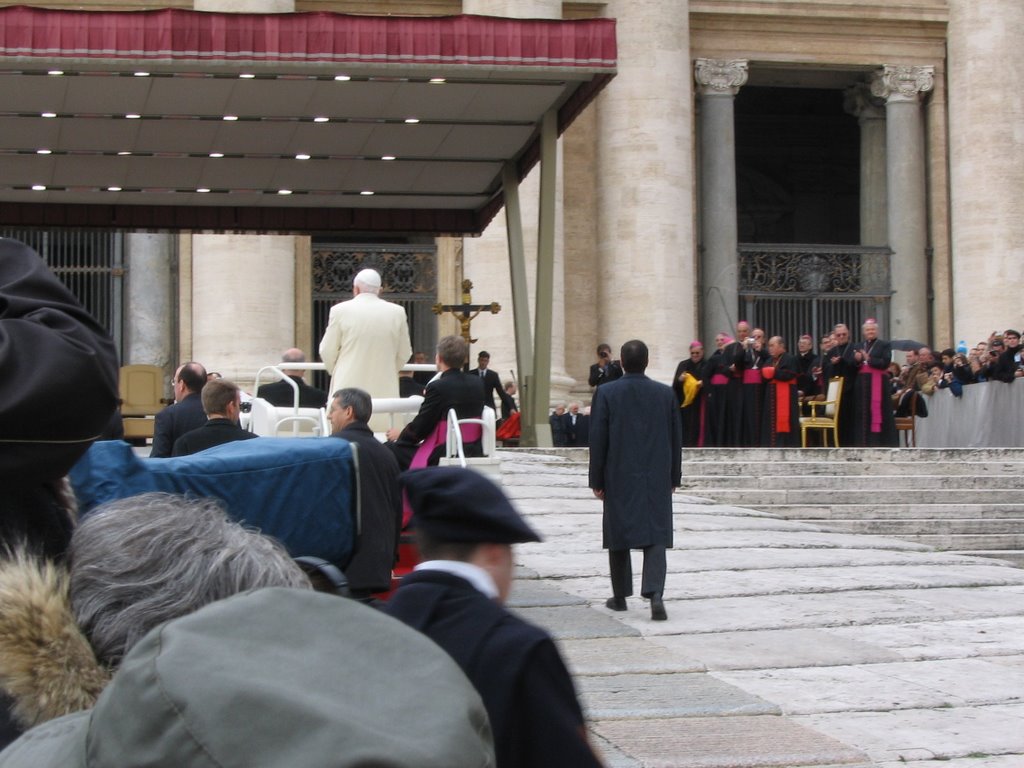
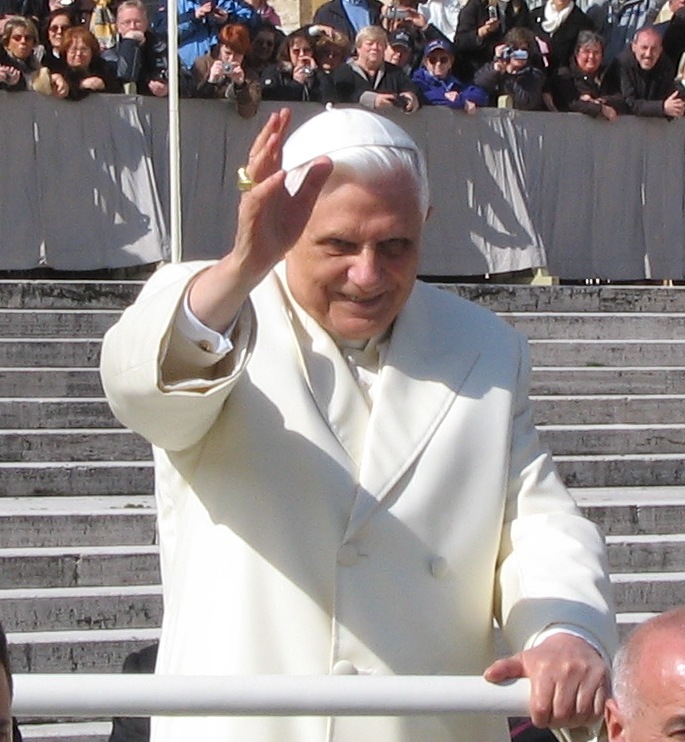
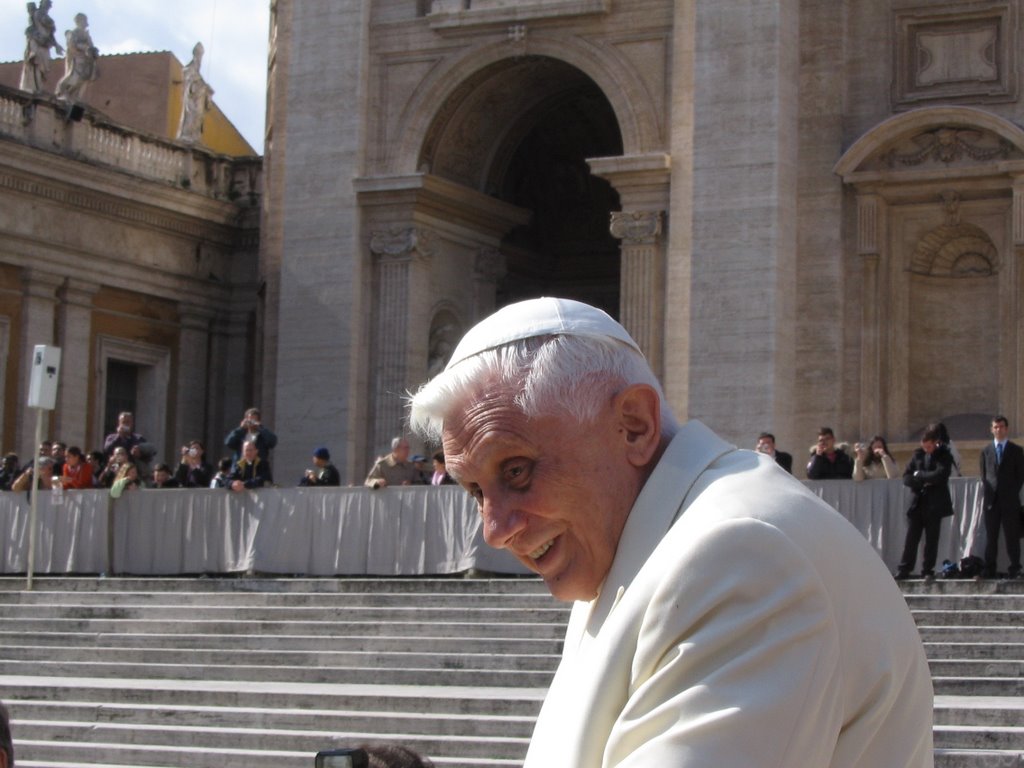
Ten o'clock arrived and we were hopeful that the pope might come out early, but not today. Then at ten thirty there was a commotion and suddenly there he was, well looking exactly like the pope! You can see how dark the skies were and the pope had on his winter coat.Pope Benedict has shunned the glass case that John Paul used after he was shot in 1981, when I saw Pope John Paul in Miami he was behind the glass of the popemobile when he drove through the streets of Miami,but then I saw him up close at Mass the next day (a Mass that wasn't finished because of a thunderstorm). I remember being shocked at how old Cardinal Ratzinger was when he celebrated the funeral of Pope John Paul, and even how he seemed bent with age as he entered the conclave to elect the new pope--but how youthful he emerged from the conclave!
Organ music is played as a background which gave the feeling of either a carnival or funeral but didn't seem to strike the right chord for the ceremony.
Now right after the Pope passed us the baby's bottle somehow dropped onto the pavement and went rolling down the path the pope had just passed. A Swiss Guard finally picked it up after it had rolled for what seemed like an eternity, and looked at it suspiciously. He finally walked over and handed it to me.After making the circuit the Holy Father's pope mobile drives up the steps and then he gets out and goes to his chair...Then you hear something along the lines of: 
Cari Fratelli e Sorelle,
Inizia oggi, con la Liturgia del Mercoledì delle Ceneri, l'itinerario quaresimale di quaranta giorni che ci condurrà al Triduo pasquale, memoria della passione, morte e risurrezione del Signore, cuore del mistero della nostra salvezza. Questo è un tempo favorevole in cui la Chiesa invita i cristiani a prendere più viva consapevolezza dell'opera redentrice di Cristo e a vivere con più profondità il proprio Battesimo. In effetti, in questo periodo liturgico il Popolo di Dio fin dai primi tempi si nutre con abbondanza della Parola di Dio per rafforzarsi nella fede, ripercorrendo l'intera storia della creazione e della redenzione.
Which I now know means:
Dear Brothers and Sisters,
Today, with the Ash Wednesday Liturgy, the Lenten journey of 40 days begins that will lead us to the Easter Tridium, the memorial of the passion, death and Resurrection of the Lord, heart of the mystery of our salvation. It is a favourable time when the Church invites Christians to have a keener awareness of the redeeming work of Christ and to live their Baptism in greater depth.

The audience continues with the pope teaching a lesson in Italian. At the conclusion various Monsignors in different languages greet the pope in the name of the various language groups present. Some groups when they are announced sing, some just cheer. The pope acknowledges them with a wave, then responds with a summary of his teaching in that language. This pope like John Paul before him is fluent in a number of tongues and it is interesting to hear him speak English.
Finally the Pope gives his Apostolic blessing, blessing religious articles also.
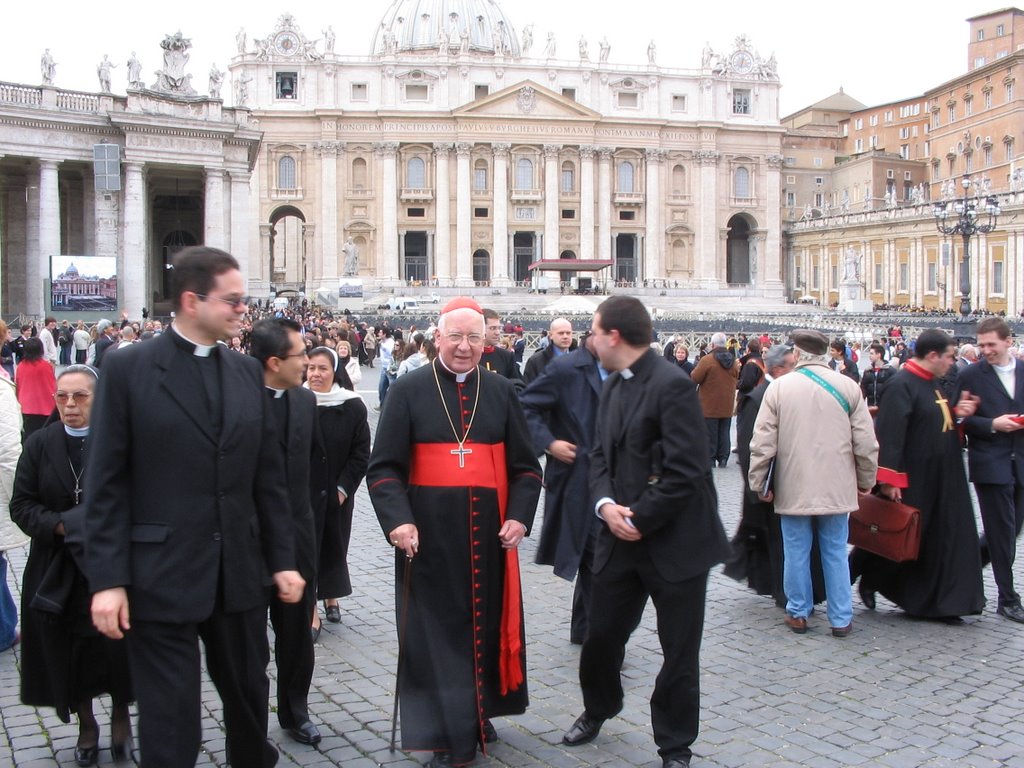
Then he greets the Cardinals and bishops present. At this audience there was one cardinal (I believe it is Cardinal Jorge Arturo Medina Estevez the very Cardinal who announced to the world last year Habemus Papam!) pictured here in the piazza afterwards. Then the sick and handicapped are brought in wheelchairs before him, pushed by nuns for the most part, and he gives each of them a blessing. I'm not sure what the history of this is or for how long this has been done, but I found it to be one of the most poignant moments of the audience. There was a long parade of these crucified memembers of the Body of Christ and they evoked from the Marian prayer "do you do we cry, poor banished children of Eve, in this valley of tears." The wisdom of giving these souls the privileged position at the audience and the primacy of a personal meeting with the pope was incredibly Christian--a great witness. Would that all in attendance learn to see in those marginalized the truly important.
After this the pope walked over to the barrier to the left at which were standing a group of Moslems and he greeted them and spoke to them and then worked down the line. At the end of this line he mounted the popemobile and then passed along the barrier on the right and shook hands as he went along. Then the popemobile made its way down the steps toward me. (Click on any image for a full size shot)
Until finally, there he was right in front of me.
So I put the camera down for a second or two. Then after I gave him a wave, I picked it up again just in time because someone handed him a baby.
Then he was gone, as Joseph would say "back to the Pope cave (ala batcave)." The thousands that had gathered began to disperse. Amy had more Rome Reports video to shoot, so she went with the kids for the outside shots. I was to meet with Jeffrey Kirby to take a walk up to the North American College for a tour and lunch. While waiting, I spotted another group gathered for the pope's audience, a group of Eastern monks.
More about Michael Dubruiel 

Tuesday, March 5, 2019

Michael Dubruiel Interview

You can listen to an interview program with Michael Dubruiel about his book, The Power of the Cross. The interview is with Kris McGregor of KVSS radio.


Episode 3
 – The Cross of Christ unites…

 – Michael discusses:

 Day 8 – The Temporal and Eternal
Day 9 – Those Divided by Sin
 Day 10 – In Humility
Day 11 – In Sin
Day 12 – Those Who Suffer For Justice
Day 13 – Us in the Work We Have to Do
 Day 14 – God’s Mercy and Love

"michael Dubruiel"


You can find out more about The Power of the Cross here, including a free download of the book. 

Monday, March 4, 2019

Fulton J. Sheen


From Praying in the Presence of the Lord with Fulton Sheen by Michael Dubruiel. 
Bishop Sheen’s “Now-moment” corresponds to the thinking of the great spiritual writer Jean Pierre de Caussade. In Abandonment to Divine Providence, Fr. Caussade gives the reader a sure way of knowing the will of God at any moment—by simply confronting the present moment with all its reality. It seems simple, but if we reflect for a second most of us will find that we spend most of our lives avoiding the present moment.
A few years ago an English translation of the Father Caussade’s work appeared in the United States changing the original title to read “The Sacrament of the Present Moment.” This captures the essence of Father Caussade’s work and Bishop Sheen’s meditation that in the present time we are presented with an opportunity that is truly unique. Each moment is sacramental.
Most of us are capable of presenting ourselves with some amount of reflection as we celebrate the sacraments. If we celebrated the sacrament of Baptism as an adult certainly we came expecting to be changed by God. Each time we enter a confessional surely we have examined our conscience beforehand and are penitent expecting to be forgiven by God. Undoubtedly every time we approach the altar to receive the Eucharist we expect to encounter God. But what about the other moments of our lives?
As we awake in the morning, is our first thought of God? As we greet our brothers and sisters throughout the day do we expect that God might be present? Every moment of our lives is an opportunity to encounter God who is always present.
Spend some time reflecting on the following:
1. Go over the events of the present day and ask yourself where God might have been in each of them. Is there a consistent pattern to your day?
2. Reflect on the life of your favorite saint, and meditate on how he or she dealt with the people they met in their daily journeys. How could you imitate this saint? What enabled the saint to act in the way he or she did toward others?
3. Imagine as you leave from this time of prayer that God wishes to continue to be present to you as you go forth. How will you react to his presence in others?
PrayerLord, help me to search for you in the garden of life in the same way that St. Mary Magdalene did when she found your tomb empty. May my search be rewarded as hers was by knowledge of your abiding presence. Amen.
"michael dubruiel" "fulton sheen"

Sunday, March 3, 2019

RCIA Resource on the Mass

The How to Book of the Mass  by Michael Dubruiel would be a great gift for an RCIA candidate or catechumen.


The How-To Book of the Mass is the only book that not only provides the who, what, where, when, and why of themost time-honored tradition of the Catholic Church but also the how.
In this complete guide you get:
  • step-by-step guidelines to walk you through the Mass
  • the Biblical roots of the various parts of the Mass and the very prayers themselves
  • helpful hints and insights from the Tradition of the Church
  • aids in overcoming distractions at Mass
  • ways to make every Mass a way to grow in your relationship with Jesus
If you want to learn what the Mass means to a truly Catholic life—and share this practice with others—you can’t be without The How-To Book of the Mass. Discover how to:
  • Bless yourself
  • Make the Sign of the Cross
  • Genuflect
  • Pray before Mass
  • Join in Singing the Opening Hymn
  • Be penitential
  • Listen to the Scriptures
  • Hear a Great Homily Everytime
  • Intercede for others
  • Be a Good Steward
  • Give Thanks to God
  • Give the Sign of Peace
  • Receive the Eucharist
  • Receive a Blessing
  • Evangelize Others
  • Get something Out of Every Mass You Attend
"Is this not the same movement as the Paschal meal of the risen Jesus with his disciples? Walking with them he explained the Scriptures to them; sitting with them at table 'he took bread, blessed and broke it, and gave it to them."1347, Catechism of the Catholic Church

Find more about The How to Book of the Mass here.

Saturday, March 2, 2019

Catholic Meditation by Michael Dubruiel

The Third Step of the 73:


3. Then, not to kill...


I still remember vividly an incident that happened when I was a child and my family was on vacation in the White Mountains of New Hampshire. On a particular day we had just arrived at the summit of the mountain where the “Old Man of the Mountains,” a natural rock formation is located (it is on the New Hampshire quarter). We were sitting on some rocks and nearby was a long haired bearded guy—a hippie.


There were plenty of hippies in New England in the 1960’s, so there was nothing novel about that, but the action of this one was very memorable. He kept brushing away flies that were surrounding him. The more they continued to land on him, the more he would gently urge them to find another place to alight. His gentle tone and the words he spoke to the pests made it clear that he did not want to harm them.


My mother bent down to say that she had figured out that he felt that it was wrong to kill even a fly. Later I would read about people of various Eastern religions that shared this belief, “that all life was sacred," which of course is what we believe too--but we usually make endless distinctions.


St. Benedict’s counsel is simple. He does not elaborate about who or what we are not to kill. He keeps it simple and allows us the simple injunction to simple “not kill.”


This counsel follows after the first two; love God and love your neighbor. Now we are told not to kill. God is the source of all life and the Scriptures make it clear from the first pages of Genesis that to take back the spirit of Life is the domain of God and that blood spilt cries out to heaven.


It is also clear that in the first pages of Genesis that our neighbor is not only the people that surround us but every being in creation. We should respect all of creation in the same manner.


The hippie who allowed the fly to live on that vacation day in New Hampshire does not remain in my memory as some nut but rather as a prototype of a holy man who understands this fundamental truth. If you and I want to grow in holiness then we must reverence the life force that God has placed in all of creation.


“Not to kill” also extends beyond physical murder. We are to be a life force in God’s creation. Building up rather than tearing down. Uplifting rather than destroying.


I remember a friend in school who was fond of bringing up in the midst of conversations that were less than charitable about others a simple question, “How is this building up the body of Christ?” It really ticked off everyone at the table but like the hippie with the fly it has remained in my memory whereas the topics of our table conversations have long passed on into obscurity.


There are many ways to kill without actually taking someone’s physical life. Unfortunately there are too many walking dead in our midst who have had their spirit killed by those who were not careful in their speech or their judgments.


Lifting up these poor souls, reversing the damage done is a way to positively live out this injunction. It is not simply a matter of what not to do but to have an attitude of doing the opposite. The person who puts God first will carry with them an imitation of God who “breathes life” into inanimate clay.


What will this day be like if in every instance I put God first, treat all those who inhabit my environment with the attitude that I want to be a life giving force, a person of affirmation? Without God this is impossible and that is why prayer is something that is a 24/7 activity. We need to constantly turn to God, at every moment, in every encounter; to be silent until God is brought into the moment and then to be life giving as God is.

Michael Dubruiel

Friday, March 1, 2019

Friday Stations of the Cross for Lent

Next Friday, many people will be praying the Stations of the Cross for Lent.

 
In 1991, Pope John Paul II introduced a new Bible-based interpretation of the Stations of the Cross. This devotional guide invites readers to prayerfully walk in solidarity with Jesus on his agonizing way of the cross—from his last torturous moments in the Garden of Gethsemane to his death and burial.
 
Now with full-color station images from previously unpublished paintings by Michael O'Brien, this booklet creates an ideal resource for individual or group devotional use, particularly during the Lenten season.
 
"michael Dubruiel"
 

Thursday, February 28, 2019

The Meaning of the Catholic Mass


From chapter 1 - Serve. Part 2

H E O R D
Jesus told his followers that when they had done all that had been commanded of them they should say:“We are unworthy servants; we have only done what was our duty” (Luke 17:10).
Our lives often are like a field of weeds with pressing concerns that can seem to take priority, but indeed the weeds are not as powerful as they might seem, and remembering who is Lord, Master, and God can help us put everything into perspective.
LE S S O N S LE A R N ED F RO M A H REE -Y E A R -O L D
Anyone who has a young child has a built-in reminder that coming to the Eucharist requires servitude. Preparations have to be made so that the child will be taken care of during the celebration. Sometimes this means making sure that a child’s prayer or Mass book is in his or her possession. At other times it simply means having tissue for a runny nose or having an extra dose of patience to deal with any outburst that might occur. One thing is certain: any parent who has a young child is already bringing the attitude of a servant to the Eucharist. If I get a little too comfortable in the pew and lean back in the posture of a spectator, my three-year-old will pretty quickly remind me that I’m not there to relax but to serve.

“Whoever receives this child in my name receives me, and whoever receives me receives him who sent me; for he who is least among you all is the one who is great.”
— LUKE 9 : 4 8

Having a young child in our midst, whether it is our own or someone else’s in the next pew, is a great reminder to us to humble ourselves, that in serving the child we may serve the Lord himself.

Wednesday, February 27, 2019

Ash Wednesday is March 6, 2019


Here's a free book that you can use for daily devotions during Lent, which begins on March 6, 2019.

The Power of the Cross by Michael Dubruiel


Here you may download a free .pdf copy of The Power of the Cross by Michael Dubruiel.

Just click here.

You can read it on Scribd, here,

Also: Michael Dubruiel recorded a series of interviews with KVSS radio based on the book. You can find those interviews here.


Here is a link to the first episode

Tuesday, February 26, 2019

Understanding the Catholic Mass

From How to Get the Most Out of the Eucharist by Michael Dubruiel


I was giving a talk at a Catholic parish in rural Ohio a few years ago about the topic of this book.When I had concluded my presentation someone asked,“Why do people care so little about their faith today?”
I told them of a man, a non-Catholic, I had known who cared little about his faith but attended Mass every week with his Catholic wife because he wanted to make her happy. He did this for years, to the point that several priests tried to convince him that he should convert to the Catholic faith since he had been attending the Eucharist for so many years. He refused.
Then he was diagnosed with bone cancer. His condition deteriorated rapidly. In a few months he went from being robust and strong to bedridden and totally dependent upon others.He called for a priest, who heard his first confession and then offered the Eucharist at his bedside, where he received his First Holy Communion. In the last months of his life, his Catholic faith was all that mattered to him.
This led a woman in the group to recall an incident when a tornado had wiped out her family’s farm and the family had sat huddled together in the storm cellar, praying the Rosary. At that moment their faith had mattered more than anything else in the world to them.
Someone else mentioned that in the weeks following the 9/11 terrorist attacks on this country he had noticed more people in the Church and more fervency in the way people seemed to pray.
Our faith is a matter of life and death and our faith is totally centered on Jesus Christ.The Scriptures reveal that Jesus did not leave us as orphans but founded a Church. He made the very human apostle Peter the first leader of this Church. He left a memorial of his saving death in the Eucharist and commanded his disciples to perform it.
Getting the most out of the Eucharist is an urgent task, then, because our very life depends upon Christ, and Jesus comes to us in the celebration of his passion, death, and resurrection at every Eucharist. Jesus said that he is the vine and that we are the

branches. In the Eucharist we receive the very life that connects us to Christ the Vine.
Jesus told a parable about what happens when a storm comes that lashes out against our very lives (see Matthew 7:24–27). He said that the wise person builds his house (his life) on solid ground,on rock (the image that he used to speak about his church and Peter). The foolish person builds on sand and is destroyed by the storms of life.

The work of building the foundation on which our lives depend takes place every time we participate in the Eucharist. While I was putting the finishing touches on this book I traveled to Florida, right after Hurricane Frances had made a direct hit near Stuart, Florida. I had been scheduled to give a talk in nearby Palm Beach Gardens two days after the storm had hit.The talk was canceled because the church, St. Patrick’s, was without power, but I had the opportunity to meet with the pastor of the parish, Father Brian Flanagan, and some of the parish staff. In the midst of much devastation what remains vivid in my mind is how peaceful everyone there was. I know Father Brian to be a man whose deep faith is rooted in the Eucharist, and what I experienced in those days immediately following Hurricane Frances was a literal exposition of Jesus’s parable — the storm had come,but because the lives of the people I met were built on solid rock, they were not destroyed.
Isn’t this what we all want, a joy that the world cannot take away, no matter what might happen? Our Lord offers it to us at every Eucharist. It is my hope that this small book will help you to better experience this joy, and to discover the richness the Lord’s Eucharistic presence can add to your life.

Monday, February 25, 2019

How to "Offer it Up"

From How to Get the Most Out of the Eucharist by Michael Dubruiel


A  N O T E      O F A U T I O N

N ow, I want to be clear that what I am proposing in this book is not the “victim-ism” that was sometimes prevalent in the older spirituality of “offering it up.” In every situation we are free to choose how we will respond to an event: we can blame someone else for what is happening, or we can feel powerless and do 
nothing. It is my contention that neither of these responses is Christlike.The experience of “offering up” our lives to God needs to be a positive and co-redemptive act.Thankfully, with God’s help we are all capable of freely choosing to respond in this fashion.

Those who promoted the spirituality of “offering it up” in a previous age often quoted St.Paul’s words to the Colossians:“Now I rejoice in my sufferings for your sake, and in my flesh I complete what is lacking in Christ’s afflictions for the sake of his body, that is, the church” (Colossians 1:24). In offering our sacrifice at the Eucharist, in the same way that we offer up any suffering we endure in life, we take whatever is negative and turn it into a positive, life-giving force both in our own lives and in the lives of those around us. We make up for what is “lacking” for the sake of  “his body,”the Church — that is,ourselves in communion with all Christians with all of our imperfections and all of our failings. “The miracle of the church assembly lies in that it is not the ‘sum’ of the sinful and unworthy people who comprise it, but the body of Christ,” Father Alexander Schmemann remarked.This is the power of the cross of Jesus Christ,taking what appears to be weakness and allowing God to transform it into strength!

Sunday, February 24, 2019

Sunday Mass Reflection by Michael Dubruiel

From How to Get the Most Out of the Eucharist by Michael Dubruiel


H E  U C H A R I S T     A S   A  A C R I F I C E

The solution to this modern dilemma is simple — put Jesus back at the center of the Eucharist and you immediately change all of this. In his encyclical Pope John Paul II says, “In giving his sacrifice to the Church, Christ has also made his own the spiritual sacrifice of the Church, which is called to offer herself in union with the sacrifice of Christ.This is the teaching of the Second Vatican Council concerning all the faithful: ‘Taking part in the Eucharistic Sacrifice,which is the source and summit of the whole Christian life,they offer the divine victim to God,and offer themselves along with it.’ ”2
As we participate in the Eucharist, not only do we participate in Christ’s sacrifice on Calvary but we are called to share in that sacrifice.Just knowing this should change how we view everything that irks us at Mass. Are you:
    Suffering mental anguish — like a crown of thorns isupon your head?
    Weighed down by worldly concerns — like the weight ofthe cross is on you?
    Feeling powerless — like you are nailed to a cross?
If we take away a sacrificial attitude toward the Eucharist, we are likely to fail to see the connection between our lives and what we do at Mass.We are apt to sit in judgment, waiting to be entertained (whether we are conservative or liberal, what we want to see differs but the attitude is the same). When we fail to bring a sacrificial attitude to the Eucharist, our participation seems at times to be modeled more after Herod’s banquet, where Simone’s dance cost the Baptist his head, than after the Last Supper of Our Lord, where there was every indication that partaking in this banquet was likely to cost the disciples their own lives. (Indeed, ten of the twelve were martyred,Judas took his own life,and John survived being boiled alive in a cauldron of oil.)
When was the last time that you celebrated the Eucharist with the thought that you were being asked to “offer yourself” — to give your very life? Chances are,you haven’t thought of it,but you may have experienced it …
    By thinking “I could be doing something else.”
    By asking “Why am I here?”
Yet you weren’t doing anything else and you were there — what was missing was the free offering of “your sacrifice,” the choice to offer your suffering along with that of the Passion of Our Lord.
Participation in the Eucharist requires that we die to ourselves and live in Christ. If we want to get the most out of the Eucharist, then sacrifice is the key.This is what has been lost on many of us, and if we want to reclaim all the spiritual riches that are available to us we must relearn what it means not only to “offer it up” but indeed to offer ourselves up.

Saturday, February 23, 2019

Fr. Benedict Groeschel


The genesis of this book was inspired by a set of talks that Father Benedict J. Groeschel C.F.R., gave several years ago in the Diocese of Manchester, NH. At the time while researching material for a project I was working on I came across an advertisement for the talks and found both the title and topic striking. The topic seemed to fit Father Benedict's lifetime of working among the poor and raising money to help their plight. I approached him, shortly after listening to the tapes and asked him to consider doing a book version. He liked the idea but was reluctant to pursue the project alone due to the shortage of time available to work on it.

"Michael Dubruiel"

Unwilling to let go of the project, I approached another friend of the poor, Bishop Robert J. Baker of the Diocese of Charleston. I knew that Bishop Baker's priestly ministry had been devoted to finding Christ in the poor and with a wealth of experience he had in this area that if I could join his thoughts with Fr. Groeschel' s we would have a book that would be of great benefit to the rest of us. After approaching Bishop Baker with my request he agreed and then Father Benedict agreed to collaborate on this book.


While the Bishop and Father Benedict were working on the written text of the book I came across a stunning work of iconography one day while visiting an Eastern Catholic church. On the back wall of the church was an icon of the Last Judgment taken from Matthew 25. I found that the great iconographer Mila Mina had written the icon. I immediately contacted Mila and asked if the icon might be used as an illustration for this book, her response was "anything to make the Gospel known!" Thanks to Mila and her son Father John Mina for allowing Joyce Duriga and David Renz to photograph the icon at Ascension of Our Lord Byzantine Catholic Church, Clairton, PA.

Fr. Groeschel has written the introductory text that begins each section as well as the final "What Should I Do?" at the end of the book, and Bishop Baker has written the individual meditations and prayers contained in each of the six sections.


While this book was being written, Father Benedict was involved in a horrific accident that nearly took his life. At the time of the accident the text he was working on was in his suitcase. He had just finished the introduction to "When I was a stranger..." as you read over the text for that section you might sense that he was having a premonition of what was about to happen in his life-where he would soon be in an emergency room under the care of doctors, nurses and as well as his family and religious community.


You will find that this book provides you with keys to finding Our Lord in the poor, and to overcoming the fears and obstacles (represented by the seven deadly sins in each section) that prevent you from responding to His call.

Fr. Benedict Groeschel


The genesis of this book was inspired by a set of talks that Father Benedict J. Groeschel C.F.R., gave several years ago in the Diocese of Manchester, NH. At the time while researching material for a project I was working on I came across an advertisement for the talks and found both the title and topic striking. The topic seemed to fit Father Benedict's lifetime of working among the poor and raising money to help their plight. I approached him, shortly after listening to the tapes and asked him to consider doing a book version. He liked the idea but was reluctant to pursue the project alone due to the shortage of time available to work on it.

"Michael Dubruiel"

Unwilling to let go of the project, I approached another friend of the poor, Bishop Robert J. Baker of the Diocese of Charleston. I knew that Bishop Baker's priestly ministry had been devoted to finding Christ in the poor and with a wealth of experience he had in this area that if I could join his thoughts with Fr. Groeschel' s we would have a book that would be of great benefit to the rest of us. After approaching Bishop Baker with my request he agreed and then Father Benedict agreed to collaborate on this book.


While the Bishop and Father Benedict were working on the written text of the book I came across a stunning work of iconography one day while visiting an Eastern Catholic church. On the back wall of the church was an icon of the Last Judgment taken from Matthew 25. I found that the great iconographer Mila Mina had written the icon. I immediately contacted Mila and asked if the icon might be used as an illustration for this book, her response was "anything to make the Gospel known!" Thanks to Mila and her son Father John Mina for allowing Joyce Duriga and David Renz to photograph the icon at Ascension of Our Lord Byzantine Catholic Church, Clairton, PA.

Fr. Groeschel has written the introductory text that begins each section as well as the final "What Should I Do?" at the end of the book, and Bishop Baker has written the individual meditations and prayers contained in each of the six sections.


While this book was being written, Father Benedict was involved in a horrific accident that nearly took his life. At the time of the accident the text he was working on was in his suitcase. He had just finished the introduction to "When I was a stranger..." as you read over the text for that section you might sense that he was having a premonition of what was about to happen in his life-where he would soon be in an emergency room under the care of doctors, nurses and as well as his family and religious community.


You will find that this book provides you with keys to finding Our Lord in the poor, and to overcoming the fears and obstacles (represented by the seven deadly sins in each section) that prevent you from responding to His call.

Friday, February 22, 2019

Lent Stations of the Cross

Two weeks today, many people will begin praying the Stations of the Cross on Fridays during Lent.

You can get John Paul II's Biblical Way of the Cross by Michael Dubruiel and Amy Welborn here.  

In 1991, Pope John Paul II introduced a new Bible-based interpretation of the Stations of the Cross. This devotional guide invites readers to prayerfully walk in solidarity with Jesus on his agonizing way of the cross—from his last torturous moments in the Garden of Gethsemane to his death and burial.

Now with full-color station images from previously unpublished paintings by Michael O'Brien, this booklet creates an ideal resource for individual or group devotional use, particularly during the Lenten season.

"michael Dubruiel"

Thursday, February 21, 2019

What is a Novena?


When Jesus ascended into heaven, he told his Apostles to stay where they were and to "wait for the gift" that the Father had promised: the Holy Spirit.  The Apostles did as the Lord commanded them. "They all joined together constantly in prayer, along with the women and Mary the mother of Jesus, and with his brothers" (Acts 1:14). Nine days passed; then, they received the gift of the Holy spirit, as had been promised. May we stay together with the church, awaiting in faith with Our Blessed Mother, as we trust entirely in God, who loves us more than we can ever know. 

"michael Dubruiel"

Wednesday, February 20, 2019

Free Lent Devotional

When we look back over our lives, we often find that every
event is intricately interwoven with another, and then another,
with bright spots of serendipity when we “just happened” to be
in the right spot at the right time at key moments. This realization
will deepen the mystery that is life; regardless how long or
short our life, our mission and purpose is God’s. If he seems slow
to respond, look to the cross of Christ, which illumines even the
lag time between the promise and the fulfillment.


Tuesday, February 19, 2019

Michael Dubruiel

Most of us think of the commandments as "something" not to do, but this is not Benedict's take. He sees them as something that requires action on our part daily. The type of action required is either to "fight" against the urges that keep us from fulfilling God's commands or to "flee" the devil as we run toward God.
Fighting or fleeing are the actions demanded of the disciple of Christ. Most of us may find that we are moved to do neither. It could be that in our complacent lifestyle that following God's commandments doesn't seem to ask much of us. We peer out of the windows of our house or car and see the world outside of our selves and are quite unmoved by the plight of those who live down the street or in another neighborhood. We somehow listen to the Gospels and confuse Jesus with someone who "didn't care" and wouldn't have lifted a finger to help anyone.
If this definition hits close to home, then you know what you must "fight" in order to fulfill God's commands daily--indifference. If on the other hand this definition makes you angry and you don't like the mean guy saying that perhaps you aren't a "good" Christian after all, then you need to flee the devil who has taken hold of your life (coming no doubt as an angel of light) and run to God who will empower you to fulfill His commands.
This counsel is against complacency. It is against thinking that we have ever arrived and now all we need to do is sit back and relax. It is a warning against the riches that can blind us to the truth of the Gospel which can neither be lost by the gnawing of a moth or the rot of rust. Works are demanded of us daily in order that God's will might be done on earth as it is in Heaven.

More by Michael Dubruiel

Friday, February 15, 2019

When is Ash Wednesday?


Here's a free book that you can use for daily devotions during Lent, which begins on March 6, 2019

The Power of the Cross by Michael Dubruiel


Here you may download a free .pdf copy of The Power of the Cross by Michael Dubruiel.

Just click here.

You can read it on Scribd, here,

Also: Michael Dubruiel recorded a series of interviews with KVSS radio based on the book. You can find those interviews here.


Here is a link to the first episode

Thursday, February 14, 2019

The Real St. Valentine Michael Dubruiel


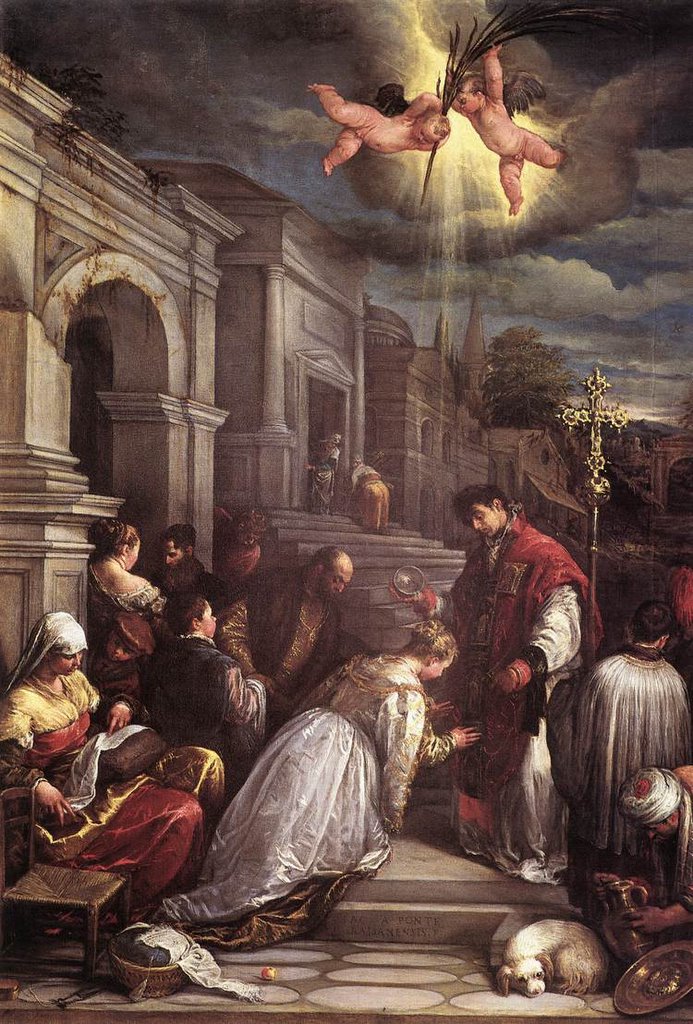
From the CATHOLIC ENCYCLOPEDIA:
At least three different Saint Valentines, all of them martyrs, are mentioned in the early martyrologies under date of 14 February. One is described as a priest at Rome, another as bishop of Interamna (modern Terni), and these two seem both to have suffered in the second half of the third century and to have been buried on the Flaminian Way, but at different distances from the city. In William of Malmesbury's time what was known to the ancients as the Flaminian Gate of Rome and is now the Porta del Popolo, was called the Gate of St. Valentine. The name seems to have been taken from a small church dedicated to the saint which was in the immediate neighborhood. Of both these St. Valentines some sort of Acta are preserved but they are of relatively late date and of no historical value. Of the third Saint Valentine, who suffered in Africa with a number of companions, nothing further is known.

Michael Dubruiel's Books 

Wednesday, February 13, 2019

Parish Stations of the Cross for Lent


In 1991, Pope John Paul II introduced a new Bible-based interpretation of the Stations of the Cross. This devotional guide invites readers to prayerfully walk in solidarity with Jesus on his agonizing way of the cross—from his last torturous moments in the Garden of Gethsemane to his death and burial.

Now with full-color station images from previously unpublished paintings by Michael O'Brien, this booklet creates an ideal resource for individual or group devotional use, particularly during the Lenten season.

Monday, February 11, 2019

Our Lady of Lourdes - February 11

Michael Dubruiel conceived and put together the small hardbound book, Praying the Rosary.  Click on the cover for more information.

"Michael Dubruiel"


The Gospels show that the gaze of Mary varied depending upon the circumstances of life. So it will be with us. Each time we pick up the holy beads to recite the Rosary, our gaze at the mystery of Christ will differ depending on where we find ourselves at that moment.

Thereafter Mary’s gaze, ever filled with adoration and wonder, would never leave him. At times it would be a questioning look, as in the episode of the finding in the Temple: “Son, why have you treated us so?” (Lk 2:48); it would always be a penetrating gaze, one capable of deeply understanding Jesus, even to the point of perceiving his hidden feelings and anticipating his decisions, as at Cana (cf. Jn 2:5). At other times it would be a look of sorrow, especially beneath the Cross, where her vision would still be that of mother giving birth, for Mary not only shared the passion and death of her Son, she also received the new son given to her in the beloved disciple (cf. Jn 19:26-27). On the morning of Easter hers would be a gaze radiant with the joy of the Resurrection, and finally, on the day of Pentecost, a gaze afire with the outpouring of the Spirit (cf. Acts 1:14) [Rosarium Virginis Mariae, no. 10].


As we pray the Rosary, then, we join with Mary in contemplating Christ. With her, we remember Christ, we proclaim Him, we learn from Him, and, most importantly, as we raise our voices in prayer and our hearts in contemplation of the holy mysteries, this “compendium of the Gospel” itself, we are conformed to Him.