Thursday, May 11, 2017

Mary and the Muslims - Fatima

From the National Rosary Crusade, written many years ago by the Servant of God Bishop Fulton Sheen:

MARY
The Qu'ran, which is the Bible for the Muslims, has many passages concerning the Blessed Virgin. First of all, the Qu'ran believes in her Immaculate Conception, and also in her Virgin Birth. The third chapter of the Qu'ran places the history of Mary's family in a genealogy which goes back through Abraham, Noah, and Adam. When one compares the Qu'ran's description of the birth of Mary with the apocryphal Gospel of the birth of Mary, one is tempted to believe that Mohammed very much depended upon the latter. Both books describe the old age and the definite sterility of the mother of Mary. When, however, she conceives, the mother of Mary is made to say in the Qu'ran: "O Lord, I vow and I consecrate to you what is already within me. Accept it from me."

When Mary is born, the mother says: And I consecrate her with all of her posterity under thy protection, O Lord, against Satan!"

The Qu'ran passes over Joseph in the life of Mary, but the Muslim tradition knows his name and has some familiarity with him. In this tradition, Joseph is made to speak to Mary, who is a virgin. As he inquired how she conceived Jesus without a father, Mary answered:

Do you not know that God, when he created the wheat had no need of seed, and that God by his power made the trees grow without the help of rain? All that God had to do was to say, 'So be it, and it was done.'

The Qu'ran was also verses on the Annunciation, Visitation, and Nativity. Angels are pictured as accompanying the Blessed Mother and saying: "Oh, Mary, God has chosen you and purified you, and elected you above all the women of the earth." In the nineteenth chapter of the Qu'ran there are 41 verses on Jesus and Mary. There is such a strong defense of the virginity of Mary here that the Qu'ran, in the fourth book, attributed the condemnation of the Jews to their monstrous calumny against the Virgin Mary.

FATIMA 
Mary, then, is for the Muslims the true Sayyida, or Lady. The only possible serious rival to her in their creed would be Fatima, the daughter of Mohammed himself. But after the death of Fatima, Mohammed wrote: "Thou shalt be the most blessed of all women in Paradise, after Mary." In a variation of the text, Fatima is made to say, "I surpass all the women, except Mary."

This brings us to our second point: namely, why the Blessed Mother, in the 20th century, should have revealed herself in the insignificant little village of Fatima, so that to all future generations she would be known as "Our Lady of Fatima." Since nothing ever happens out of Heaven except with a finesse of all details, I believe that the blessed Virgin chose to be known as "Our Lady of Fatima" as a pledge and a sign of hope to the Muslim people, and as an assurance that they, who show her so much respect, will one day accept her divine Son too.

Evidence to support these views is found in the historical fact that the Muslims occupied Portugal for centuries. At the time when they were finally driven out, the last Muslim chief had a beautiful daughter by the name of Fatima. A Catholic boy fell in love with her, and for him she not only stayed behind when the Muslims left, but even embraced the faith. The young husband was so much in love with her that he changed the name of the town where he lived to Fatima. Thus, the very place where our lady appeared in 1917 bears a historical connection to Fatima, the daughter of Mohammed.

The final evidence of the relationship of Fatima to the Muslims is the enthusiastic reception which the Muslims in Africa, India, and elsewhere gave to the pilgrim statue of Our Lady of Fatima. Muslims attended the church services in honor of our Lady, they allowed religious processions and even prayers before their mosques; and in Mozambique, the Muslims who were unconverted, began to be Christian as soon as the statue of Our Lady of Fatima was erected.

Wednesday, May 10, 2017

Damien of Molokai - May 10


From Vultus Christi, who sees in Damien the patron for all whose lives don't turn out as they planned:

When Providence Writes One's Life

Blessed Damien is, I think, a very suitable patron for those who lives have not turned out as they planned. By the time a child has reached adolescence, he has already dreamed dreams and nourished hopes for his life. The vivid reveries of little boys and girls take shape in a kind of autobiography written in the imagination and lived ahead of time in a world of fantasy. In that world no desire is broken, no hope dashed, no dream unfulfilled, but rarely do the life stories we write for ourselves correspond to those written for us by Providence. Events and circumstances — illness, loss, changes in fortune, failure — shatter dreams, close some doors and open others. The chance encounter with one person or the discovery of a particular book can change the direction of a life, leading to unexpected twists and turns.
The Designs of the Heart of Jesus

God intervenes in a thousand little ways, and sometimes dramatically, to realize in every generation “the designs and thoughts of His Heart” (cf. Ps 32:11). “For my thoughts are not your thoughts, neither are my ways your ways, says the Lord. For as the heavens are higher than the earth, so my ways are higher than your ways, and my thoughts than your thoughts” (Is 55:8-9).

Yes to the Plan of God

The life story of each of us written in the Heart of God surpasses by far anything we could have imagined or written for ourselves. When one realizes that one’s life is not unfolding as one thought it would, two responses are possible. One can refuse the path opened by God, “kicking against the goads” (Ac 26:14), or one can say “Yes” to it.

Blessed Damien said “Yes” to God’s astonishing plan for him, a plan that led him from Belgium to Hawaii and, after ten years, to the dreaded leper colony of Molokai. The suffering Christ called Damien to a costly, sacrificial love, and to configuration with himself. He became “as one from whom men hide their faces” (Is 53:3), identified fully with the suffering Christ and with the lepers he served.

A Benedictine Without A Monastery

As a religious of the Congregation of the Sacred Hearts of Jesus and Mary, Father Damien’s life was based on the Rule of Saint Benedict. Without living in a monastery and without the benefits and protection of the cloister, Father Damien found himself living the Rule of Saint Benedict on Molokai in ways prepared for him by the Providence of God. “To relieve the poor. To clothe the naked. To visit the sick. To bury the dead. To give help in trouble. To console the sorrowful. To avoid worldly behaviour. To set nothing before the love of Christ” (RB 4:14-21). “The care of the sick,” says Saint Benedict in another place, “is to be given priority over everything else, so that they are indeed served as Christ would be served, since he himself said, ‘I was sick and you visited me’” (RB 36:1-2).

From Vultus Christi, who sees in Damien the patron for all whose lives don't turn out as they planned:

When Providence Writes One's Life

Blessed Damien is, I think, a very suitable patron for those who lives have not turned out as they planned. By the time a child has reached adolescence, he has already dreamed dreams and nourished hopes for his life. The vivid reveries of little boys and girls take shape in a kind of autobiography written in the imagination and lived ahead of time in a world of fantasy. In that world no desire is broken, no hope dashed, no dream unfulfilled, but rarely do the life stories we write for ourselves correspond to those written for us by Providence. Events and circumstances — illness, loss, changes in fortune, failure — shatter dreams, close some doors and open others. The chance encounter with one person or the discovery of a particular book can change the direction of a life, leading to unexpected twists and turns.
The Designs of the Heart of Jesus

God intervenes in a thousand little ways, and sometimes dramatically, to realize in every generation “the designs and thoughts of His Heart” (cf. Ps 32:11). “For my thoughts are not your thoughts, neither are my ways your ways, says the Lord. For as the heavens are higher than the earth, so my ways are higher than your ways, and my thoughts than your thoughts” (Is 55:8-9).

Yes to the Plan of God

The life story of each of us written in the Heart of God surpasses by far anything we could have imagined or written for ourselves. When one realizes that one’s life is not unfolding as one thought it would, two responses are possible. One can refuse the path opened by God, “kicking against the goads” (Ac 26:14), or one can say “Yes” to it.

Blessed Damien said “Yes” to God’s astonishing plan for him, a plan that led him from Belgium to Hawaii and, after ten years, to the dreaded leper colony of Molokai. The suffering Christ called Damien to a costly, sacrificial love, and to configuration with himself. He became “as one from whom men hide their faces” (Is 53:3), identified fully with the suffering Christ and with the lepers he served.

A Benedictine Without A Monastery

As a religious of the Congregation of the Sacred Hearts of Jesus and Mary, Father Damien’s life was based on the Rule of Saint Benedict. Without living in a monastery and without the benefits and protection of the cloister, Father Damien found himself living the Rule of Saint Benedict on Molokai in ways prepared for him by the Providence of God. “To relieve the poor. To clothe the naked. To visit the sick. To bury the dead. To give help in trouble. To console the sorrowful. To avoid worldly behaviour. To set nothing before the love of Christ” (RB 4:14-21). “The care of the sick,” says Saint Benedict in another place, “is to be given priority over everything else, so that they are indeed served as Christ would be served, since he himself said, ‘I was sick and you visited me’” (RB 36:1-2).

_by Michael Dubruiel

Tuesday, May 9, 2017

Monday, May 8, 2017

Fulton Sheen Celebrations - May 8 Michael Dubruiel

Hundreds of churches around the world are celebrating Mass in honor of Fulton Sheen on his birthday, today, May 8.

From Praying in the Presence of the Lord with Fulton Sheen by Michael Dubruiel. 

Bishop Sheen’s “Now-moment” corresponds to the thinking of the great spiritual writer Jean Pierre de Caussade. In Abandonment to Divine Providence, Fr. Caussade gives the reader a sure way of knowing the will of God at any moment—by simply confronting the present moment with all its reality. It seems simple, but if we reflect for a second most of us will find that we spend most of our lives avoiding the present moment.
A few years ago an English translation of the Father Caussade’s work appeared in the United States changing the original title to read “The Sacrament of the Present Moment.” This captures the essence of Father Caussade’s work and Bishop Sheen’s meditation that in the present time we are presented with an opportunity that is truly unique. Each moment is sacramental.
Most of us are capable of presenting ourselves with some amount of reflection as we celebrate the sacraments. If we celebrated the sacrament of Baptism as an adult certainly we came expecting to be changed by God. Each time we enter a confessional surely we have examined our conscience beforehand and are penitent expecting to be forgiven by God. Undoubtedly every time we approach the altar to receive the Eucharist we expect to encounter God. But what about the other moments of our lives?
As we awake in the morning, is our first thought of God? As we greet our brothers and sisters throughout the day do we expect that God might be present? Every moment of our lives is an opportunity to encounter God who is always present.
Spend some time reflecting on the following:
1. Go over the events of the present day and ask yourself where God might have been in each of them. Is there a consistent pattern to your day?
2. Reflect on the life of your favorite saint, and meditate on how he or she dealt with the people they met in their daily journeys. How could you imitate this saint? What enabled the saint to act in the way he or she did toward others?
3. Imagine as you leave from this time of prayer that God wishes to continue to be present to you as you go forth. How will you react to his presence in others?
PrayerLord, help me to search for you in the garden of life in the same way that St. Mary Magdalene did when she found your tomb empty. May my search be rewarded as hers was by knowledge of your abiding presence. Amen.
"michael dubruiel" "fulton sheen"

Friday, May 5, 2017

Solanus Casey to be Beatified by Michael Dubruiel

It has been announced that Father Solanus Casey will be beatified. This reflection is from the early 2000's. By Michael Dubruiel.

Rosary Walks


I spend my lunch time taking a walk at one of two places--one an active convent with beautiful grounds that include several nature trails and the other an abandoned Capuchin Friary where Solanus Casey once lived. Both offer me a variety of places to stop and reflect on the meaning of the mysteries of the rosary in the lived lives of both places--usually at the cemetery where I pause and reflect that surely one or two or more saints are buried who will join their prayers to mine.


Yesterday was a rather eventful day. I was at the convent and noticed police tape blocking the entrance to a path down a hill that includes a grotto of the resurrection and a downward path of the Stations of the Cross. A short walk under the tape and I discovered the reason why--a wall had tumbled down as the result of all the rain that we've had in this part of the country this Spring--a landslide. I think I was up the second joyful mystery--the visitation. I wondered what this act of nature might signify? I noticed that the display of the stations had not really been affected by the landslide but that the resurrection grotto had--it was as though the "removed stone" had been placed back at the entrance. I thought of the preoccupation of the women walking to the tomb "who will remove the stone?" and thought that this probably was the worry now of some of the nuns at the convent but probably only a few.


This convent is primarily interested in the environment. Nothing wrong with that. Trees are identified throughout the property and dedicated to various sisters. No Hunting or Fishing signs dot the landscape. It all makes for a very peaceful place at least from the perspective of violent people anyway. But nature is not really peaceful as the landslide near the fourteenth station demonstrates and the illusion has sometime been given that "man" is responsible for all the ills of nature--but indeed man is not the only creature that is fallen in Christian belief, rather it is all of creation.


Next I made my way to the graveyard. It is usually the place where I notice the most activity. New graves appear almost weekly as the rapidly dwindling numbers of nuns are laid to rest. There are a few stones from the 1980's that commemorate the missing bodies of nuns who gave their bodies to science but that fad seems to have passed now. On this day there were new deep holes burrowed into the earth for the placement of new grave-markers. The ten or so prepared last year are only one from being all used up. It is now the fifth joyful mystery the Finding of Jesus in the Temple--I wonder as I often do when I visit either of these sacred places (the abandoned friary and the soon to be abandoned convent) if Christ has been lost or is this just the natural cycle of religious communities?


Now I am on the trail of God's Splendid Creation as one of the sister's has entitled it on the sign that tells me the meandering path is .8 of a mile. Nature has ravaged this path also as the torrential rains have left huge piles of sand at the base of a hill that normally is very dry but now still wet weeks after the last rainfall. A deer is startled by my entrance into the forest and creates quite a stir as it flies over fallen trees and brush to make its way deeper into the forest. It is the first Luminous mystery--The Baptism of Jesus by John "I must decrease and he must increase," crosses my mind as I also think of the psalm "like a deer that yearns for running water so my soul thirsts for you my God!"


About half-way to the end of the path, the deer emerges again. Once again the sound of broken limbs under the weight of the deers landings, this time joined by squirrels scurrying in every direction. One squirrel winds his way around a tree and looks out at me with expectation of a treat--a little too tame for my liking. It is the third luminous mystery--Jesus preaching the Kingdom of God--"seek first the Kingdom of God" I think as I run past the tree where the squirrel lurches out from for some reason fearing that he will jump upon me and attack me for not having brought him any nuts. He does not and I go back to trying to seek God's dominion over me.


At the end of the trail I emerge upon the road lined with trees that leads back to the convent. I notice the deer's head staring at me from across the road, his ears flicking. I imagine the deer thinking that I'm following him. I walk closer to him and he doesn't move this time. Perhaps they feed him too, I think. I am now only five feet from the deer and I talk to him. He only cocks his head this way and that but doesn't flee until I turn to continue my journey. The fourth luminous mystery--the Transfiguration, an invitation to encounter Jesus in the Old Testament I think meditating on the significance of Moses and Elijah the prophet.


The sun beats down mercilessly and the tar is soft under my feet. I look back and see the deer still peering at me watching to see if I really am going in a different direction. I am, my lunch time nears its end. The maintenance worker is mowing the grass. His plumb body hangs over the sides of the seat and his beard covers his chest. As I make my way to the parking lot I notice his license plate "Rode Kill" misspelled I reason because someone must have already had "road kill" in this state of connoisseurs of varmint meat. On the side of his truck he has a bumper sticker, "I love animals...they taste real good." The fifth sorrowful mystery--the Crucifixion. In the way a sinner is attracted to the cross of salvation, I reason, perhaps this man with his desires was attracted to the environmental sisters.


So be it! Amen.

Thursday, May 4, 2017

The Jesus Prayer by Michael Dubruiel

Since the time of early Christianity, there have been forms
of prayer that use breathing as a cadence for prayer. The Jesus
Prayer and the Rosary, along with various forms of contemplative
prayer, are all variations of this type of prayer. The real prayer
behind all of these methods is the prayer of surrender: “Into
your hands I commend my spirit.” This was the prayer that Jesus
prayed to the Father from the cross.

Though confession alone does not remove the temporal penalty
of sin, healing still is possible by God’s grace. Prayer, reading the
Scripture, giving alms, doing good works all are acts that have
had indulgences attached to them by the Church. By obtaining
an indulgence, the Christian receives healing from the temporal
penalty of even the gravest sins, reducing or eliminating altogether
the time of purification needed in purgatory (CCC 1471).

Ideally, the Christian is motivated to perform these spiritual
exercises not from fear of punishment but out of love for God.
As we read in the preceding passage, St. Paul tells the Ephesians
to offer themselves as a spiritual sacrifice with Christ, who has
paid the debt of our sins. Seeing Christ on the cross and meditating
on his love for us should help us to understand how much
God loves


-The Power of the Cross  by Michael Dubruiel

Wednesday, May 3, 2017

Graduation Gift Idea

The How To Book of the Mass is also a great resource for inquirers and RCIA sessions.

You can find more information at this page. 

"amy welborn"

In this complete guide you get:
  • step-by-step guidelines to walk you through the Mass
  • the Biblical roots of the various parts of the Mass and the very prayers themselves
  • helpful hints and insights from the Tradition of the Church
  • aids in overcoming distractions at Mass
  • ways to make every Mass a way to grow in your relationship with Jesus
If you want to learn what the Mass means to a truly Catholic life—and share this practice with others—you can’t be without The How-To Book of the Mass.
Discover how to:
  • Bless yourself
  • Make the Sign of the Cross
  • Genuflect
  • Pray before Mass
  • Join in Singing the Opening Hymn
  • Be penitential
  • Listen to the Scriptures
  • Hear a Great Homily Everytime
  • Intercede for others
  • Be a Good Steward
  • Give Thanks to God
  • Give the Sign of Peace
  • Receive the Eucharist
  • Receive a Blessing
  • Evangelize Others
  • Get something Out of Every Mass You Attend


“Is this not the same movement as the Paschal meal of the risen Jesus with his disciples? Walking with them he explained the Scriptures to them; sitting with them at table ‘he took bread, blessed and broke it, and gave it to them.”

Tuesday, May 2, 2017

Catholic Mother's Day Gift

Michael Dubruiel conceived and put together the small hardbound book, Praying the Rosary.  Click on the cover for more information.

"Michael Dubruiel"


The Gospels show that the gaze of Mary varied depending upon the circumstances of life. So it will be with us. Each time we pick up the holy beads to recite the Rosary, our gaze at the mystery of Christ will differ depending on where we find ourselves at that moment.

Thereafter Mary’s gaze, ever filled with adoration and wonder, would never leave him. At times it would be a questioning look, as in the episode of the finding in the Temple: “Son, why have you treated us so?” (Lk 2:48); it would always be a penetrating gaze, one capable of deeply understanding Jesus, even to the point of perceiving his hidden feelings and anticipating his decisions, as at Cana (cf. Jn 2:5). At other times it would be a look of sorrow, especially beneath the Cross, where her vision would still be that of mother giving birth, for Mary not only shared the passion and death of her Son, she also received the new son given to her in the beloved disciple (cf. Jn 19:26-27). On the morning of Easter hers would be a gaze radiant with the joy of the Resurrection, and finally, on the day of Pentecost, a gaze afire with the outpouring of the Spirit (cf. Acts 1:14) [Rosarium Virginis Mariae, no. 10].


As we pray the Rosary, then, we join with Mary in contemplating Christ. With her, we remember Christ, we proclaim Him, we learn from Him, and, most importantly, as we raise our voices in prayer and our hearts in contemplation of the holy mysteries, this “compendium of the Gospel” itself, we are conformed to Him.


Monday, May 1, 2017

Sunday, April 30, 2017

Road to Emmaus - Sunday Gospel April 30


When our Lord gave the disciples on the road to Emmaus the bread that He had blessed and broken, "he vanished out of their sight" (Luke 24:31). It was then that they recognized Him. We receive the Lord as they did in receiving the Eucharist. Now, at the moment that He is within us, we too should reflect, as they did, on the Scriptures that He has opened to us during this Mass, especially on what has made our "hearts burn."

In our consumer-minded society, we can miss the treasure that we receive if we treat it like one more thing to "get" and then go on to the next thing. Our Lord is not a "thing." He is God, who has deigned to come intimately into our lives. We should reflect on His Presence within us and ask what He would have us do.

More on The How to Book of the Mass by Michael Dubruiel here. 


"michael dubruiel"

Friday, April 28, 2017

Easter Season Reflection by Michael Dubruiel

Coming to the tomb of Jesus that first Easter morning, the
women discovered an angel there, the rock rolled away. It was a
shocking and unexpected sight. The guards, who were there to

This is the power of
the cross for the follower
of Christ, no matter
what happens to us or can
happen to us we are not
defeated.
make sure that the disciples did not steal the body of the Lord,
were also witnesses to this. They were overcome with fear—to the
point of being “like dead men.”
One experience, two groups of people, two different reactions.
One group looks at the empty tomb and rushes to tell what
they have witnessed. The other group is paralyzed by the life
event. This wasn’t just something that happened thousands of
years ago; it happens every moment of every day. Those who see
the cross as the end of their life, meet death there; those who
believe and place their trust in God, find in the cross life and victory.
"michael dubruiel"

Thursday, April 27, 2017

Michael Dubruiel

You can listen to an interview program with Michael Dubruiel about the first four chapters of his book, The Power of the Cross. The interview is with Kris McGregor of KVSS radio.


Episode 1 – The Preliminary Lenten Days –
Michael discusses:
 Ash Wednesday – Eternal Life or Death?
Thursday – Jesus’ Invitation
Friday – How Much We Need Jesus
Saturday – A Matter of Life and Death

"michael Dubruiel"


You can find out more about The Power of the Cross here, including a free download of the book. 

Wednesday, April 26, 2017

Michael Dubruiel Interview

You can listen to an interview program with Michael Dubruiel about his book, The Power of the Cross. The interview is with Kris McGregor of KVSS radio.


Episode 4 –
The Cross of Christ unites…
– Michael discusses:
 Day 15 – How We Worship Day
16 – How We See Jesus Day
17 – How We Forgive Day
 18 – Law and Love Day
 19 – Our Lives Day
20 – Our Priorities
Day 21 – How We See Ourselves

"michael Dubruiel"


You can find out more about The Power of the Cross here, including a free download of the book. 

Monday, April 24, 2017

Book on the Catholic Mass by Michael Dubruiel

Eucharist means..."thanksgiving"

Michael Dubruiel wrote a book to help people deepen their experience of the Mass.  He titled it, How to Get the Most Out of the Eucharist.  You can read about it here. 


How to Get the Most Out of the Eucharist gives you nine concrete steps to help you join your own sacrifice to the sacrifice of Christ as you:
  • Serve: Obey the command that Jesus gave to his disciples at the first Eucharist.
  • Adore: Put aside anything that seems to rival God in importance.
  • Confess: Believe in God’s power to make up for your weaknesses.
  • Respond" Answer in gesture, word, and song in unity with the Body of Christ.
  • Incline: Listen with your whole being to the Word of God.
  • Fast: Bring your appetites and desires to the Eucharist.
  • Invite: Open yourself to an encounter with Jesus.
  • Commune: Accept the gift of Christ in the Eucharist.
  • Evangelize :Take him and share the Lord with others.


Filled with true examples, solid prayer-helps, and sound advice, How to Get the Most Out of the Eucharist shows you how to properly balance the Mass as a holy banquet with the Mass as a holy sacrifice. With its references to Scripture, quotations from the writings and prayers of the saints, and practical aids for overcoming distractions one can encounter at Mass, this book guides readers to embrace the Mass as if they were attending the Last Supper itself.

Saturday, April 22, 2017

Divine Mercy Novena - Day 9

Ninth Day

"Today bring to Me The Souls Who Have Become Lukewarm and immerse them in the abyss of My mercy. These souls wound My Heart most painfully. My soul suffered the most dreadful loathing in the Garden of Olives because of lukewarm souls. They were the reason I cried out: 'Father, take this cup away from Me, if it be Your will.' For them the last hope of salvation is to run to My mercy."

Go here for instructions.

Friday, April 21, 2017

Divine Mercy Novena - Day 8

Eighth Day

"Today bring to Me The Souls Who Are Detained in Purgatory and immerse them in the abyss of My mercy. Let the torrents of My Blood cool down their scorching flames. All these souls are greatly loved by Me. They are making retribution to My justice. It is in your power to bring them relief. Draw all the indulgences from the treasury of My Church and offer them on their behalf. Oh, if you only know the torments they suffer, you would continually offer for them the alms of the spirit and pay off their debt to My justice.

Go here for instructions.

Thursday, April 20, 2017

Divine Mercy Novena

The Divine Mercy Novena continues:


When Jesus ascended into heaven, he told his Apostles to stay where they were and to "wait for the gift" that the Father had promised: the Holy Spirit.  The Apostles did as the Lord commanded them. "They all joined together constantly in prayer, along with the women and Mary the mother of Jesus, and with his brothers" (Acts 1:14). Nine days passed; then, they received the gift of the Holy spirit, as had been promised. May we stay together with the church, awaiting in faith with Our Blessed Mother, as we trust entirely in God, who loves us more than we can ever know. 

"michael Dubruiel"
Divine Mercy Novena

Wednesday, April 19, 2017

Confirmation Gift

Michael Dubruiel conceived and put together the small hardbound book, Praying the Rosary.  Click on the cover for more information.
"Michael Dubruiel"
The Gospels show that the gaze of Mary varied depending upon the circumstances of life. So it will be with us. Each time we pick up the holy beads to recite the Rosary, our gaze at the mystery of Christ will differ depending on where we find ourselves at that moment.
Thereafter Mary’s gaze, ever filled with adoration and wonder, would never leave him. At times it would be a questioning look, as in the episode of the finding in the Temple: “Son, why have you treated us so?” (Lk 2:48); it would always be a penetrating gaze, one capable of deeply understanding Jesus, even to the point of perceiving his hidden feelings and anticipating his decisions, as at Cana (cf. Jn 2:5). At other times it would be a look of sorrow, especially beneath the Cross, where her vision would still be that of mother giving birth, for Mary not only shared the passion and death of her Son, she also received the new son given to her in the beloved disciple (cf. Jn 19:26-27). On the morning of Easter hers would be a gaze radiant with the joy of the Resurrection, and finally, on the day of Pentecost, a gaze afire with the outpouring of the Spirit (cf. Acts 1:14) [Rosarium Virginis Mariae, no. 10].

As we pray the Rosary, then, we join with Mary in contemplating Christ. With her, we remember Christ, we proclaim Him, we learn from Him, and, most importantly, as we raise our voices in prayer and our hearts in contemplation of the holy mysteries, this “compendium of the Gospel” itself, we are conformed to Him.
 

Tuesday, April 18, 2017

Easter Octave Meditation by Michael Dubruiel

Coming to the tomb of Jesus that first Easter morning, the
women discovered an angel there, the rock rolled away. It was a
shocking and unexpected sight. The guards, who were there to

This is the power of
the cross for the follower
of Christ, no matter
what happens to us or can
happen to us we are not
defeated.
make sure that the disciples did not steal the body of the Lord,
were also witnesses to this. They were overcome with fear—to the
point of being “like dead men.”
One experience, two groups of people, two different reactions.
One group looks at the empty tomb and rushes to tell what
they have witnessed. The other group is paralyzed by the life
event. This wasn’t just something that happened thousands of
years ago; it happens every moment of every day. Those who see
the cross as the end of their life, meet death there; those who
believe and place their trust in God, find in the cross life and victory.

Monday, April 17, 2017

Divine Mercy Novena

The Divine Mercy Novena continues:


When Jesus ascended into heaven, he told his Apostles to stay where they were and to "wait for the gift" that the Father had promised: the Holy Spirit.  The Apostles did as the Lord commanded them. "They all joined together constantly in prayer, along with the women and Mary the mother of Jesus, and with his brothers" (Acts 1:14). Nine days passed; then, they received the gift of the Holy spirit, as had been promised. May we stay together with the church, awaiting in faith with Our Blessed Mother, as we trust entirely in God, who loves us more than we can ever know. 

"michael Dubruiel"
Divine Mercy Novena

Sunday, April 16, 2017

Easter Sunday

Taking Up Our Cross. . . Be Not Afraid 


There is no fear in love, but perfect love casts out fear. For fear has to do with punishment, and he who fears is not perfected in love. We love, because he first loved us. 1 JOHN 4:18–19 

There was a great earthquake; for an angel of the Lord descended from heaven and came and rolled back the stone, and sat upon it. His appearance was like lightning, and his raiment white as snow. And for fear of him the guards trembled and became like dead men. But the angel said to the women, “Do not be afraid; for I know you seek Jesus who was crucified. He is not here; for he has risen, as he said. Come, see the place where he lay.” MATTHEW 28:2–6 

“There are no accidents,” insisted Father Benedict Groeschel as he began to recover from the injuries he suffered in Florida. This strong statement of faith is similar to what Jesus told the disciples on the road to Emmaus: “O foolish men, and slow of heart to believe all that the prophets have spoken! Was it not necessary that the Christ should suffer these things and enter into his glory?” (Luke 24:25–26)

Not an accident. . . necessary!

Father Groeschel frequently quotes St. Augustine in this regard: “God does not cause evil, but that evil should not become the worst.” So, when a car struck him that January night, Father Benedict’s faith told him that there was a reason for this cross, a reason that ultimately God would reveal in time. This is the power of the cross for the follower of Christ: No matter what happens to us or can happen to us, we are not defeated.

Years ago I worked with someone who told me that her mother had labeled her and her brother as “accidents”—two unwanted, unpleasant surprises. Unwilling to think that a parent would say such a thing, I assumed my colleague’s recollection of her mother’s words was exaggerated. Some years later, I was introduced to her mother. In the course of conversation, the topic of abortion was raised. The woman pointed at her daughter and said, “If abortion had been legalized when I was young, I would never have had any children!” By that time she was an old woman; her daughter, who was divorced, lived with her and was a faithful companion. I pointed out that, had abortion been legalized, she would now be alone. “Wouldn’t that be great!” the mother replied. I left their home feeling very sad for both of them.

Without the gospel message, some people see only accidents in their lives—all of which have prevented them from reaching some dreamed of earthly paradise. They never seem to realize they cannot reach this paradise without help from above.

 Reactions 

Coming to the tomb of Jesus that first Easter morning, the women discovered an angel there, the rock rolled away. It was a shocking and unexpected sight. The guards, who were there to make sure that the disciples did not steal the body of the Lord, were also witnesses to this. They were overcome with fear—to the point of being “like dead men.” One experience, two groups of people, two different reactions. One group looks at the empty tomb and rushes to tell what they have witnessed. The other group is paralyzed by the life event. This wasn’t just something that happened thousands of years ago; it happens every moment of every day. Those who see the cross as the end of their life, meet death there; those who believe and place their trust in God, find in the cross life and victory.

St. Peter Chrysologus (the “golden-worded”) was known for his clear and simple style of preaching. About the angel’s appearance at the tomb, he preached, “Pray that the angel would descend now and roll away all the hardness of our hearts and open up our closed senses and declare to our minds that Christ has risen, for just as the heart in which Christ lives and reigns is heaven, so also in the heart in which Christ remains dead and buried is a grave.” For those who do not believe, life unfolds as a series of accidents. When a follower of Christ sees his life in exactly the same way, Jesus calls that person foolish, slow to believe. Someone like that needs to redirect his attention to the cross.

Gifts 

The procession of the cross that begins and ends each celebration of the Eucharist should help us to redefine our lives whenever we witness it. As the Mass begins we join all of our crosses to the cross of Christ, asking the Lord to have mercy upon us for our inability to see. We listen to the Scriptures to once again learn about all the necessary events of our lives, proclaim the Church’s belief as our own, and give thanks to God as we offer the sacrifice that he has provided for us. We then receive the Living God before the cross leads us back into the world! Having received the life of Christ in us, we are better able to extend that love to others.

 I was reminded of this again a few years ago, when I met another family who also had an unplanned child. In the presence of the child they said what a gift they had been given—like nothing they could have ever dreamed of asking for, an incredible blessing. Their joy mirrored that of God the Father, who could not contain himself in heaven when his Son walked the earth. He opened up the heavens to exclaim, “This is my beloved Son, with whom I am well pleased” (Matthew 3:17). That same Son would experience horrible suffering at the hands of cruel men. Assured of the love of the Father, he knew that ultimately the Father would not let him down. When you and I are finally convinced in the same way that God loves us, we will welcome whatever comes our way in this life and see it with a vision that others will marvel at. On that day we will say, “Alleluia. Praised be God!”

The Power of the Cross  by Michael Dubruiel is a book well-suited to daily reading during Lent. The book is available here in pdf version. Daily excerpts will be reprinted in this space during Lent.
"michael Dubruiel"

Saturday, April 15, 2017

Holy Saturday

Day 39 Taking Up Our Cross. . . Be Prepared 


Whoever, therefore, eats the bread or drinks the cup of the Lord in an unworthy manner will be guilty of profaning the body and blood of the Lord. Let a man examine himself, and so eat of the bread and drink of the cup. For any one who eats and drinks without discerning the body eats and drinks judgment upon himself. That is why many of you are weak and ill, and some have died. 1 CORINTHIANS 11:27–30 

Now on the first day of Unleavened Bread the disciples came to Jesus, saying, “Where will you have us prepare for you to eat the passover?” He said, “Go into the city to a certain one, and say to him, ‘The Teacher says, My time is at hand; I will keep the passover at your house with my disciples.’” And the disciples did as Jesus had directed them, and they prepared the passover. MATTHEW 26:17–19

While I was preparing material for the National Catholic Educators Association convention in St. Louis a year ago, my son came into the room and turned on the stereo. Out boomed the voice of Archbishop Fulton J. Sheen. It was a tape that had remained in the stereo from the time I had been listening to some of the archbishop’s talks as I compiled a book of Eucharistic
meditations based on his writings. The book was later published as Praying in the Presence of Our Lord with Fulton J. Sheen. The archbishop read from Paul’s First Letter to the Corinthians: “For any one who eats and drinks without discerning the body eats and drinks judgment upon himself. That is why many of you are feeble and sick, and a number have died” (1 Corinthians 11:30, NEB). The archbishop read it very dramatically, and commented that it was interesting no one ever took that verse into account. Then, without any further remark, he went on to talk about something else.

That night I found myself thinking about the passage, over and over. I knew from previous courses that the meaning of the passage confused many commentators. The next morning, I did a quick study and found that the Greek word that Paul used for “died,” koima?, literally means “fallen asleep.” Thought it often means “death,” it can also mean actual sleep. We know from the Acts of the Apostles that St. Paul once preached a very long sermon, which caused a boy, Eutychus, to fall into such a deep sleep that he toppled out a window. Most of the worshippers presumed he was dead. Paul momentarily interrupted his preaching to check on Eutychus and declare him alive. Paul then went on with the breaking of the bread, in what we would call today the rest of the Mass.

We who are called to the Lord’s Supper have a duty to prepare ourselves for our encounter with the Lord. We must examine ourselves so that we may worthily take up his cross, from the moment we sign ourselves with holy water from the baptismal font. In the Eucharist, our sacrifice is joined to the one sacrifice of Christ at the moment of kairos, God’s “opportune time.”


It dawned on me that Eutychus might have been the inspiration for what Paul was writing to the Corinthians when he referred to “some who have even fallen asleep”!

 Know What You Celebrate 

How often do we attend the Sacrifice of the Mass without really knowing why we are there, or without paying attention to what is going on? This is how we eat and drink without discerning: We grow sick of the Mass, and don’t get anything out of it. We grow feeble in our faith or—like poor Eutychus—we are bored to death! In “The Constitution on the Sacred Liturgy,” the fathers of the Second Vatican Council noted that pastors have a duty to ensure that the “faithful take part fully aware of what they are doing, actively engaged in the rite and enriched by its effects” (SC 11). Unfortunately, when it comes to the Sacrifice of the Mass, those who should know are often as muddled as those who look to them for the answers.

 On the day of the Last Supper, when he instituted the Eucharist, Our Lord sent his apostles ahead to make the preparations. They were to tell the “certain one” that his “time was at hand.” The fact that no name is given is interesting. Some commentators have noted that it could be that the Matthew did not want to reveal the name of the individual, to protect them from the authorities; of course, this makes sense only if the Gospel were written much earlier than is commonly believed. Another possibility is that the generic “certain one” is you and I; in much the same way as the “disciple whom Jesus loved” can be the reader or hearer of the word as well as the historical individual. In the Book of Revelation Our Lord says, “Behold, I stand at the door and knock; if any one hears my voice and opens the door, I will come in to him and eat with him, and he with me”  We who are called to the Lord’s Supper have a duty to prepare ourselves for this encounter with the Lord. We must examine ourselves so that we may worthily take up the cross he gives us. In the Eucharist, our sacrifice is joined to the one sacrifice of Christ, it is our entrance into his kairos, “God’s time."

 Being Prepared

What will we say when the messengers of Our Lord come to us and tell us that the time is at hand, and the Lord wishes for us to prepare for his Passover? Will we open the door of our hearts and welcome him? Maria Montessori, founder of the Montessori method of learning, wrote a book in the early twentieth century about the Mass for Children. She began by describing the inside of a church: candles lit, altar cloths set on the altar. Something very special must be about to take place here, she said. Just as the disciples prepared for the Passover, the Last Supper of the Lord, so we must prepare to welcome the Savior before we approach his banquet. Being prepared for Mass is essential to the disciple and follower of Jesus Christ who wishes to be enriched with his teaching and be fed with his Body and Blood. St. Paul’s admonition to examine ourselves is paramount if we are not to eat and drink judgment upon ourselves—but rather partake in the Way, the Truth, and the Life.


The Power of the Cross  by Michael Dubruiel is a book well-suited to daily reading during Lent. The book is available here in pdf version. Daily excerpts will be reprinted in this space during Lent.


"michael Dubruiel"

Friday, April 14, 2017

Good Friday Stations of the Cross


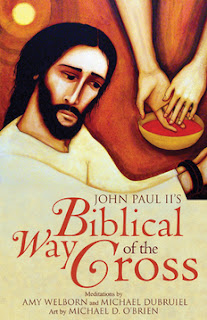
In 1991, Pope John Paul II introduced a new Bible-based interpretation of the Stations of the Cross. This devotional guide invites readers to prayerfully walk in solidarity with Jesus on his agonizing way of the cross—from his last torturous moments in the Garden of Gethsemane to his death and burial.

Now with full-color station images from previously unpublished paintings by Michael O'Brien, this booklet creates an ideal resource for individual or group devotional use, particularly during the Lenten season.