After being voted in last year by the Conclave of Cardinals, Pope Benedict the 16th says leading the world's 1.1 billion Catholics is not a small task and he has just started to "learn" his new job.
The German-born Pope was speaking while addressing journalists on Friday. He had just completed a private holiday in the northern Italian mountains. Reuters quotes him telling reporters, "During this period I have also been working, because holidays are good only if you do some work. Without doing anything, they are not holidays."
He is slated to travel to the papal summer retreat at Castel Gandolfo, south of Rome. The Pope will spend his time recollecting at the retreat that is scheduled to end by late September.
Saturday, July 29, 2006
Pope Still Learning How to be Pope
From All Headline News:

Friday, July 28, 2006
Spanish Bishops "The Church is sick"
And in need of a cure...fascinating document that was done in conjunction with the Congregation for the Doctrine of the Faith when the Pope was still a cardinal and the head of it. It lays out what the problem is, its origin and the cure...
From Magister:
And from the actual document:
From Magister:
The sickness is “the secularization within the Church”: a widespread loss
of faith caused in part by “theological propositions that have in common a
deformed presentation of the mystery of Christ.”The cure is precisely that of
restoring life to the profession of faith: “You are the Christ, the Son of the
living God” (Matthew 16:16), in the four areas where it is most seriously
undermined today:
- the interpretation of Scripture,
- Jesus Christ as the only savior of all men,
- the Church as the Body of Christ,
- moral life.
The instruction is organized under these four main headings. In each section, the
document first presents the features of correct Christological doctrine, and
then denounces the theologies that deform it. It denounces the theologies, not
the theologians. The instruction does not target particular authors, but limits
itself to denouncing erroneous tendencies. The names found in the notes that
accompany the text are simply those of theologians already marked out in the
past by doctrinal condemnations and disciplinary sanctions by the Vatican
Congregation for the Doctrine of the Faith or by the Spanish bishops’
conference.
And from the actual document:
2. They are not few who, in the shadow of a nonexistent Council, in terms of both letter and spirit, have sown agitation and disquiet in the hearts of many of the faithful.
13. From the denial of one aspect of the profession of faith, one passes to the total loss of the faith itself, in that by selecting some aspects and refuting others one does not respect the testimony of God, but rather human reasoning. When one alters the profession of faith, the entire Christian life is compromised by this.
19. In some instances the biblical texts are studied and interpreted as if these were nothing more than ancient texts. There is also the application of methods that systematically exclude the possibility of revelation, miracles, and intervention of God. Instead of integrating the contributions of history, philology, and other scholarly disciplines with the faith and the Church’s tradition, frequently the ecclesial interpretation itself is presented as the problem and considered as extraneous, if not opposed, to “scientific exegesis.”
25. The historical-critical method has been abused without a recognition of its limits, and this has gone so far as the assertion that the pre-existence of the divine person of Christ is a mere philosophical deformation of the biblical evidence. [...] The mission of Christ has been understood as a merely earthly event, if not political-revolutionary, thus denying his voluntary death on the cross for mankind.
Wednesday, July 26, 2006
Florida Housing Heading in Other Direction
After rising steeply, now its heading in the other direction...
Weeping Icon a Fake?
And other horrors at Orthodox monastery in Texas. The ring leader is a former Benedictine monk who left years ago, sold land in Texas and then formed an Orthodox monastery.
Read more about it here:
Read more about it here:
Besides naming the two boys tracked down by investigators, Elsbury said Greene confirmed suspicions that the picture of the Virgin Mary that was said to weep tears of rose oil was a fake.
"The whole thing is going to be exposed as a sham," the sheriff said. "They just put the tear drops on there themselves and then got all these people making donations trying to get some kind of miracle cure."
Give us Peace Today!
From Pope Benedict XVI:
Just a quick word of meditation on the reading we have just listened to. What is striking, against the background of the dramatic situation in the Middle East, is the beauty of the vision illustrated by the apostle Paul: Christ is our peace. He has reconciled us with one another, Jews and gentiles, uniting them in his body. He overcame enmity in his body, upon the cross. With his death he has overcome enmity, and has united us all in his peace.
But what strikes us even more than the beauty of this vision is its contrast with the reality we experience and see. And we can do nothing, at first, but say to the Lord: “But Lord, what does your apostle say to us – ‘We are reconciled’?” We see in reality that we are not reconciled... There is still war among Christians, Muslims, and Jews; and there are others who foment war and are still full of enmity and violence. Where is the efficacy of your sacrifice? Where in history is this peace of which your apostle speaks?
We human beings cannot solve the mystery of history, the mystery of human freedom to say “no” to God’s peace. We cannot solve the entire mystery of the revelation of the God-man, of his activity and our response. We must accept the mystery. But there are elements of an answer that the Lord gives to us.
A first element – this reconciliation from the Lord, his sacrifice – has not remained without efficacy. There is the great reality of the communion of the universal Church, found among all the peoples, the fabric of Eucharistic communion that transcends the boundaries of culture, civilization, peoples, and times. There is this communion, there are these “islands of peace” in the Body of Christ. They exist. And they are forces of peace in the world. If we look at history, we can see the great saints of charity who have created “oases” of this divine peace in the world, who have always rekindled his light, and were always able to reconcile and create peace. There are the martyrs who have suffered with Christ, have given this witness of peace, of the love that places a limit on violence.
And seeing that the reality of peace is there – even if the other reality also remains – we can go more deeply into the message of this Letter of Paul to the Ephesians. The Lord has triumphed upon the cross. He did not triumph with a new empire, with a power greater than the others and capable of destroying them; he triumphed, not in a human way, as we would imagine, with an empire more powerful than the other. He triumphed with a love capable of reaching even to death. This is God’s new way of winning: he does not oppose violence with a stronger form of violence. He opposes violence with its exact opposite: love to the very end, his cross. This is God’s humble way of winning: with his love – and this is the only way it is possible – he puts a limit on violence. This is a way of winning that seems very slow to us, but it is the real way to overcome evil, to overcome violence, and we must entrust ourselves to this divine way of winning.
Entrusting ourselves means entering actively within this divine love, participating in this work of peacemaking, in order to conform with what the Lord says: “Blessed are the peacemakers, those who work for peace, because they are the children of God.” We must bring, as much as possible, our love to all those who suffer, knowing that the judge of the last judgment identifies himself with the suffering. So whatever we do to the suffering we do to the ultimate judge of our lives. This is important: that in this moment we can bring this victory of his to the world, participating actively in his charity.
Today, in a multicultural and multireligious world, many are tempted to say: “It is better for peace in the world among religions and cultures that one not speak too much about the specifics of Christianity, about Jesus, the Church, the sacraments. Let us be satisfied with the things that can be held more or less in common...” But it’s not true. At this very moment – at a moment of a great abuse in the name of God – we need the God who triumphed upon the cross, who wins not by violence, but by his love. At this very moment, we need the face of Christ, in in order to know the true face of God and thus to bring reconciliation and light to this world. And so together, with love, with the message of love, with all that we can do for the suffering in this world, we must also bring the witness of this God, of the victory of God precisely through the nonviolence of his cross.
So let’s go back to the starting point. What we can do is give the witness of love, the witness of faith; and above all, raise a cry to God: we can pray! We are certain that our Father hears the cry of his children. At the Mass, preparing for holy communion, to receive the Body of Christ who unites us, we pray with the Church: “Deliver us, O Lord, from all evil, and grant us peace in our day.” Let this be our prayer in this moment: “Deliver us from all evil, and give us peace.” Not tomorrow or the next day: give us peace, Lord, today! Amen.
Tuesday, July 25, 2006
Way of Penitents for Divorced and Remarried in Italy?
Italian theologian tries to find a way for those living in an invalid marriage and excluded from Holy Communion that includes a life of penitence:
From Magister:
What I find appealing in this is that it is a step in the right direction not only for this issue but countless others that the face individuals in the Church today--that the focus is on conversion, deepening a relationship with Christ and it realizes that most of the sinful behavior committed in our lives is due to our lack of conversion.
From Magister:
It would, moreover, require a certain span of time that should be determined with prudence, which would include some of the following penitential acts, according to the traditional threefold model of prayer, fasting, and almsgiving, practiced on a daily or weekly basis for a few months, according to a set schedule: the reading of the Scriptures, the prayer of the Psalms or of the Liturgy of the Hours, participation in the celebration of the Eucharist (but without receiving communion) and in adult classes of catechesis, the recitation of the Rosary, pilgrimages, moderate fasting from food and from diversions, especially in preparation for the Sunday liturgy, monetary donations to poor people nearby or far away, the assumption of roles of social service in a professional or volunteer capacity, an effort to establish forgiveness and reconciliation with the spouse, etc. Of course, this journey would need to be modeled in reference to the confession of sins, and thus to the actual condition of the penitent.
At this point it becomes clear that, according to our proposal, admission to the sacraments cannot be decided privately by the individual believer on the basis of the judgment of his own conscience, but rather passes entirely through the ecclesiastical celebration and the priestly ministry.
And again, the individual believer cannot simply make this decision under some extraordinary circumstances, for example at a child’s first communion or at the funeral for a relative. Nor can it simply be left to the prudential judgment of the individual priest. It is appropriate that there should be a common and specific ecclesiastical practice in this matter.
What I find appealing in this is that it is a step in the right direction not only for this issue but countless others that the face individuals in the Church today--that the focus is on conversion, deepening a relationship with Christ and it realizes that most of the sinful behavior committed in our lives is due to our lack of conversion.
Monday, July 24, 2006
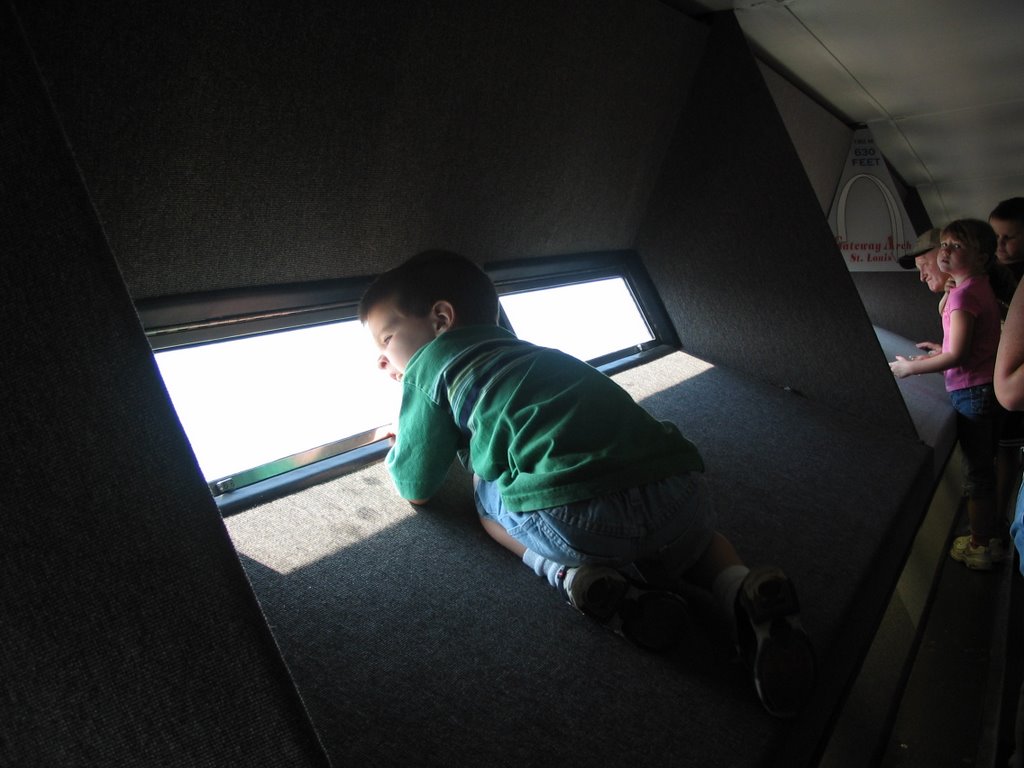
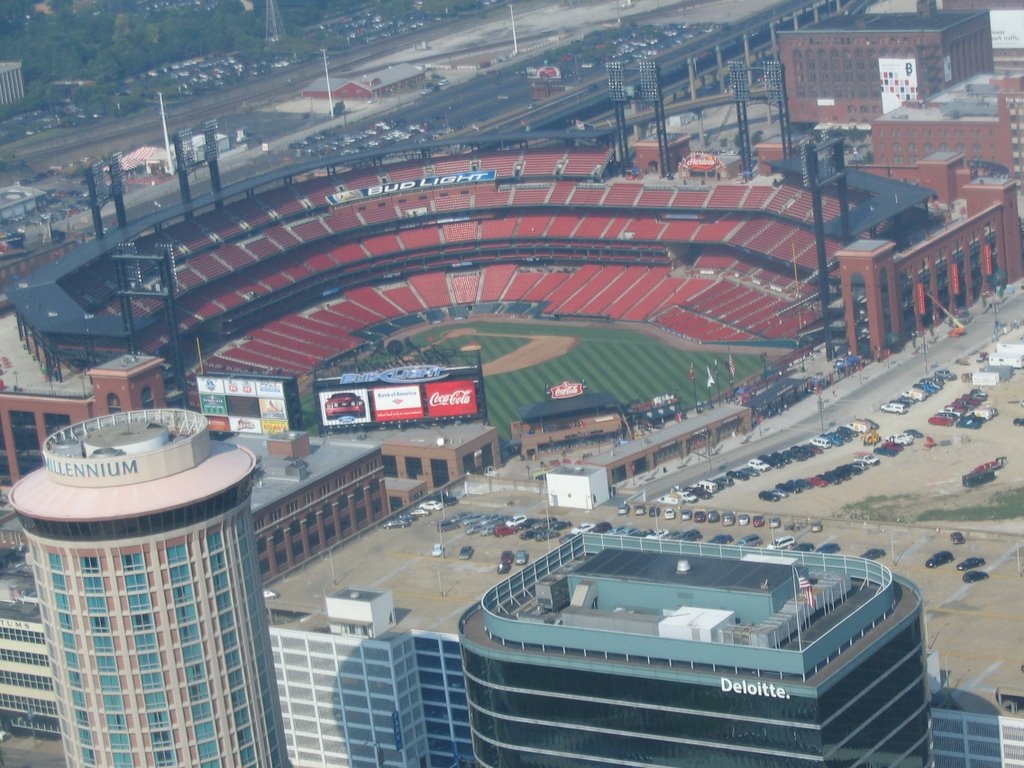
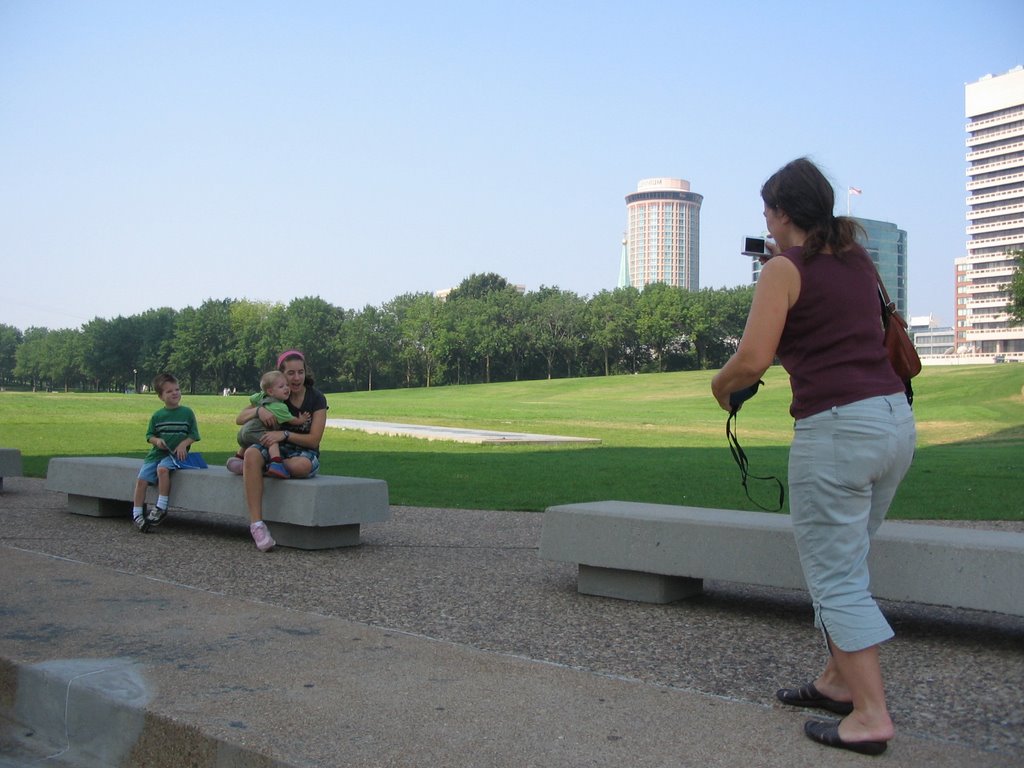
Saint Louis--The Arch
First, from below...

Then from above...

The preferred method of viewing...

The New Busch Stadium before the big storm...

How Amy takes all those nice pictures...

On the banks of the Mississippi...


Then from above...

The preferred method of viewing...
The New Busch Stadium before the big storm...
How Amy takes all those nice pictures...
On the banks of the Mississippi...

Miracle Attributed to Sheen Sent to Rome
I'm a big fan and promoter of Bishop Sheen's cause. For a free holy card to pray for his intercession click here and follow the instructions.
From the Peoria Journal Star:
Copies of a report on an alleged miracle that took place in 1999 through the intercession of the late Archbishop Fulton J. Sheen were signed and sealed Sunday by Roman Catholic Church officials.
The 500-page report and supporting documents will now be delivered to Rome by canon lawyer Andrea Ambrosi, postulator of the cause to have Sheen recognized as a saint. There, Ambrosi will argue to a Vatican panel that this case and another being prepared in the Diocese of Pittsburgh are evidence of Sheen's sainthood.
From the Peoria Journal Star:
Copies of a report on an alleged miracle that took place in 1999 through the intercession of the late Archbishop Fulton J. Sheen were signed and sealed Sunday by Roman Catholic Church officials.
The 500-page report and supporting documents will now be delivered to Rome by canon lawyer Andrea Ambrosi, postulator of the cause to have Sheen recognized as a saint. There, Ambrosi will argue to a Vatican panel that this case and another being prepared in the Diocese of Pittsburgh are evidence of Sheen's sainthood.
Wednesday, July 19, 2006
Pope's Second Encyclical to Focus on Jesus?
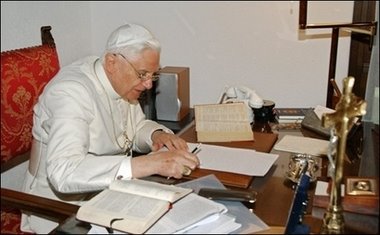
Heard that it would be on social justice but this story which talks about a "book" seems to be talking about the subject of the next encyclical.
Monday, July 17, 2006

Sunday, July 16, 2006
Pope Entrusts Conflict to Our Lady of Mt. Carmel

Today's feast, origination of the brown scapular devotion...
Friday, July 14, 2006
Dancing the Night Away
From Catholic Online:
Why not join together in prayer? My guess is that no one wants to impose their "style of prayer" upon the other, but "you will dance!"
Look for my upcoming book Where Ratzinger Was a Swear Word
The nuns said that when Bush arrived in Milwaukee they would "pause for a
time of silent prayer, join together in a dance of universal peace and pray for
continual conversion of your heart."
Why not join together in prayer? My guess is that no one wants to impose their "style of prayer" upon the other, but "you will dance!"
Look for my upcoming book Where Ratzinger Was a Swear Word
New Office to Oversee Liturgical Music?
From The Church:
Some of these “reforms of the reform” will concern music. On June 30, the
head of the Pontifical Institute of Sacred Music, Msgr. Valentino Miserachs
Grau, announced that the pope will make a personal visit there in November to
inaugurate the new academic year. And he said he expects the creation of a new
Vatican office “that would coordinate with authority the activity of all those
who work in liturgical music, and would watch over the liturgical celebrations.”
Tuesday, July 11, 2006
New Papal Spokesman--A Priest
From AGI online:
Father Federico Lombardi is the new spokesman for the Pope. A Jesuit, he was previously the general director of the Vatican Radio and director of the Vatican television centre. With his nomination as new director of the press office of the Holy See, there is a de facto synergy among the three organisms. Joaquin Navarro Valls is now out of the scene, having directed the press office for over 22 years and followed Pope John Paul II on all his trips since 1984.
Father Federico Lombardi is the new spokesman for the Pope. A Jesuit, he was previously the general director of the Vatican Radio and director of the Vatican television centre. With his nomination as new director of the press office of the Holy See, there is a de facto synergy among the three organisms. Joaquin Navarro Valls is now out of the scene, having directed the press office for over 22 years and followed Pope John Paul II on all his trips since 1984.
Monday, July 10, 2006
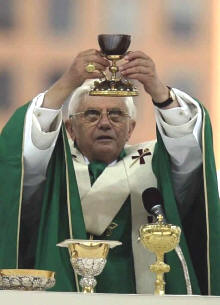
Pope Benedict uses Holy Grail at Mass
From Spero News:
Pope Benedict XVI used the Holy Chalice of Valencia at Sunday's Mass for
the World Congress of Families. The chalice is said by its supporters to have
been used by Christ at the Last Supper.
On Saturday when the Pope
entered Valencia's Cathedral the chalice was placed on the altar, where
Benedict said a prayer.
Thursday, July 6, 2006

Thursday, June 29, 2006
Solemnity of SS Peter and Paul
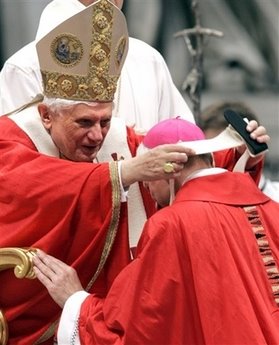
Pope Benedict's Homily highlights from Asia News Italy:
Benedict XVI dedicated his entire homily to the primacy of Peter and later,
the reflection for the Angelus too, focusing on three Gospel passages that draw
attention to him. At the end of the mass, in his words to the crowd gathered in
St Peter’s Square for the recital of the Angelus prayer, he recalled the
martyrdom of Peter and Paul, and after apologizing for the delay due to the
prolonged rite in the basilica, he said: “This is why the Bishop of Rome,
Successor to the apostle Peter, undertakes a specific ministry in the service of
the doctrinal and pastoral unity of the People of God scattered around the
world.”
During the mass, explaining the logic of the three Gospel passages,
he said they “tackle the same task, but the diversity of situations and imagery
used makes it clear for us what interested and interests the Lord.” The first
was the passage from Matthew in which “his specific task is conferred upon him
through three images: that of the rock that becomes the foundation or
cornerstone; that of the keys and of loosening and binding”. At this time,
continued the pope, “I do not intend to interpret once again these three images,
which the Church, throughout the centuries, has constantly explained anew;
rather, I would like to draw attention to the geographical and chronological
context of these words. The promise was made near the source of the Jordan, at
the border of Jewish land, on edge of the Pagan world. The moment in which the
promise was made marks a decisive turning point in the journey of Jesus: now the
Lord is walking toward Jerusalem, and for the first time, he tells his disciples
that this journey towards the Holy City is a journey to the Cross.” “Both things
go together and determine the inner place of the Primacy, in fact, of the church
in general: the Lord is continually on a journey towards the Cross, towards the
lowliness of the suffering and killed servant of God, but at the same time, he
is also headed for the vastness of the world, in which He goes before us as the
Risen Lord, so that the light of his word and the presence of his love may shine
in the world.”
“The Church – and Christ in it – still suffers today. In the
Church, Christ is relentlessly mocked and stricken over and again; there are
always efforts to push it out of the world. The small boat of the Church is
forever being buffeted by the wind of ideologies that penetrate it with their
waters, seemingly condemning it to sink. And yet, right in the suffering Church,
Christ is victorious. Notwithstanding everything, faith in Him is renewed in
strength again and again. Still today, the Lord commands the waters and reveals
himself as the Lord of the elements. He stays on his boat, the ship of the
Church. Thus even in the ministry of Peter is revealed on the one hand the
weakness of what comes from man, but together with the strength of God.”
The
second passage recalled by Benedict XVI was that from the Gospel of Luke which
is about the Last Supper, when “Jesus, straight after the institution of the
Sacrament, talked about the meaning of being disciples, the ‘ministry’, in the
new community: he said it was a commitment of service, the same as He himself,
who was among them as one who served. And then he turned to Peter. He said Satan
had demanded to sift the disciples like wheat.” Akin to the biblical narrative
of Job, “this is what happens to the disciples of Jesus – in all times.”
However, “Jesus continues: ‘I have prayed for you that your own faith may not
fail’ (Lk 22:32). The prayer of Jesus is the limit posed on the power of evil.
The prayers of Jesus are the protection of the Church. We can seek refuge under
this protection, cling to it and be sure of it. But, as the Gospel tells us,
Jesus prayed especially for Peter: ‘that your faith may not fail’. There it is:
don’t ever allow this faith to become dumb, always reinvigorate it again, even
in the face of the cross and all the contradictions of the world – this is the
task of Peter. This is precisely why the Lord does not only pray for the
personal faith of Peter but for his faith in the service of others. This is what
He means when He says: ‘and you, when once you have turned back, strengthen your
brothers’ (Lk22:32).”
“The Lord entrusts to Peter the responsibility for his
brothers through the promise of his prayer.”
The third reference to the
Primacy that Benedict XVI referred to was from the Gospel of John (21:15-19).
“The Lord rose and as the Risen Lord he entrusted his flock to Peter. Here too,
the Cross and the Resurrection are intertwined. In his words to Peter, Jesus
portends his journey towards the cross. In this Basilica, erected over the tomb
of Peter – a pauper’s grave – we see that the Lord, thus, through the Cross,
always triumphs. His power is not a power according to the rules of this world.
It is a power of goodness, of truth and love, which is stronger than death. Yes,
his promise is true: the power of death, the gates of hell will not prevail
against the Church He built for Peter (cfr Mt 16:18), and that He, precisely in
this way, continues to edify in person.”
Tuesday, June 27, 2006
No Comment
From the Holy See Press Office:
"I have no comments to make on news that has appeared in various organs of the press concerning ongoing contacts between a Holy See delegation and the Chinese authorities."
"I have no comments to make on news that has appeared in various organs of the press concerning ongoing contacts between a Holy See delegation and the Chinese authorities."
Monday, June 26, 2006
Traveling Pope--To Germany in September
Holy See Press Office Director Joaquin Navarro-Valls today announced that Benedict XVI will make an apostolic trip to Germany from September 9 to 14, where he will visit Munich, Altotting and Regensburg.
Sunday, June 25, 2006
Pope's Angelus
 From Asia News Italy:
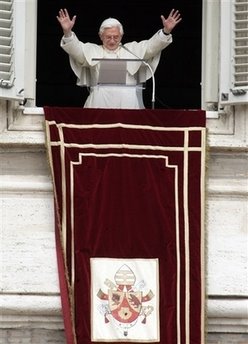
Recalling the feast celebrated on Friday 23 June, Benedict XVI said: “The consecration of the Sacred Heart was – and still is in some countries – a tradition in some families, which kept an image of the same in their homes. The roots of this devotion are embedded in the mystery of the Incarnation; it is precisely through the Heart of Jesus that the Love of God for mankind is revealed in a sublime way.” Genuine worship of the Sacred Heart, which became widespread in the seventeenth century, “preserves all its validity”, continued the pope. It “attracts above all souls thirsty for God’s mercy, as they find there an infinite font from which to draw the water of Life, capable of irrigating the desert of the soul and of making hope blossom again.”
Benedict XVI also recalled that the solemn feast of the Sacred Heart of Jesus is also the World Day of Prayer for the Sanctification of Priests. He said: “I take the opportunity to invite all of you, dear brothers and sisters, to pray for priests always, that they may be valid witnesses to the love of Christ.
Turning to the feast of the birth of John the Baptist – marked yesterday – the pope highlighted the expression “He must increase, but I must decrease” (Jn 3:30). This expression, he said, “is programmed for each and every Christian”. The pope said: “Our life is always ‘relative’ to Christ and it is realized by welcoming Him, Word, Light and Spouse, of whom we are the voice, lamp and friends (cfr Jn1:1,23; 1:7-8; 3:29)”.
Dwelling on the feast of Saints Peter and Paul, the pontiff said: “Allowing the ‘I’ of Christ to replace our ‘I’ was, in exemplary manner, the ardent desire of the Apostles Peter and Paul, who the Church will venerate in a solemn feast on 29 June. St Paul wrote of himself: “It is no longer I who lives, but Christ who lives in me. (Gal 2:20).”
Before the prayer of the Angelus, the pope also recalled the feast of the Immaculate Heart of Mary, “Heart of a Mother, who continues to keep watch with tender concern over us all. May her intercession grant that we will always remain faithful to our Christian vocation.”
Thursday, June 22, 2006
New Secretary of State at Vatican
Effective September 15th...Our Lady of Sorrows... (a Papal sense of humor?)
Via the Vatican itself...
Pope Benedict accepts Sodanno's retirement and replaces him with Card. Tarcisio Bertone as has been widely speculated.
Also accepts retirement of Cardinal Szoka as governor of the Vatican City State and replaces him with Bishop Giovanni Lajolo.
Via the Vatican itself...
Pope Benedict accepts Sodanno's retirement and replaces him with Card. Tarcisio Bertone as has been widely speculated.
Also accepts retirement of Cardinal Szoka as governor of the Vatican City State and replaces him with Bishop Giovanni Lajolo.
Social Encyclical Coming from the Pope in 2007
From Catholic News:
Pope Benedict will next year release his first social encyclical on globalisation to coincide with the 40th anniversary of Pope Paul VI's encyclical Populorum Progressio, an Italian newspaper predicts.Catholic World News reports
that according to an Italian business daily, Il Sole 24 Ore, "unofficial
information" points to an encyclical on "ethical and spiritual questions posed
by the process of globalisation."The year 2007 will bring the 20th anniversary
of the encyclical Sollicitude Rei Socialis, in which John Paul II commented on
world economic affairs, the Italian daily notes.
What Amy Was Doing Yesterday
Besides waiting at O'Hare late into the night to return home...
From The Courrier Post:
From The Courrier Post:
Following the remarks by the bishop, author and daily blogger Amy Welborn
echoed Galante's quest to listen to the laity, by asking reporters to do the
same.
The northern Indiana resident admonished the media to do a better job
of reporting what is going on within the Catholic Church.
The author of
De-Coding Da Vinci: The Facts Behind the Fiction of the Da Vinci Code said
reporters should talk more with parishioners, rather than focusing on a handful
of church experts.
Welborn said her 5-year-old blog (www.amywelborn.com) receives
about 10,000 unique visitors a day.
The response to her blog is a raw and
unedited look at what Catholic people around the world are thinking.
She
said her "hyperinformed Catholic" community of readers want journalists "to let
Catholics tell their own story."
If they had the chance, Catholics would
tell the media to "stop trying to label us as either conservative or liberal,"
Welborn said. "Stop trying to put labels to Catholic theological
questions."
Wednesday, June 21, 2006
From The Great Temptor
Visit his page and you'll find out what Augustine really didn't say too!
From What Does the Prayer Really Say:
From What Does the Prayer Really Say:
His Eminence Dionigi Card. Tettamanzi wrote a book on “The Great Tempter” entitled in the original Italian Il Grande Tentatore (Edizioni Piemme, 2001). In this useful little volume, indeed on the book’s back cover, Card. Tettamanzi gives us ten salutary points by way of a “decalogue against temptation”:
1. Do not forget that the devil exists.
2. Do not forget that the devil is a tempter.
3. Do not forget that the devil is very intelligent and astute.
4. Be vigilant concerning your eyes and heart. Be strong in spirit and virtue.
5. Believe firmly in the victory of Christ over the tempter.
6. Remember that Christ makes you a participant in His victory.
7. Listen carefully to the word of God.
8. Be humble and love mortification.
9. Pray without flagging.
10. Love the Lord your God and offer worship to Him only.
Recommended Books
First for Apologetics:
For a modern Biblical understanding of St. Paul:
The Book that is outselling the Da Vinci Code in Paraguay:
And an excellent primer on Opus Dei by Scott Hahn (I read a galley of it):
For a modern Biblical understanding of St. Paul:
The Book that is outselling the Da Vinci Code in Paraguay:
And an excellent primer on Opus Dei by Scott Hahn (I read a galley of it):
Because of Heat, Pope Abbreviates
 He's on the road to being a great one too!
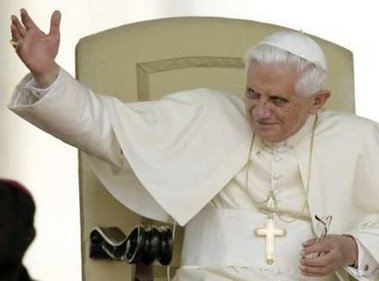
He seemed a little hoarse and looked flushed toward the end of the Audience.
From Ansa Italy:
The heat on Wednesday got to Pope Benedict XVI, who cut short his address to a packed St. Peter's Square because of the soaring temperatures .
"Because it's too hot, I would like to abbreviate," the 79-year-old pope said .
His words were applauded by the some 25,000 sun-baked pilgrims gathered in the piazza for the pontiff's midweek audience .
The German-born pope's short homily focused on St. James the apostle .
Benedict urged Christians to "be ready to follow Christ, even when he asks us to leave the boat of our human securities" .
"If we follow Christ as St. James did, then we know that even when we encounter difficulties, we are on the right road," the pope concluded .
Tuesday, June 20, 2006
1. Et cum Spiritu tuo..."And with your spirit"
From the New Testament texts... Galatians 6:18 "The grace of our Lord Jesus Christ be with your spirit, brethren. Amen" and 2 Timothy 4:22 "The Lord be with your spirit."
Fr. Joseph Jungman S. J. had two footnotes about the origin of this, one in which he called the phrase a Semitism that simply meant "and also with you" (which obviously is what the original ICEL translators focused on to arrive at the translation that we have been using over these past years). Yet another footnote alludes to the fact that this reply in the usage of the Church's liturgy was given only to a priest or bishop and that the implication was that the greeting was to the Holy Spirit that the ordained minister had received upon their ordination. St. John Chrysostom mentioned this in a homily and an early Council of the Church reinforced its meaning.
What saying "And With Your Spirit" can teach us...
The Liturgy is the work of the Holy Spirit, not the individual presider. In fact there is no "individuals" in the liturgy save the Body of Christ. Our response acknowledges the one Holy Spirit poured upon the presider and reminds us that the work we witness in this Eucharist is the Opus Dei...the work of God.
Fr. Joseph Jungman S. J. had two footnotes about the origin of this, one in which he called the phrase a Semitism that simply meant "and also with you" (which obviously is what the original ICEL translators focused on to arrive at the translation that we have been using over these past years). Yet another footnote alludes to the fact that this reply in the usage of the Church's liturgy was given only to a priest or bishop and that the implication was that the greeting was to the Holy Spirit that the ordained minister had received upon their ordination. St. John Chrysostom mentioned this in a homily and an early Council of the Church reinforced its meaning.
What saying "And With Your Spirit" can teach us...
The Liturgy is the work of the Holy Spirit, not the individual presider. In fact there is no "individuals" in the liturgy save the Body of Christ. Our response acknowledges the one Holy Spirit poured upon the presider and reminds us that the work we witness in this Eucharist is the Opus Dei...the work of God.
Friday, June 16, 2006
And with your Spirit...
Approved
Catechise your parish now...A New Translation of the Mass Prayers?
And it is about the Bible!!!
Catechise your parish now...A New Translation of the Mass Prayers?
And it is about the Bible!!!
Thursday, June 15, 2006
A Glimpse Inside the Conclave
From Cardinal Anthony Okogie of Lagos as reported in Catholic News:
Reminiscing on his first Conclave experience, the Cardinal said that if he was elected Pope he would have collapsed, explaining that to be elected Pope one must be able to speak more than four international languages.
"That place they call Conclave is a top secret place and I was going there for the first time, like many of the cardinals. I was filled with big awe. I felt as if I wasn't really in the world especially when they said 'everybody out of the room.'
"You will swear and after that they will read the rules and regulations and thereafter the ballot papers are distributed. There is no nomination," he explained.
Cardinal Okogie said that they were free to interact with anybody until the order is given for all that non-eligible electors to go out as the papers are distributed to the electors.
"I believe really that there is something supernatural about the Conclave," he said, wondering how everybody could be backing one particular individual but after the first ballot, that person's name would suddenly disappear.
Mass Revision not Massive Changes
What the bishops are voting on is a more accurate translation of the Mass. If you've attended Mass in Spanish you already know that the English translation isn't exactly the same.
Aren't people use to the current translation? Absolutely.
So why change? Because the translation we currently use isn't exact and doesn't match the Scripture from which it is taken.
Pray for the bishops.
Aren't people use to the current translation? Absolutely.
So why change? Because the translation we currently use isn't exact and doesn't match the Scripture from which it is taken.
Pray for the bishops.
Wednesday, June 14, 2006
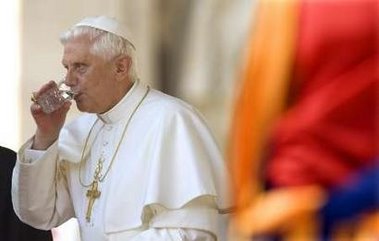
St. Andrew: Pope's Audience on a Hot Roman Day
From Asia News Italy:
Today, Benedict XVI drew a picture of the personality of the brother of Simon, Andrew, who was the “first-called”, and therefore he is known as the “Protoclete”. The Pope said: “It is certain that because of the brotherly relationship between Peter and Andrew, the Church of Rome and the Church of Constantinople feel, in a special way, like sisters.” He continued: “To highlight this relationship, my predecessor Pope Paul VI, in 1964, restored the relics of St Andrew, which until then had been kept in the Vatican Basilica, to the Orthodox Metropolitan Bishop of the city of Patrasso in Greece, where according to tradition, the apostle was crucified.
The Pope did not talk merely about Andrew’s role as evangelizer of the Greek world; he also drew attention to his attitude when faced with the Cross on which he was to die. Tradition has it that Andrew defined the Cross as “blessed” because it was taking him to Jesus: an attitude that invites the faithful “to consider and to welcome” evils that strike us, “our crosses… as part of the cross of Christ”.
After recalling that the Gospels mention Andrew several times, showing him to be an eminent figure among the Twelve, the Pope added: “Very ancient traditions see Andrew not only as the interpreter of some Greeks meeting Jesus, they consider him as the Apostle of the Greeks in the years following Pentecost; they inform us that for the rest of his life, he proclaimed Jesus to the Greek world. Peter from Jerusalem reached Rome through Antioch to exercise his universal mission; Andrew, meanwhile, was the apostle of the Greek world: thus they appear in life and in death as true brothers – a brotherhood that is symbolically expressed in the special ties of the Sees of Rome and Constantinople, truly sister Churches”.
Benedict XVI also recalled the tradition of the death of Andrew at Patrasso, “where he too was submitted to the torment of crucifixion. At that supreme moment, however, like his brother Peter, he asked to be put on a cross different to that of Jesus. In his case, it was a saltire, x-shaped, tilted cross, that would become known as the ‘cross of St Andrew’. This is what the Apostle is said to have uttered on that occasion, according to an ancient narrative (from the early sixth century) entitled the Passion of Andrew: ‘Hail, O Cross that has been sanctified by the body of Christ, and adorned with his limbs as with precious stones! Before the Lord was nailed to you, you inspired fear on earth, but now you inspire heavenly love, and are desired as a blessing. Believers know how much joy you possess, how many gifts you have prepared. Thus I come to you assured and joy-filled, so that you may graciously receive me, the disciple of Him who hung upon you; O most beautiful cross that received majesty and beauty by carrying the body of Christ!... Take me, o cross, release me from my life among men and bring me to the Master so that through you he will receive me, he, who through you has saved me. Hail o Cross, yes hail!’” Evident here, continued Benedict XVI, is a very profound Christian spirituality, which considers the Cross not so much an instrument of torture as an incomparable means of full assimilation with the Redeemer. We must learn a very important lesson from this: our crosses acquire value if they are considered and welcomed as part of the cross of Christ, if they are touched by the reflection of his light. It is only through that Cross that our sufferings too are made noble and acquire their true meaning. The apostle Andrew, then, teaches us to follow Jesus promptly (cfr Mt 4:20; Mk 1:18), to speak to Him enthusiastically when we meet, and especially to cultivate a relationship of genuine familiarity with him, well aware that only in Him, we find the ultimate sense of our life and death.”
Monday, June 12, 2006
The Parish of My Baptism, First Communion and Confirmation
To be merged which I thought this had already happened, does this really mean close?
Catholic diocese announces parish changes
From the Manchester Union Leader:
Catholic diocese announces parish changes
From the Manchester Union Leader:
The St. Joseph Parish in Hinsdale will merge with the St. Stanislaus Parish in Winchester. The new parish, which will be known as "Mary, Queen of Peace," will share a pastor with the St. Bernard Parish in Keene.
Sunday, June 11, 2006
Did He Challenge Them The Way Jesus Challenged?
Being with sinners and outcasts definitely is what Jesus did, but he brought them a life giving message that changed them forever--that seems to be what's missing here:
Ousted Newton priest cheered at gay pride service
Ousted Newton priest cheered at gay pride service
``I told a friend of mine, about a month ago, that I was going to be here today, speaking at the gay pride interfaith service, and she said to me, `What's a Catholic priest doing at a gay pride service?' Cuenin said. ``My response was, `Why wouldn't a Catholic priest be here?' In the tradition of my own Christian faith, it seems to me, as I read it, that Jesus was always with those who were often the target of hatred and persecution."
Trinity Sunday-Pope's Angelus
From Asia News Italy:
This Sunday, dedicated to the most Holy Trinity, Benedict XVI addressed 40,000 people who came to St Peter’s Square to pray the Angelus. He stressed how “thanks to the Holy Spirit, who leads to understanding of the words of Jesus and guides one into all the truth (cfr Jn 14:26; 16:13), believers may know, so to speak, the intimacy of God himself, discovering that He is not infinite solitude but communion of light and love, life given and received in an eternal dialogue between Father and Son in the Holy Spirit – Lover, Loved One, and Love, to echo St Augustine.”
And although men cannot see him now, “the entire universe, for those who have faith, speaks of the One and Triune God. From the stellar systems to the microscopic particles, all that exists goes back to a Being who communicates through a multiplicity and variety of elements, like an immense symphony”, in which “all beings are arranged according to a harmonic dynamism that we can analogically call ‘love’. But it is only in the human being – free and endowed with reason – that this dynamism becomes spiritual; it becomes responsible love as a response to God and neighbour in a sincere giving of self. In this love, the human being finds his truth and happiness. Among the many analogies of the ineffable mystery of the One and Triune God that believers are capable of discerning, I wish to cite the family. This is called to be a community of love and life, in which diversities must come together to form a ‘parable of communion’.
Saturday, June 10, 2006
Tropical Storm Alberto Expected This Weekend
It's a Tropical Depression right now....
For all things tropical....
The Mega Weather Blog
and the
Sun Sentinel of Ft. Lauderdale that I think has the best tropical storm coverage outside of the blog listed above online.
For all things tropical....
The Mega Weather Blog
and the
Sun Sentinel of Ft. Lauderdale that I think has the best tropical storm coverage outside of the blog listed above online.
Friday, June 9, 2006

Huh?
Catholic Bishop William Skylstad said Thursday that his own investigation found no evidence to support a woman's claim that he sexually abused her 40 years ago.
His own investigation? How could anyone put that out with a straight face?
His own investigation? How could anyone put that out with a straight face?
Thursday, June 8, 2006
Fr. Benedict on Venerable Solanus Casey
An Interesting Visitor, in the one sentence where Fr. Benedict references recently visiting St. Felix Friary where he once witnessed Solanus in ecstasy--I was with him, in fact drove him there. It was a blessed event as he would stop and recount his experiences of this future saint(I pray) of the Church.
Expect a Clarification from Cardinal McCarrick
McCarrick: Same-Sex Civil Unions Acceptable, But Not Marriage
I think it is the term "union" that should be unacceptable to a Catholic, not the "rights" issues.
I think it is the term "union" that should be unacceptable to a Catholic, not the "rights" issues.
New Bishop of Raleigh, New Auxiliary for Philly
The Holy Father has:
Appointed Bishop Michael Francis Burbidge, auxiliary of Philadelphia, U.S.A., as bishop of Raleigh, (area 82,524, population 4,073,983, Catholics 188,101, priests 138, permanent deacons 37, religious 118), U.S.A. He succeeds Bishop Francis Joseph Gossman, whose resignation from the pastoral care of the same diocese, the Holy Father accepted, upon having reached the age limit.
Appointed Msgr. Daniel E. Thomas of the clergy of the archdiocese of Philadelphia, U.S.A., pastor of the parish of Our Lady of the Assumption, as auxiliary of the same archdiocese (area 5,652, population 3,875,021, Catholics 1,479,895, priests 1,048, permanent deacons 224, religious 3,733). The bishop-elect was born in Philadelphia in 1959 and ordained a priest in 1985.
Appointed Bishop Michael Francis Burbidge, auxiliary of Philadelphia, U.S.A., as bishop of Raleigh, (area 82,524, population 4,073,983, Catholics 188,101, priests 138, permanent deacons 37, religious 118), U.S.A. He succeeds Bishop Francis Joseph Gossman, whose resignation from the pastoral care of the same diocese, the Holy Father accepted, upon having reached the age limit.
Appointed Msgr. Daniel E. Thomas of the clergy of the archdiocese of Philadelphia, U.S.A., pastor of the parish of Our Lady of the Assumption, as auxiliary of the same archdiocese (area 5,652, population 3,875,021, Catholics 1,479,895, priests 1,048, permanent deacons 224, religious 3,733). The bishop-elect was born in Philadelphia in 1959 and ordained a priest in 1985.
Wednesday, June 7, 2006
Jesus Only Changed the Name of One

Simon bar Jonah, from the weekly audience:
Jesus did not usually change the names of his disciples”, in fact, “He never gave a new name to any of his disciples. However he did so with Simon, and that name, translated in Greek as Petros, would crop up several times in the Gospels and would end up by replacing his original name. This fact takes on particular significance when one recalls that in the Old Testament, changing a name was usually a prelude to entrusting one with a mission (cfr Jn 17:5; 32:28ff). In fact, the intention of Christ to attribute special importance to Peter within the Apostolic College emerges in many instances: in Capernaum, the Teacher went to lodge in Peter’s house (Mk 1:29); when the crowd flocked to the banks of the lake of Gennesaret, Jesus chose Peter’s boat from the two moored there (Lk 5:3); when in particular circumstances, Jesus took three disciples to accompany him, only Peter is always recalled as the first of the group: the same happened in the resurrection of the daughter of Jairus (cfr Mk 5:37; Lk 8:51); in the Transfiguration (cfr Mk 9:2; Mt 17:1; Lk 9:28), during the agony in the Garden of Gethsemane (cfr Mk 14:33; Mt 16:37). And again: it was Peter who was approached by the tax collectors at the Temple and the Teacher paid for himself and for Peter alone (cfr Mt 17: 24-27); it was Peter whose feet He washed first at the Last Supper (cfr Jn 13:6) and it was only for him that He prayed so that his faith would not fail and that he may in turn strengthen his brothers (cfr Lk 22: 30-31)”.
“Peter himself is, after all, aware of his unique position: it is he who often, in the name also of the rest, speaks out, asking for an explanation for some difficult parable (Mt 15:15) or the exact meaning of a precept (Mt 18:21) or the formal promise of reward (Mt 19:27).”
Tuesday, June 6, 2006
Three New Auxilary Bishops for Brooklyn
Monsignor Octavio Cisneros, Monsignor Guy Sansaricq, and Monsignor Frank J. Caggiano.
Monday, June 5, 2006
Subscribe to:
Comments (Atom)