From Corpus Christi Parish:
FOR VIOLATIONS TO THE DIGNITY OF THE HUMAN PERSON COMMITTED THROUGH ACTS OF ABORTION AND A DAY OF PRAYER FOR THE FULL RESTORATION OF THE LEGAL GUARANTEE OF THE RIGHT TO LIFE.
FOR VIOLATIONS TO THE DIGNITY OF THE HUMAN PERSON COMMITTED THROUGH ACTS OF ABORTION AND A DAY OF PRAYER FOR THE FULL RESTORATION OF THE LEGAL GUARANTEE OF THE RIGHT TO LIFE.
The Holy Father then highlighted how this requires, "together with human maturity and close adherence to revealed truth, which the Magisterium of the Church faithfully reflects, a serious commitment to personal sanctity and the exercise of virtue, especially humility and charity. It is also necessary to nurture communion with the various elements of the People of God, so that everyone may have a growing awareness of belonging to the one Body of Christ."
"That all this may happen, I invite you to keep your gaze fixed on Christ. ... The more you remain in communion with Him, the more able you will be faithfully to follow His footsteps so that, 'love which binds every thing together in perfect harmony,' brings your love for the Lord to maturity under the guidance of the Holy Spirit."
Vatican sources said that tensions had been exacerbated because the Pope had written the first part of the encyclical in German during his summer break and the second part was an adaptation of a document left behind in Polish by the late John Paul II. It had been passed to Vatican specialists for further revision but remained unfinished at the time of John Paul’s death ten months ago. The two parts had had to be “harmonised”.
The Pope, responding to growing speculation about the delay, told pilgrims at his weekly audience yesterday that the release of the text, originally planned for early December, had been delayed until next Wednesday.
"The delay in similar operations happening in America has not been because of failure to break through your security measures. But the operations are happening in Baghdad and you will see them here at home the minute they are through (with preparations), with God's permission," he said.

The renovation, the workman related, was long overdue. The architects said they were surprised at the poor state of the apartment.
For one thing, the electrical system was not up to code. Some rooms still used old 125-volt electrical outlets, which were phased out years ago in Italy in favor of 220 volts. The water pipes were encrusted with rust and lime, and the heating system was approximate at best.
Above the false ceiling, workers discovered big drums placed strategically to catch the leaks from the roof; some were nearly full of water.
The makeover included renovation of the medical studio, which is said to include emergency surgery and dentistry equipment. The papal bedroom, situated at the corner of the building, was completely redone, and most of the rooms were freshly wallpapered.
The new kitchen was reportedly outfitted by a German company, with state-of-the-art ovens, ranges and other appliances.
Those who frequented the papal apartment under Pope John Paul II have no doubt that the place needed an overhaul. Polish film director Krzysztof Zanussi, a friend of the late pope, once said he was astonished at the gloominess of the place, with its outmoded furnishings and lack of lighting.
The city's Roman Catholic bishop, who will celebrate 25 years in that post on Friday, has asked the Vatican to consider appointing his replacement.
Bishop Anthony Pilla declined to reveal the reasons for his retirement request, saying a letter he had written to the Vatican was private.
The date of his retirement is at the discretion of the Vatican, said Pilla, who is awaiting a response from Pope Benedict XVI and his staff
The Seventh Trumpet Mass is an additional way you can actively and powerfully promote and encourage priestly vocations. Msgr. Anthony Frontiero and Fr. Jason Jalbert from the Office of Vocations are excited to offer you this initiative which will draw together Catholic men, women, and children from all parts of New Hampshire to pray for vocations to the priesthood. Just imagine the blessings that will come from 1,000 people worshipping and praying to the Lord for an increase in priestly vocations! All we are asking is that for one Sunday a month 1,000 Heralds commit to the Seventh Trumpet Mass at St. Joseph Cathedral in Manchester which will be followed by one half hour of silent Adoration. This monthly program will begin on Epiphany Sunday, January 8 , 2006, at 3pm and will end at 4:30pm. We are confident that the Seventh Trumpet Mass and the prayers of each individual Herald will as St Paul says, “accomplish far more than we ask or imagine, by the power at work within us, to Him be glory in the church and in Christ Jesus to all generations, forever and ever.” Amen.
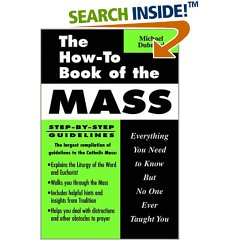 The How-To Book of the Mass: Everything You Need to Know but No One Ever Taught You
“Terrorism, nihilism and fanatical fundamentalism -- faced with these threats, it becomes more than necessary to work together for peace,” the Pope said.
“There is the need for a leap of courage and faith in God and mankind to choose the path to peace.”
Tropical Storm Zeta tied a record for the latest developing named storm when it formed Friday in the open ocean, another surprising turn in an already-infamous 2005 Atlantic hurricane season.
Although the National Hurricane Center said Zeta wasn't forecast to become a hurricane or threaten land, Zeta's development was significant because it came a month after the official Nov. 30 end to the busy season.
Similar to its take on the controversial "Da Vinci Code," ABC News "Primetime" gives credence to the claim that a woman disguised as a man served as pope in medieval Rome.
Titled "On the Trail of Pope Joan," an ABC promo says, "Diane Sawyer takes you on the trail of a passionate mystery. Just as intriguing as 'The Da Vinci Code.' Chasing down centuries-old clues hidden even inside the Vatican. Could a woman disguised as a man have been pope? Thursday night. One astonishing Primetime."
Why are you afraid, Herod, when you hear of the birth of a king? He does not come to drive you out, but to conquer the devil. But because you do not understand this you are disturbed and in a rage, and to destroy one child whom you seek, you show your cruelty in the death of so many children.
You are not restrained by the love of weeping mothers or fathers mourning the deaths of their sons, nor by the cries and sobs of the children. You destroy those who are tiny in body because fear is destroying your heart. You imagine that if you accomplish your desire you can prolong your own life, though you are seeking to kill Life himself.
Yet your throne is threatened by the source of grace, so small, yet so great, who is lying in the manger. He is using you, all unaware of it, to work out his own purposes freeing souls from captivity to the devil. He has taken up the sons of the enemy into the ranks of God?s adopted children.
If you?re interested in reading a blog with excellent and informative combox discussions, go to Open Book (amywelborn.typepad.com/openbook), the blog of author Amy Welborn. Along with Welborn?s incisive analysis, you?ll find worthwhile perspectives from scores of commentators ? Catholic writers, clergy and ordinary laypersons who are devoted to the Church and well-versed in its teachings.
To speak about St Stephen's martyrdom in the joyful atmosphere of Christmas is not out of place. Indeed, the cross already cast its shadow on the manger in Bethlehem. This was foretold by the poor stable where the Child wailed, by the prophecy of Simeon on the sign of contradiction and the sword that would pierce the Virgin?s soul, and by Herod?s persecution which made the flight to Egypt necessary.
It is not surprising that upon reaching adult age the Child should call on his disciples to follow him on the path of the Cross with total trust and faithfulness.
Drawn by His example and sustained by His love, many Christians from the dawn of the Church bore witness to their faith with their blood. Others have followed the first martyrs across the centuries until now.
How not to see that, even in our times and in various parts of the world, being Christian requires a martyr's heroism? How not to recognise that everywhere, even where there is no persecution, living the Gospel coherently carries a high price.?
Contemplating the divine Child in Mary?s arms and looking at the example of St Stephen, let us ask God to grant us the grace of living our faith coherently, always ready to give an explanation to anyone who asks us for a reason for our hope (cf 1 Pt, 3: 15).

"Papal spokesman Joaquin Navarro-Valls told the ANSA and Apcom news agencies that the encyclical will carry the date of Dec. 25, 2005. It will be called 'Deus, Caritas Est,' and will have the Italian title of 'Dio E' Amore,' ('God is Love'), according to Apcom and other Italian news reports.
'The decision to make it public in January is due to the fact that the pope will release important documents over this period,' Navarro-Valls was quoted as saying by Apcom."
That which was from the beginning, which we have heard, which we have seen with our eyes, which we have looked upon and touched with our hands, concerning the word of life -- the life was made manifest, and we saw it, and testify to it, and proclaim to you the eternal life which was with the Father and was made manifest to us --that which we have seen and heard we proclaim also to you, so that you may have fellowship with us; and our fellowship is with the Father and with his Son Jesus Christ.
This is the message we have heard from him and proclaim to you, that God is light and in him is no darkness at all. If we say we have fellowship with him while we walk in darkness, we lie and do not live according to the truth; but if we walk in the light, as he is in the light, we have fellowship with one another, and the blood of Jesus his Son cleanses us from all sin. If we say we have no sin, we deceive ourselves, and the truth is not in us. If we confess our sins, he is faithful and just, and will forgive our sins and cleanse us from all unrighteousness. If we say we have not sinned, we make him a liar, and his word is not in us.
Yet I am writing you a new commandment, which is true in him and in you, because the darkness is passing away and the true light is already shining. He who says he is in the light and hates his brother is in the darkness still. He who loves his brother abides in the light, and in it there is no cause for stumbling. But he who hates his brother is in the darkness and walks in the darkness, and does not know where he is going, because the darkness has blinded his eyes. I am writing to you, little children, because your sins are forgiven for his sake.
Brother Roger's message was centered on the phrase "God is love" from the First Letter of John. The same phrase is the theme of Pope Benedict XVI's first encyclical, which is expected to be issued soon.
Brother Roger said "God is love" was a dazzling spiritual intuition.


Lord Jesus, I see myself as a weak little bird, with only a light down covering. I am not an eagle, but I have an eagle's eyes and heart. In spite of my littleness, I dare to gaze upon the Divine Sun, the Sun of Love, and my heart soars like an eagle to fly toward You.
Flapping my small wings, I seek to fly toward the Sun, climbing upwards toward the Divine Furnace of the Holy Trinity. What shall I do, with such small wings?
I shall not be troubled. With bold surrender and cheerful confidence I shall continue gazing upon the Divine Sun. Nothing will frighten me-not the wind nor the rain, nor even dark couds. For I know that beyond any clouds is Your light, and Your Brightness will not be eclipsed for even a single instant.
When tired or hungry or overcome by the burdens of life, I do not hide amid storms, but turn toward the beloved Sun, presenting my helpless wings to Your beneficent rays. I shall gaze at the Sun, until I die. I delight in feeling small and helpless in Your Presence, for my heart is at peace. (Adapted from Story of a Soul)
Pope Benedict XVI has appointed Reverend David R. Choby as the eleventh Bishop of Nashville. Rev. Choby will be ordained a bishop and installed as the eleventh Bishop of Nashville at the Cathedral of the Incarnation at a time to be announced later.
Father Choby, 58, is a native of Nashville and is currently serving as the Administrator of the Diocese of Nashville and pastor of St. John Vianney Parish in Gallatin.
As bishop, he will lead a diocese of approximately 75,000 Catholics in 51 parishes and 3 missions. The Diocese of Nashville includes 38 counties in Middle Tennessee.
“I am truly honored and humbled by this appointment,” Rev. Choby said. “I will do my best to respond to the confidence that Pope Benedict places in me.”
"I Jesus have sent my angel to you with this testimony for the churches. I am the root and the offspring of David, the bright morning star,"
The Spirit and the Bride say, "Come." And let him who hears say, "Come." And let him who is thirsty come, let him who desires take the water of life without price.
Behold, the Lord, the LORD of hosts will lop the boughs with terrifying power; the great in height will be hewn down, and the lofty will be brought low. He will cut down the thickets of the forest with an axe, and Lebanon with its majestic trees will fall. There shall come forth a shoot from the stump of Jesse, and a branch shall grow out of his roots. And the Spirit of the LORD shall rest upon him, the spirit of wisdom and understanding, the spirit of counsel and might, the spirit of knowledge and the fear of the LORD.
"Where is he who has been born king of the Jews? For we have seen his star in the East, and have come to worship him."
I would like today to turn my attention to the figure of St Joseph. In today?s gospel pages, St Luke presents the Virgin Mary as ?engaged to a man whose name was Joseph, of the house of David? (Lk 1:27). However it is the evangelist Matthew who gives the greatest prominence to the putative father of Jesus, pointing out that, through him, the Child was legally inserted in David?s line and thus he realized the Scriptures, in which the Messiah was prophesied as the ?son of David?. But Joseph?s role certainly cannot be reduced to this aspect. He is the model of the ?just? man (Mt 1:19), who in perfect sympathy with his spouse, welcomes the Son of God made man and guards over his human growth. For this reason, the days leading up to Christmas are as good a time as ever to establish a sort of spiritual conversation with St Joseph, because he helps us to live to the full this great mystery of faith.
The beloved Pope John Paul II, who was very devoted to St Joseph, left us an awesome meditation dedicated to him in the Apostolic Exhortation Redemptoris Custos, "Guardian of the Redeemer". Among the many aspects it highlights, particular emphasis is placed on the silence of St Joseph. His is a silence permeated by contemplation of the mystery of God, in an attitude of total availability to his divine wishes. In other words, the silence of St Joseph was not the sign of an inner void, but on the contrary, of the fullness of faith he carried in his heart, and which guided each and every one of his thoughts and actions...
...Let us allow ourselves to be ?infected? by the silence of St Joseph! We have much need of it in a world which is often too noisy, which does not encourage reflection and listening to the voice of God. In this time of preparation for Christmas, let us cultivate interior meditation to welcome and watch over Jesus in our lives.
The Holy Father:
- Accepted the resignation from the office of auxiliary of the archdiocese of San Antonio, U.S.A., presented by Bishop Thomas J. Flanagan, upon having reached the age limit.
- Appointed Bishop George Hugh Niederauer, bishop of Salt Lake City, as metropolitan archbishop of San Francisco (area 2,620, population 1,744,050, Catholics 425,210, priests 425, permanent deacons 62, religious 1,004), U.S.A. The archbishop-elect was born in Los Angeles, U.S.A. in 1936, he was ordained a priest in 1962 and consecrated a bishop in 1995.
Appointed Fr. Alexander King Sample of the clergy of Marquette, U.S.A., diocesan chancellor, as bishop of the same diocese (area 42,152, population 317,616, Catholics 68,360, priests 100, permanent deacons 28, religious 70). The bishop-elect was born in Kalispell, U.S.A. in 1960 and ordained as a priest in 1990. He succeeds Bishop James Henry Garland, whose resignation from the pastoral care of the same diocese, the Holy Father accepted, in accordance with canon 401 para. 2 of the Code of Canon Law.
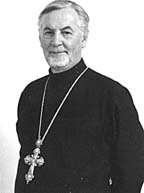
Nowadays, expecially in the U.S., the Church is perceived as an enterprise, an activity. The priest constantly harasses people to do something for the Church. And their activism is measured by quantitative criteria: how many meetings, how much money, how much "doing." I'm not sure it is all necessary. What is dangerous is not activity itself, but the reduction of the Church, the identification of this activity with life in the Church. The idea of the Church, the sacramental principle of its life, lies in taking us away from activity ("let us put aside all earthly cares"), in making us commune with a new life, eternity, the Kingdom. And the idea of the Church, the principle of its life also demands that we would bring into the world this experience of a new life so that we would purify this world, illumine it with the non-worldliness of the experience of the Church. Quite often the opposite happens: we bring activity into the Church, the fuss of this world, and submit the Church, poison its life with incessant fuss. What happens is not that life becomes the Church, but the Church becomes worldly.

"The image of the beloved Virgin of Guadalupe has moved from the solemn walls of Catholic churches and onto the stylish hips of fashionistas like Priscila Ferrand.
The Mexican version of the Virgin Mary is on the Scottsdale nurse's $300 belt, threaded through her low-rise jeans. Her dark-skinned face shines on a silver buckle surrounded by green stones.
For almost five centuries, since her legendary appearance to a peasant Aztec atop a Mexican mountain, she has been the religious icon of the devout. Today, la Virgen de Guadalupe is also a pop icon. "
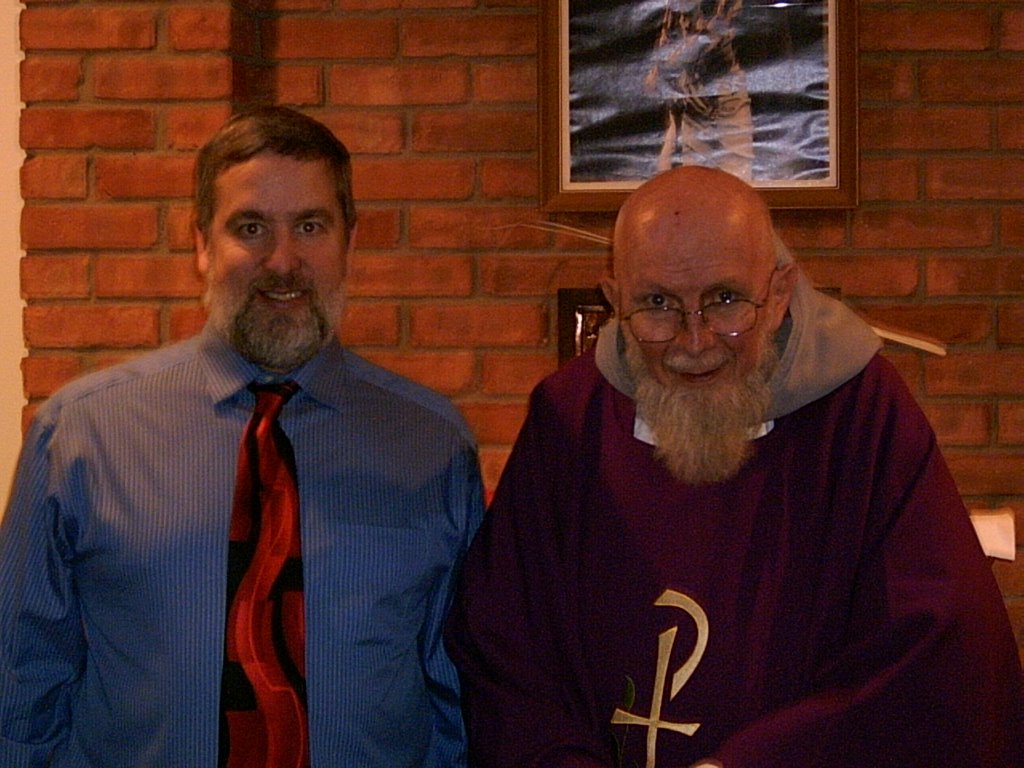
After having celebrated the feast of Mary’s Immaculate Conception, we enter these days into the striking climate of preparation for the Holy Christmas. In today’s consumeristic society, alas, this period has undergone a sort of commercial “pollution”, which threatens to change its authentic spirit, characterised by meditation, by sobriety, and by an intimate rather than external joy. And so it is providential that, almost like an entrance to Christmas, there is the feast of She who is the Mother of Jesus, and who can lead us to know, love and adore the Son of God made man better than anyone else can. Let us then allow Her to accompany us; let her sentiments animate us, so that we will prepare ourselves with sincerity of heart and openness of spirit to recognise the Son of God in the Child in Bethlehem, who came to earth for our redemption. Let us walk together with Her in prayer, and welcome the oft-repeated invitation which the Advent Liturgy extends to us, to be in waiting, a watchful and joyful waiting because the Lord will not delay: He comes to free his people from sin.
In many families, following a beautiful and consolidated tradition, the preparation of the Crib follows soon after the feast of the Immaculate Conception, as though to relive together with Mary these days full of trepidation which preceded the birth of Jesus. Making the Crib at home can turn out to be a simple but effective way of presenting the faith to transmit it to one’s children. The Crib helps us to contemplate the mystery of God’s love which revealed itself in the poverty and simplicity of the grotto in Bethlehem. St Francis of Assisi was so taken by the mystery of the Incarnation that he wanted to present it once again in the living Crib in Greccio, becoming thus the man who started the long popular tradition which still today conserves its value for evangelization. The Crib may in fact help us to understand the secret of the true Christmas, because it talks about the humility and merciful goodness of Christ, who “although he was rich, became poor” (2 Cor 8,9) for us. His poverty enriches those who embrace it and Christmas brings joy and peace for all those who, like the shepherds in Bethlehem, welcome the words of the gospel: “This will be a sign for you: you will find a child wrapped in bands of cloth and lying in a manger” (Lk 2:12). This remains the sign, for us too, men and women of 2000. There is no other Christmas.
As the beloved John Paul II used to do, soon I too will bless the statues of the Baby Jesus which the children of Rome will put in the Crib in their homes. With this gesture, I want to invoke the Lord’s help so that all Christian families will prepare to celebrate the upcoming Christmas festivities with faith. Mary helps us to enter into the true spirit of Christmas.

Secular life is a life frantically dedicated to escape, through novelty and variety, from the fear of death. But the more we cherish secular hopes, the more they disappoint us. And the more they disappoint us, the more desparately do we return to the attack and forge new hopes more extravagant than the last. These too let us down. And we revert to the insufferable condition from which we have vainly tried to escape...
...In the sacred society, on the other hand, man admits no dependence on anything lower than himself, or even "outside" himself in a spacial sense. His only Master is God. Only when God is our Master can we be free, for God is within ourselves as well as above us. He rules us by liberating us and raising us to union with Himself from within. And in so doing He liberates us from our dependence on created things outside of us.
The only certain big thing on the horizon is the pope's first encyclical, a 46-page meditation titled "Deus Caritas Est" ("God Is Love"), which takes its inspiration from the first letter of St. John. It will be published in early December.
News about the encyclical's content, first reported by Catholic News Service in October, was one of the few tidbits to filter out of the Apostolic Palace in recent weeks. That, too, marks a change.
"We used to joke around here that 'pontifical secret' meant everyone knows except the pope. But under this pope, no one knows anything.
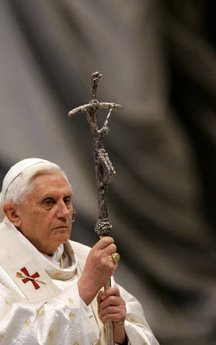
Forty years ago, on 8 December 1965, here in the Basilica of St Peter, Pope Paul VI solemnly brought to a close the Second Vatican Council. It had been inaugurated by the wish of John XXIII on 11 October 1962, then the feast of the Motherhood of Mary, and it ended on the day of the Immaculate Conception. A
Marian framework surrounds the Council. In reality, it is much more than a framework: it is a direction for its entire journey. It sends us back, as it sent the Council Fathers then, to the image of the Virgin who listens, who lives the Word of God, who preserves in her heart the words coming from God, and joining them together in a mosaic, learns to understand them (cfr Lc 2,19.51); it sends us back to the great Believer who, full of faith, placed herself in God’s hands, abandoning herself to His will; it sends us back to the humble Mother who, when the Son’s mission so required, put herself aside and at the same time, to the courageous woman who, when the disciples fled, stayed besides the cross. Paul VI, in his address for the occasion of the promulgation of the Conciliar Constitution on the Church, had described Mary as "tutrix huius Concilii" - "protectress of this Council" (cfr Oecumenicum Concilium Vaticanum II, Constitutiones Decreta Declarationes, Vatican City 1966, pag. 983) and, with an unmistakable allusion to the account of Pentecost handed down by Luke (At 1,12-14), he had said the Fathers were gathered in the Council hall "cum Maria, Matre Iesu" and they would leave it also thus, in her name (pag. 985).
There is a moment fixed indelibly in my mind, when on hearing his words, "Mariam Sanctissimam declaramus Matrem Ecclesiae" - "let us declare Mary the Most Holy Mother of the Church”, the Fathers leapt out of their chairs and stood applauding, paying homage to the Mother of God, our Mother, the Mother of the Church. In fact, it is with this title that the Pope summed up the Marian doctrine of the Council and gave the key for its understanding. Mary does not just have a unique relationship with Christ, the Son of God who, as man, wanted to become her son. Being totally united to Christ, she belongs also totally to us. Yes, we can say Mary is closer to us than any other human being, because Christ is man for mankind and all his being is a “being for us”. Christ, said the Fathers, as Head is inseparable from his Body that is the Church, making a sole living subject together with it, so to speak. The Mother of the Head is also the Mother of all the Church; she is, so to speak, totally expropriated from herself; she gave herself entirely to Christ and with Him she is given as a gift to all of us. In fact, the more a human being gives of himself, the more he finds himself.
The Council intended to say this: Mary is so interwoven in the great mystery of the Church, that she and the Church are inseparable just as she and Christ are.
Mary reflects the Church, she prefigures it in her person and, in all the turbulences which afflict the suffering and toiling church, she remains always the star of salvation. It is she who is the true centre in which we trust, even if often the periphery [of the church] weighs on our soul. Pope Paul VI, in the context of the promulgation of the Constitution of the Church, highlighted all this through a new title which is deeply rooted in Tradition, precisely with the intention of illuminating the interior structure of Church teaching developed in the Council. Vatican II was meant to express itself on the Church’s institutional components: the bishops and the Pope, the priests, lay people and religious in their communion and in their relationships; it was meant to describe the pilgrim Church, “the Church, embracing in its bosom sinners, at the same time holy and always in need of being purified…” (Lumen gentium, 8). But this “Petrine” aspect of the Church is included in the “Marian” one. In Mary, the Immaculate, we meet the essence of the Church in a way which is not deformed. From her, we must learn to become “church souls” too, as the Fathers expressed themselves, to be able to come as “immaculate” in the presence of the Lord, according to the word of St Paul, as He has wanted us to be from the beginning (Col 1,21; Ef 1,4).
But now we must ask ourselves: What does “Mary the Immaculate Conception” mean? Does this title have something to tell us? Today’s liturgy clarifies the content of this word for us with two great images. There is first of all the marvelous account of the annunciation to Mary, the Virgin of Nazareth, about the coming of the Messiah. The Angel’s greeting is woven by threads from the Old Testament, especially from the prophet Sophoniah. This shows that Mary, the humble provincial woman who came from a priestly lineage and carried in her the great priestly patrimony of Israel, is “the sacred remains” of Israel to which the prophets, in all the times of torment and shadows, had referred. In her, the true Zion is present, the pure, living dwelling of God. The Lord dwells in her; in her he finds the place of his rest. She is the living dwelling of God, who does not live in stone buildings but in the heart of the living man. She is the branch which, in the dark winter night of history, comes forth from the trunk felled by David. In her the words of the Psalm are fulfilled: “The earth will yield its fruit” (67:7). She is the sapling from which the tree of redemption and the redeemed comes. God did not fail, as may have appeared already from the beginning of history with Adam and Eve, or during the period of the Babylonian exile, and as appeared once again in the time of Mary, when Israel had become a people without importance in an occupied region, with very few recognizable signs of its holiness. God did not fail. In the humility of the house of Nazareth, the holy Israel lives, the pure remains. God saved His people. From the felled trunk comes blazing forth his history once again, becoming a new living force which directs and pervades the world. Mary is the holy Israel; she says “yes” to the Lord, she puts herself fully at his disposal and becomes thus the living temple of God.
The second image is much more difficult and obscure. This metaphor taken from the Book of Genesis comes to us from a distant time in history and it is only with an effort that it can become clear; only in the course of history has it been possible to develop a deeper understanding of its relevance and meaning. It is prophesied that throughout all history, the struggle between man and the serpent, that is, between man and the forces of evil and death, will continue.
However, there is also the announcement that the “lineage” of a woman will win over and crush the serpents’ head to death; it is prophesied that the lineage of the woman – and the woman and mother herself – will win and that thus, through man, God will triumph. If together with the believing and praying Church, we hearken to this text, we will be able to begin to understand the meaning of original sin, hereditary sin and even what salvation from this hereditary sin is, what redemption is.
What is the picture placed before us in this page? Man did not trust God. He harboured the suspect that God, at the end of the day, was taking something from his life, that God was a competitor who limits our freedom and that we will be fully human only when we have put him aside; all in all, that only in this way can we fully realize our freedom. Man lives in the suspicion that the love of God creates a dependency and that it is necessary to get rid of this dependency to be fully oneself. Man does not want to receive his existence and fullness of life from God. He wants to be the one to draw from the tree of knowledge the power to mould the world, to make himself god, raising himself to His level, and to win over death and darkness. He does not want to count on love which does not seem trustworthy to him; he counts only on knowledge in that it confers power upon him. Rather than love, he aims for power with which he wants to take his own life in his hands, to be autonomous. And in doing so, he places his trust in deceit rather than in truth and thus, he sinks with his life into a void, into death. Love is not dependence but a gift which gives us life. The freedom of mankind is the freedom to be a creature with limitations and that is therefore a limitation in itself. We can possess it only as a shared freedom, in the communion of freedom; only if we live in the right way with each other and for each other can freedom develop. However, we live in the right way if we live according to the truth of our being and that is, according to the will of God. For God’s will for man is not a law imposed from outside which forces him, but an intrinsic measure of his nature, a measure which is inscribed in him, making him in the image of God, therefore a free creature. If we live against love and against truth – against God – then we destroy each other and we destroy the world. Then we will no longer find life, but we will serve the interests of death. All this is narrated with immortal images in the story of original sin and the banishment of man from the earthly Paradise.
Dear brothers and sisters! If we reflect sincerely about ourselves and our history, we must say that this account describes not only the beginning of history but history throughout the ages, and that we all carry inside us a drop of poison of that way of thinking illustrated in the images of the Book of Genesis. This drop of poison is called original sin. Even on the feast of the Immaculate Conception, the suspect emerges in us that a person who does not sin at all is really boring; that something is missing in his life: the dramatic dimension of being autonomous; that the freedom to say no is part of truly being men, the descent into the darkness of sin and to do as one pleases; that only then will one be able to exploit completely the vastness and depth of being men, of being truly ourselves; that we must put this liberty to the test even against God to become in reality fully ourselves. In a word, we think that really evil is good, at least a little, we need to experiment the fullness of being. We think that Mephistocles – the tempter – was right when he said he was the strength “which always wants evil and always does good” (J.W. v. Goethe, Faust I, 3). We think that bargaining a little with evil, reserving some freedom against God, is good, perhaps even necessary.
However, looking at the world around us, we can see it is not like this, that evil always poisons, it does not elevate man, it degrades and humiliates him, it does not make him bigger, more pure or rich; it damages him and makes him smaller. Rather, we must learn this on the day of the Immaculate Conception: the man who abandons himself completely in the hands of God does not become God’s puppet, an annoying, conscientious person; he does not lose his freedom. Only the man who entrusts himself totally to God finds true freedom, the great and creative vastness of the freedom of good. The man who turns towards God does not become smaller, but bigger, because thanks to God and together with Him, he becomes large, divine, he becomes truly himself. The man who puts himself in God’s hands does not distance himself from others, withdrawing into his own private salvation; on the contrary, only then his heart will be truly awakened and he can become a sensitive person, hence benevolent and open.
The closer man is to God, the closer he is to men. We see it in Mary. The fact that she is completely near to God is also the reason why she is close to mankind. Thus, she can be the Mother of all consolation and all help, a Mother to whom anyone can turn in their weakness and sin for any need, because she has understanding for all and she is for all the open strength of creative goodness. It is in her that God stamped his own image, the image of Him who followed the lost sheep as far as the mountains and among the thorns and thorn-bushes of the sins of the world, to get the sheep on his shoulders to take it home. As a Mother who has compassion, Mary is the prefigure and permanent photo of the Son. And so we see that even the image of Our Lady of Sorrows, of the Mother who shares suffering and love, is a true image of the Immaculate Conception. Her heart, through being and feeling together with God, has expanded. In her the goodness of God has come very close to us. Thus Mary stands before us as a sign of consolation, encouragement and hope. She turns to us, saying: “Have courage to dare with God! Try it! Do not be afraid of Him! Have the courage to risk with faith! Have the courage to risk with goodness! Have the courage to risk with a pure heart! Jeopardize yourself with God then you will see that thus, your life will become larger and illuminated, not boring, but full of infinite surprises, because the infinite goodness of God is never exhausted!
On this day of celebration, we wish to thank the Lord for the great sign of his goodness which he gave us in Mary, his Mother and Mother of the Church.
We wish to pray to him to put Mary on our journey as a light which helps us, that we too may become a light and take this light to the nights of history. Amen.
From the Vatican Information Service:
The Holy Father has:
Appointed Fr. George J. Rassas of the clergy of the archdiocese of Chicago, U.S.A., vicar general, as auxiliary of the same archdiocese (area 3,653, population 6,104,000, Catholics 2,442,000, priests 1,781, permanent deacons 632, religious 3,953). The bishop-elect was born in 1942 and ordained a priest in 1968.
"Nevada Senator Harry Reid thinks Osama Bin Laden was killed in last month's earthquake in Pakistan.
Speaking Wednesday on News 4's Nevada News Makers, Reid says he was informed today that Bin Laden may have died in the October temblor.
'I heard today that he may have died in the earthquake that they had in Pakistan, seriously.' Reid says that if that is the case, 'that's good for the world.'"